Sunday, February 24, 2008

#82: Hamlet

Hamlet, 1948, directed by Laurence Olivier, screenplay by Laurence Olivier and Alan Dent, from the play by William Shakespeare.

Staging Hamlet requires a special sort of madness, feigned or genuine. It's not just the greatest work in Western literature. It's not just the most fully realized portrait of human consciousness and self-consciousness, with all the miserable paradoxes they entail. The situation's a little more serious. To quote the never-bombastic Harold Bloom, "Hamlet and Western self-consciousness have been the same for about the last two centuries of Romantic sensibility." Embodying Western self-consciousness: now there's an easily achievable goal for a filmmaker! And given that you have no chance of creating a definitive version of literature's "center of centers," one wonders if it's really worth the trouble. I hope no one attempts Hamlet for critical acclaim. It's true that films of Shakespeare inevitably get tarred with the middlebrow prestige brush, but the best one can hope for from serious critics (i.e., those who know Shakespeare well) are left-handed compliments like the one James Agee gave Olivier in his review for Time:

A man who can do what Laurence Olivier is doing for Shakespeare—and for those who treasure or will yet learn to treasure Shakespeare—is certainly among the more valuable men of his time.

I suppose Olivier managed to console himself with his Best Actor and Best Picture Academy Awards, but still. For a critic like Agee, the Oliver Shakespeare films are valuable to the extent they point viewers back to the texts, the platonic ideals. And any account of an individual staging of the play is necessarily a list of ways the specific instance falls short of the general case. To paraphrase the lines Olivier chooses as an epigraph:

...these [productions of Hamlet]
Carrying, I say, the stamp of one defect
Their virtues else—be they as pure as grace,
Shall in the general censure take corruption
From that particular fault.

But like Everest, Hamlet is there, and theatrical minds of all calibers will continue to try to scale it. It was inevitable that Olivier would make the attempt. I'll talk about his film's particular faults in a moment, but first, here's what this version gets right.

It seems to me that the worst mistake you can make with Hamlet is to try to bind it to a specific place and time. The play tells us so much about what it is to be human, and so little about Denmark (and nothing about the 19th Century or, God forbid, Wall Street). Olivier nails this: his Elsinore is an abstraction from the very first shot:

You wouldn't call the costumes or sets minimalist, exactly (that would be its own aesthetic distraction), but they offer no respite from the text's relentless claustrophobia. I've always thought Branagh's lush colors (in 70mm, no less), worked against Hamlet, not for it. In the Olivier version, Roger Furse's sets and costumes and Desmond Dickenson's stark black and white photography work together to make Denmark the prison Hamlet proclaims it.

Dickenson's camera stitches the film together by tracking cooly down empty, narrow hallways from one scene to the next: it's a crib from the cinematic grammar of horror films, used to great effect here.

Even when we leave Elsinore for the outside world, as in Ophelia's death (presented with Gertrude's description as voiceover), we're still dealing with abstraction. Compare Jean Simmons's Ophelia:

To John Everett Millais's:

I suppose you could make a case that the visual quotation is distracting, but consider its import: Olivier is reminding us that we're not seeing the specific death of a young Danish woman, but the archetypical death of Ophelia, one presentation of thousands. The emphasis is on abstraction and timelessness, which I find completely appropriate.

This is not to say that the abstracted sets and costumes mean that Olivier doesn't have his own take on the play. He certainly embraced some of Freud's interpretation, going so far as to cast Eileen Herlie as Gertrude. She was 13 years younger than her putative son, which made the Oedipal overtones in the closet scene pretty easy to play:

Herlie's performance astonishingly good, and she's the focus of the most unnerving choice the filmmakers made. Here's how she toasts Hamlet in Act V:

Her expression was revelatory for me. Of course Gertrude knows the cup is poisoned—she knows more about Claudius than anyone else in the room.

Olivier plays Hamlet indelibly enough that every film version that has followed is compared to his version. He emphasizes Hamlet's brooding melancholy, perhaps to the detriment of his quick wit, which is not as much in evidence here:

Terrence Rafferty disagrees with me about this; in the essay that accompanies the DVD, he writes

...the striking feature of this performance—as of the whole production—is its atypical vigor: Olivier may be the only actor who has fully recognized that Hamlet’s irresolution has its own fierce energy, and that his morbidity is, at heart, a kind of ardor.

Rafferty's right to note that Olivier gains energy as the play advances, but both Gibson and Branagh gave their versions of the charactor more vigor than Olivier did, and most critics note this (e.g., Roger Ebert: "As for Hamlet, Branagh (like Mel Gibson in the 1991 film) has no interest in playing him as an apologetic mope.") Olivier's portrayal isn't lifeless, but it's a stretch to say it has "fierce energy." Which isn't to say it's a bad performance—I think it's excellent. But I find Rafferty's reading of Olivier's Hamlet bewildering.

And speaking of bewildering, let's get into that inevitable list of ways Olivier's version falls short, and talk about the screenplay. I'm not a textual purist; I have no problem with the hundreds of minor substitutions in Olivier's version (Agee claimed there were only 25, but that seems low). Neither do I mind the cuts: unless you're Kenneth Branagh, filming Hamlet means deciding what to omit. But in most productions, the script is streamlined without being drastically altered. Laurence Olivier and Alan Dent were both certainly capable of trimming Shakespeare without making radical changes—you can see this in Olivier's production of Henry V (which Dent also worked on). But in that case, they had a pretty obvious goal: transform Hal into a national hero that the beseiged Britons could rally behind during World War II. Olivier opens with a similar stab at a unifying purpose, announcing in voiceover that "this is the tragedy of a man who could not make up his mind." But strangely enough, most of the lines that dramatize Hamlet's indecision are missing. And what's left has been shuffled around to the point of incoherence.

It's easy to see what Olivier and Dent were trying for when they rearranged the scenes. As Shakespeare wrote it, Hamlet circles back on itself structurally—if you got coverage on it from a studio executive today, there are lots of scenes that would be excised completely. I.ii, I.iv., and I.v. all have scenes where Hamlet learns about, sees, and talks to his father's ghost; IV.v., IV.vi., and IV.vii. all have scenes of Laertes and Claudius plotting. I can envision page after page of the First Folio with "Do we need this beat again?" scrawled on it. So Olivier and Dent reorganized the play into loosely defined sequences. The part of I.ii. where Hamlet's friends tell him about the ghost has been moved to later, immediately before I.iv. and I.v., forming a loose sequence that might be titled "Hamlet deals with the ghost." The section in II.ii. where the Players arrive and III.ii. (the performance of The Mousetrap) are now adjacent. But while there's less jumping around, this leads to some strange lapses in causality. Olivier and Dent set all the Claudius/Laertes scenes as one giant conversation just after Ophelia's death. But half of the dialogue comes from scenes that are normally before she is dead, so some of the time he seems a little blasé about his dead sister. Still, if you can live with a few off notes, you can make a case that the momentum Olivier picks up by grouping these sequences is worth the cost.

It's harder to defend the outright cuts Olivier has made. Rosencrantz and Guildenstern aren't dead, they've completely vanished. Fortinbras is also missing. And a lot of the plot's mechanics just don't work. The plot to kill Hamlet in England disappears without much explanation, apparently without Hamlet discovering that Claudius wanted him dead. Polonius has to take over Rosencrantz and Guildenstern's investigation into Hamlet's madness, which makes the Hamlet's hostility seem more justified than it should be. And for a production supposedly dedicated to Hamlet's indecision, most of the dialogue that explains why he might be indecisive is gone. You can't write this off completely as a lack of time: Olivier found time to keep Hamlet's acting advice to the players nearly uncut, arguably the most self-indulgent lines in the entire play. But some of the most important information has gone missing, and is sorely missed. Take The Mousetrap, the centerpiece of the play. This is the scene where Hamlet discovers without a doubt that Claudius is guilty; it's a critical moment for him and for the plot. In the text, Hamlet explains what he's up to like this:

...I'll have these players
Play something like the murder of my father
Before mine uncle: I'll observe his looks;
I'll tent him to the quick: if he but blench,
I know my course. The spirit that I have seen
May be the devil: and the devil hath power
To assume a pleasing shape; yea, and perhaps
Out of my weakness and my melancholy,
As he is very potent with such spirits,
Abuses me to damn me: I'll have grounds
More relative than this: the play's the thing
Wherein I'll catch the conscience of the king.

It's expository dialogue, but it's critical information, especially if you're focusing on Hamlet's indecison. But in Olivier and Dent's screenplay, all this is gone except the last couplet, which Olivier delivers as a triumphant yell.

The mousetrap scene itself is the highlight of Desmond Dickenson's cinematography, which is marvelous throughout. The camera tracks back and forth in a lazy semicircle around the audience and stage, settling right behind Claudius as the poison is poured into Gonzago's ear, looping over to see Hamlet and Ophelia's reaction, and eventually tightening its path to focus on Claudius as he rises from his chair. It's sickeningly well staged. But let's say you've decided that your version of Hamlet is about "a man who could not make up his mind." This should be the main reaction shot of your movie. But instead of showing any kind of realization on Hamlet's face when Claudius yells for light, Olivier actually runs up and sticks a torch in his face, laughing demonically.

Played like this, Hamlet seems to have staged The Mousetrap strictly to torment Claudius. To me, that feels sadistic, not indecisive. I kind of like that reading, but it means that Olivier's epigraph is bullshit. Rafferty notes that Olivier took to calling this movie "a study in Hamlet," rather than trying to pass it off as a definitive version. I think that's probably the best way to think of it; it certainly shouldn't be the only way anyone experiences the text. (As an ex-English teacher, let me be clear: don't confuse studying "a study in Hamlet" with "studying Hamlet. N.B., lazy high school students: you want the Branagh version). Still the idiosyncracies of Olivier's version are thought-provoking enough to make it well worth seeing, assuming you're familiar enough with the play to fill in the gaps. And the individual scenes (especially between Hamlet and Gertrude) are magnificent. Put it this way: it has interesting acting, brilliant staging, and absolutely perfect cinematography, all in the service of a text that's a bit of a hash. If you know the play well, the liberties Olivier and Dent take aren't going to be a problem. If you don't know Hamlet well, you should probably quit reading blogs about movies and get to know it well. But Olivier's Hamlet won't help you much.

Randoms:

  • Straight from the IMDB:
    The final scene to be filmed was the famous shot of Olivier jumping off a high tower onto Claudius and killing him, because it was considered to be so dangerous that it was feared that Olivier would injure himself too badly performing the stunt to film any other scenes. Olivier emerged uninjured from the leap, but the stuntman doubling as Claudius was knocked out from the impact and lost two teeth.
    And here it is:

  • Speaking of uncredited performers like that poor toothless stunt-Claudius, this was one of the first appearances of the inimitable Christopher Lee. He's listed as a "spear-carrier," and I believe this is him (the still is from Hamlet's "mother and father is one flesh" speech from IV.iii.):

    He doesn't look much like Saruman or Count Dooku, or even the Hammer Dracula there, but compare the nose and cheekbones to this headshot from about ten years later (image stolen from here):

    That's gotta be him.

  • And speaking of Hammer films and Star Wars (and cheekbones, for that matter), the most incongruous casting is Peter Cushing, as Osric. Osric is one of Shakespeare's most foppish characters. Branagh gave the role to Robin Williams, which should give you a pretty clear picture of the kind of manic silliness most actors bring the part. So this is your chance to see Grand Moff Tarkin at his most cheerful.

    Here his cheekbones look a little more Tarkinesque:

  • And speaking of Lord of the Rings films, it seems to me that Peter Jackson's Ringwraiths:

    Owe a bit to Olivier's version of Hamlet's ghost, who looms over Elisnore in a similar fashion:

    And looks particularly familiar in close-up:

  • I mentioned that Desmond Dickenson's cinematography looked a lot like what you'd see in a horror film. Apparently, horror film directors noticed: he went on to shoot Meet Mr. Lucifer, Horrors of the Black Museum, The City of the Dead, Trog, Tower of Evil, and Murder Ahoy. That last one is more of a mystery than a horror film, apparently, but still, what a title!

  • Felix Aylmer's Polonius is pretty definitive. He doesn't capture any amazing insight into the character, but he's the best incompetent busybody I've seen (and his delivery of the list of genres the players know is perfect). Here he is at a typically self-important moment:

  • Rafferty notes that the final duel has "an unsettling erotic charge." I think he may have just been confused by Laertes's unsettling codpiece.

  • Jean Simmons's version of Ophelia has not aged well. She's fine towards the beginning, but the mad scenes are difficult for anyone to sell, and viewers raised on method acting are unlikely to be impressed. That's true of most classically acted mad scenes, of course, so you can't really hold it against her.

    She'd previously played Estella in Great Expectations and this performance captures her at a critical point in her career. James Agee seemed quite taken with her, and gives her a lot of space in his review. But he had concerns about her career path:
    We know what we are, the mad Ophelia says, in one of the most bemusing lines in the play; but know not what we may be. It is clear to Olivier, as to many others, that Jean Simmons is "an exceptionally bright and promising actress." It is not so clear what she may become. Olivier offered her the chance of a lifetime: a modest and gradual seasoning, first in minor roles, then in larger ones, at the Old Vic in Bristol. There is probably no more propitious training ground for legitimate acting in the English-speaking world. However, Jean has signed a five year, million-dollar contract with J. Arthur Rank. She will next appear in The Blue Lagoon, in which she wears a sarong, and dies, after having an illegitimate baby in a rowboat, somewhere in the South Pacific.
    Now that's dry reviewing.

Thursday, January 17, 2008

#81: Variety Lights

Variety Lights, 1950, directed by Federico Fellini and Alberto Lattuada, screenplay by Federico Fellini, Alberto Lattuada, and Tullio Pinelli, story by Federico Fellini.

The showbiz movie has two basic archetypes, positive and negative. In the positive version, an innocent gets discovered and rises to the top: the conflict comes when they have to choose between violating some core principle and taking some kind of short-term gain—Singin' In The Rain is probably the best example. The flip side of the mirror are the movies where a ruthless protagonist slimes his or her way to the top; think of All About Eve or The Player. But while the positive and negative archetypes may portray show business at different levels of toxicity, there's never any question of its seductive power. Half the appeal for the viewer (especially in the negative showbiz movies) is the chance to vicariously experience the power and the glory of the entertainment industry. What makes Variety Lights so charming is its version of power and glory. Here's Checco Del Monte as we first see him, embodying all the irresistable glamour of third-rate post-war Italian vaudeville:

He's not exactly Joel Grey in Cabaret. Checco is played by Peppino De Filippo, and that's as dignified as his character gets. He's the capocomico of a troupe whose appeal is becoming more selective. It's hard to imagine why; not only do they have Checco's singing, they have Giulio Cali's fantastic magic act:

His big trick is eating a lightbulb.

And if that's not enough to seal the deal, there's the act that gets the largest print in the posters... TUTTI A BIKINI!

It's as glamorous as the "Dignity... always dignity!" flashback in Singin' In The Rain. But while Don Lockwood and Cosmo Brown both go on to bigger things, for Checco and the rest of his troupe, the performance that opens the film is their finest hour. Fortunately, they reach at least one member of the audience, Carla Del Poggio's Lily Antonelli, who applauds the show's cheesy finale like it's Jesus coming back from the dead.

Lily tracks Checco and his company down on the train to their next show and explains that she is eminently qualified to perform with them: she was the winner of a local dance marathon ("I had to stop because the others did, but I wasn't tired at all"), she was elected Beach Queen, and a local paper said she had "legs like Maresca."1 Sterling qualifications, to be sure, and Checco is suitably indifferent, even when she hands him a stack of glamour shots and shows him her legs in person. She finally makes an impression when she rents a cart for the whole (flat broke) company and saves them several miles of walking. This gesture convinces Checco to give her her big break. She takes full advantage, first upstaging the prima donna:

Then winning the hearts and groins of her audience with a convenient (but accidental) wardrobe malfunction:

Needless to say, Checco knows talent when he sees it, and Lily quickly becomes the company's star attraction. This doesn't go over well with the rest of the act, but it especially doesn't go over well with Checco's sort-of-fiancée, Melina Amour. She's played by Fellini's wife Giulietta Masina, and if you remember Nights of Cabiria you know that no one plays long-suffering like Giulietta.

Of course, it's apparent that Checco's world—where success means staying on for a repeat performance of "TUTTI A BIKINI!" for an audience of farmhands—won't satisfy Lily for long. You can actually see the moment when she decides he won't be able to get her where she wants. He's taking her around Rome, trying to put a new production together, and booking agents are roundly ignoring him. He plays things cool, but she looks around appraisingly at the other agents:

It's a beautiful moment. Although Lily does turn into something of a monster over the course of the film, this is an altogether gentler film than All About Eve, and even at her worst, there's something charming about her. Checco's a rube, but he's still seen a lot more of the world than she has. She knows enough about the best of everything to order lobster and champagne when Checco takes her out:

But after one sip, she says, surprised, "It tastes just like soda!" and orders a beer instead. In short, Checco should know better, but Lily clearly doesn't. And so the film doesn't fit the mold of the negative showbiz movie: it isn't about Lily's megalomania, but about Checco making a fool of himself. Let's be clear: this is not a man with a lot of dignity to spare:

But he does have the one thing you can't afford in the entertainment industry: sentimentality. Although he treats Melina Amour terribly, he unfortunately seems to see Lily as something more than a means to an end.

Watching the gap widen between Checco's version of Lily and the genuine article will be a familiar experience for anyone who's had a good friend go off the deep end for the wrong person. And when you're emotionally invested in someone who's using you, you can always fall lower.

I'm making this sound like an unpleasant film about unpleasant people, and that isn't the case at all; whatever happens, it's clear that the filmmakers have tremendous affection for all the main characters. So they all get a happy ending, at least from their own perspectives, even Lily. She achieves the success she's always wanted; when we last see her, she's dripping with fur:

Which is considerably more than she wears onstage.

And Melina may have lost her savings, but she's doesn't seem to be too unhappy about it.

Neither is Checco, for that matter. He's put his old troupe together for a grand tour: they're playing Bisceglie2, Molfetta, and posssibly even Trani. He's also still letting Melina take care of him, but at the film's end, we see him flirting with another would-be actress. This is where the Fellini and Lattuada stumble: like Melina, they forgive Checco too much. He's squandered Melina's libretto postale and dashed her dreams of running a salumeria. While it's credible that Melina would have him back (it's clear she can't deny him anything), and he's clearly incorrigibly foolish, it's asking a lot from your audience to try to wring a lighthearted tone from his disastrous moral failures. It's a testament to the filmmakers that they almost pull off this ending, but ultimately I wasn't quite sentimental enough about Checco. It's probably churlish to play the sentimental card, given that we're talking about Italy circa 1950; it wasn't exactly a mecca for cold-eyed rationalists. You can read Luigi Barzini's The Italians, for a book-length exegisis of what I'm talking about,3 or you could just observe that in Variety Lights, an audience is brought to tears and a standing ovation by Melina Amour's singularly unconvincing impression of Garibaldi:

So the film's treatment of Checco is a product of its time and place. Sometimes the filmmakers seem to be aware of this, and sometimes they aren't. It's not a keenly observed character study, and it's not Nights of Cabiria. But Variety Lights mostly gets by on likeability and low-rent charm. A lot like Checco. Or Italy.

Randoms

  • Fellini and Lattuada do a wonderful job of capturing the feeling of life on the road. One of the film's high points is an impromptu banquet at the estate of a man who enjoyed the show. Pasta, meat, and lots of Parmigiano Reggiano.

    There's a great shot of the meal that has no conversation, just the sound of lots of people noisily chewing. Of course, the evening ends with Checco throwing a fit and getting everyone thrown out without a decent night's sleep. But that seems a fair trade-off for the food.

  • Variety Lights features Johnny Kitzmiller (aka "the only black man in Italian cinema") playing a prototype of the "magical black man" character so beloved inn American films. He shows up out of nowhere to give Checco hope and inspiration (he's wandering around Rome in the middle of the night playing trumpet, no less). More interesting is Joseph Falletta's portrayal of the"magical Mexican sharpshooter."

    Coincidentally, a magical Mexican sharpshooter is the one thing that could have saved The Legend of Bagger Vance.

  • A word about Johnny Kitzmiller's appearance. He tells Checco that he was a chemical engineer in the states ("a darn good job!"), but "I like music, so I came to Italy." Kitzmiller grew up in the states; you would think he'd have pointed out to Fellini and Lattuada that a black chemical engineer—who would have had to fight tooth and nail to get that education and that job—probably wouldn't quit on a whim. Not to mention his unlikely decision that the best place for a black man to play jazz trumpet in 1950 (that's the time Miles Davis was recording the singles that ended up on Birth of the Cool, if you keep track of these things) was Italy. Or as I like to call it, the "land of jazz."

1Probably this was a reference to Lidia Martora Maresca, an actress who seems to have been Peppino De Filippo's lover. Anyone know for sure?

2Not "Bisceglia," as the subtitle has it, but this place. Note that all three stops of Checco's tour are on a ten-mile stretch of railroad track.

3Particularly his chapter on family life—he calls Italy a "crypto-matriarchy," which is still apt.

Sunday, December 16, 2007

#80: The Element of Crime

The Element of Crime, 1984, directed by Lars von Trier, written by Niels Vørsel and Lars von Trier.

I rarely like dream sequences. They're usually a solution of last resort when a filmmaker needs to cram in some exposition about a character's mental state and can't find a way to do it elegantly. Even in Ratatouille—which I think is near-perfect—Linguini's nightmare about Ego doesn't add anything we don't see more clearly in other scenes. And when it comes to taking dream sequences seriously, using Freudian dream-logic to articulate things that characters hide from themselves and others, I'm with Nabokov: "Let the credulous and the vulgar continue to believe that all mental woes can be cured by a daily application of old Greek myths to their private parts." So that's dream sequences. But what about a dream movie? For me, one of the salient features of all of my nightmares is my inability to leave, that moment when you would like to wake up but are unable to. You can't capture that in two minutes of film, but you might be able to in a feature. Of course, then the question becomes, "But why would you want to?" Lars von Trier's The Element of Crime proposes an answer, but it's not exactly the one you might expect.

The film is a cinematic nightmare in at least two senses: it captures the logic of dreams in a way most films don't, and it's a singularly unpleasant viewing experience. This has a lot to do with the look that von Trier and cinematographer Tom Elling came up with, which is (I hope) unique in film history. Here's a still from early in the film, of a horse sinking in debris-strewn water:

That's not a brief, strangely colored insert: the entire film is lit with that same sickly yellow. It looks like Piss Christ: The Motion Picture. Von Trier and Elling got the look by using sodium vapor lamps (now illuminating a grocery store parking lot near you), and it's unforgettable. Which is not to say it was necessarily a good idea.

Michael Elphick stars as Fisher, a man undergoing hypnotherapy in an attempt to cure his headaches. After an hour of staring at The Element of Crime's palette, I knew exactly how he felt. As the film opens, Fisher is living in Cairo, where he's apparently seeking medical care on the set of Raiders of the Lost Ark:

N. B.: this doctor's office is in the "real world" that opens Fisher's hypnotized memory of his last trip to Europe. So to say the film is expressionist is an understatement. Fisher's memory is a muddled pastiche of film noir and serial killer films, with a touch of Apocalypse Now thrown in for good measure. It's a bit like what T. S. Eliot might have produced instead of "The Wasteland" if he'd known film noir instead of Dante. Here's how Fisher begins telling his story:

I'm a policeman. I've finally been called back to Europe to solve a murder case.

Note that he's telling it like a dream, not a memory; he might have begun "I'm an X-wing pilot" or "I'm a trombone." The Europe he's been called back to is unrecognizeable, even to him; the first time we see him there, he's adrift in a boat, yelling that someone has "moved the fucking stairs." The murder case he's been called back about is actually cases: a serial killer has resurfaced long after his case was supposedly closed by Fisher's discredited mentor Osborne:

Osborne was a criminologist with an unconventional method that will be familiar to fans of crime movies (and which John Woo took very literally): in order to catch a criminal, you must become him. Osborne refers to his method somewhat cryptically as "the Element of Crime." To anticipate where the serial killer will next surface, Fisher duplicates a preparatory trip the killer took before his first crimes. Fisher drives the same route, stays in the same hotels, wears a hat with the killer's name on it, and even sleeps with the same woman. Does he end up identifying a little too well with the killer? Are the killer and the cop assigned to catch him, in the end, not so different? Well, I don't want to give anything away.

Although the movie predates the long string of serial killer films of the 90s, all the tropes of the genre are there. The killer has a grand design he's enacting with geometric precision:

There's the obligatory autopsy sequence with the inappropriately cheerful coroner:

There's the repurposing of things associated with childhood, from the repetitive nursery rhyme nonsense some characters mutter (e.g., "books and bother killed my mother") to the childish drawings that cover key documents like this one:

And there's even the misogyny that lurks just beneath the surface of so many of these films, mixed with more menophobia than Carrie and Superbad combined.

But if you noticed the name "Harry Grey" a few stills back, you've figured out that Von Trier's cinematic touchstones are less De Palma and more Carol Reed—apparently Harry Lime sounded too brightly colored for such a monochromatic film. Von Trier evokes Reed's Vienna throughout the film in small ways and large:

That's appropriate, since like The Third Man, The Element of Crime takes it as a given that Europe is in its last stages of moral and physical collapse. Everyone Fisher meets seems to be on their last legs, and the sets are uniformly decaying. The references to Apocalypse Now are a tougher fit, since that film dealt with such a uniquely American catastrophe. They're there, though: Jerold Wells in the still above is meant to remind you of Brando, and there's a great helicopter shot later in the film that's should have "Ride of the Valkyries" playing over it:

Kramer, the police chief Wells is playing, goes so far as to wander around a chaotic excavation yelling "Who's in charge of this operation?" like Willard. Finally, Von Trier tips his hat once or twice to Tarkovsky, starting with the opening shot: a donkey trying to get to its feet like the wounded horse in Andrei Rublev.

The problem with this hodgepodge of cinematic references is that they don't make the film any less tedious. Von Trier does create a pretty convincing nightmare: there are plot points that almost make sense, vague suggestions of ominous things happening off-camera, and more textbook Freudian puns than Bringing Up Baby. But unless you're really emotionally invested in the decline and fall of European culture—in which case, you're probably blogging about Islamofascism, not watching arthouse movies—The Element of Crime isn't going to connect as anything more than a stylistic exercise. If you want a moving depiction of a nightmare, your time would be better spent with "In Dreams Begin Responsibilities."

So what's Von Trier's mash up of film noir, cultural anxiety, and monochromatic cinematography in service of, exactly? My theory is that it's in service of Lars Von Trier. This was his first feature, and from a game theory perspective, The Element of Crime is kind of a brilliant opening move. The script is just a draft away from being a conventional serial killer film. If a few of the stranger lines were excised, it would have been easy to raise money to get the movie made. The sodium lighting makes the film instantly memorable; you can't mistake a frame of it for anything else. And the fragments of other films Von Trier has shored against his ruins are critic bait if I've ever seen it. If Von Trier had made the serial killer film The Element of Crime is very close to becoming, it would probably have gone straight to video. If he'd announced upfront that his plan was to make an incoherent mess of references to other films, and color the whole thing like urine besides, I doubt he would have found a willing producer. By combining the two, he made a grand entrance, and hasn't slowed down since.

While I find The Element of Crime difficult to watch (it really is nightmarish), I can't deny that it has style. And style, like personality, goes a long way. In Von Trier's case, it took him to Cannes, where he was nominated for the Golden Palm and left with a Technical Grand Prize. I don't like this movie. But I do think Von Trier is a magnificent bastard for making it.

Randoms:

  • The only other Von Trier film I've seen is Dancer in the Dark, which I thought Stephanie Zacharek summed up pretty well for Salon: Von Trier's "movies are meat grinders he feeds his characters through." The Element of Crime doesn't really fit that description, but only because it's impossible to give a damn about any of the film's characters. Both films are as cruel to female characters as Brazil. In The Element of Crime, women are either there to be loathed and then fucked and then loathed again, like Me Me Lai, who plays Fischer's lover:

    Or they're anonymous victims, like nearly every other woman we see in the film:

    So Björk sort of got off easy, in the sense that she didn't have to feign sexual ecstasy while leaning over the hood of a Volkswagon.

  • Von Trier has a brief cameo, as the clerk at one of the film's many decaying hotels.

    His character is just as charming as he looks.

  • The DVD also includes Tranceformer, a profile of Von Trier directed by Stig Björkman and Fredrik von Krusenstjerna. It was made while Von Trier was directing Breaking the Waves, and is notable for two reasons. The first is a clip of Von Trier saying, "Shall we skip the niceties and get on with the interview?" on camera, presumably after the interviewer asked him how he was doing or complimented his work. It's a nice passive-aggressive thing for the filmmakers to have included, in that it makes Von Trier look like a jerk. The second is the interview footage with Peter Aalbæk Jensen, who produced Breaking the Waves. Jensen appears to have modeled his on camera persona (Producer with a capital P!) after Orson Welles in The Muppet Movie.

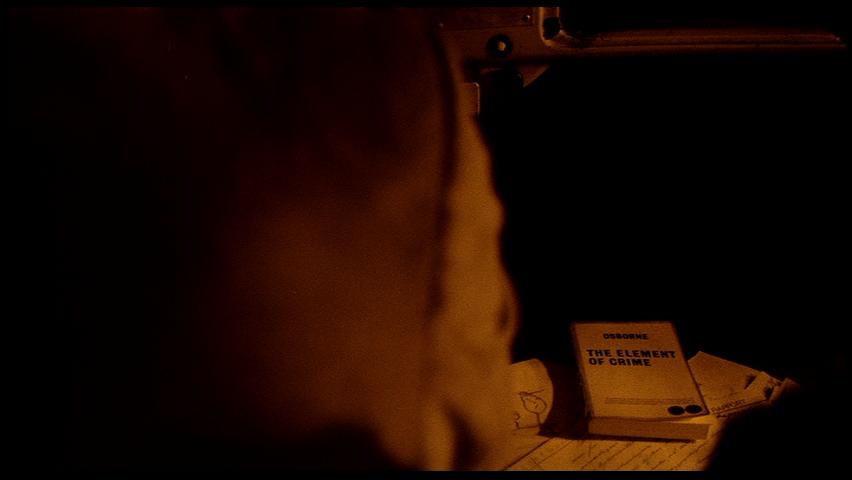
  • The Element of Crime contains a nice example of the art direction colliding with the script. Throughout the film, we see copies of Osborne's monograph, The Element of Crime in various editions, from a leather-bound hardcover to an Arabic translation. The graphic design of each different version is well designed and appropriate; this is the kind of detail I really appreciate when filmmakers take the time to get right). But Osborne doesn't have a first name, which means that the trade paperback floating around the floor of Fischer's car looks a little unbalanced. Click the image for a full-sized version:

  • Most awkward Freudianism in a film full of awkward Freudianim: Kim tells Fisher "I want to show you something," and the next shot is the two of them on a boat, sailing down a dark, wet passage.

    Fisher's therapist says he's gone "down the drain... into the tunnel of love." Save us, Nabokov!