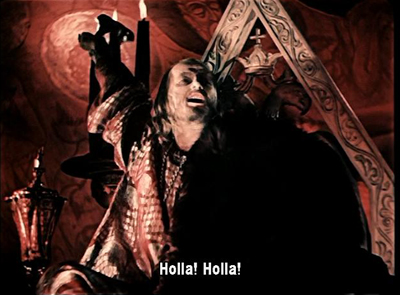
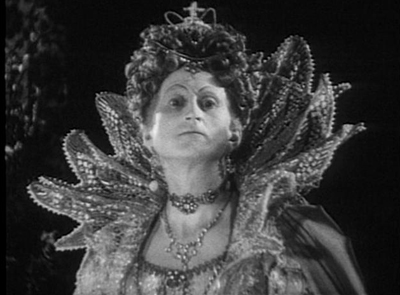
Sisters, 1973, directed by Brian De Palma, screenplay by Brian De Palma and Louisa Rose, story by Brian De Palma.
When is a travesty not a travesty?
When it's a De Palma movie.
Actually, the right answer is when the travesty succeeds on the same terms as its model, no matter how over-the-top and exaggerated it is. That's what makes Starship Troopers a parody of dumb action movies and an effective summer blockbuster; that's what keeps the soundtrack to This Is Spinal Tap on the shelves. And that's what makes Sisters so enjoyable to watch, even if it's a travesty of Psycho: it's also creepy and suspenseful in its own right. Here's Brian De Palma on his obvious debt to Hitchcock, circa 1973:
I have found that people who like and are knowledgeable about Hitchcock also like Sisters—they know the references I am making to his films and they seem to appreciate it all the more for that. Which is good, because you could so easily be attacked as a tawdry Hitchcock rip-off.
The question isn't whether or not Sisters is a tawdry Hitchcock rip-off, the question is, why does De Palma think that's an attack? Sisters is certainly tawdry: it's about siamese twins, one of whom has the unfortunate habit of stabbing men in the crotch with a chef's knife.
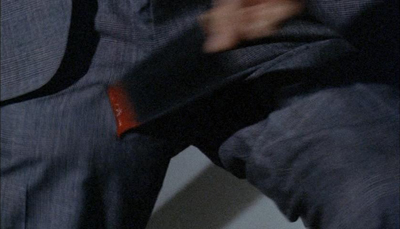
And it may be that De Palma learned to hide his debt to Hitch a little better as he got older, but Sisters contains entire sequences lifted entirely from Rope, Rear Window, and most obviously Psycho. He even got Bernard Herrmann to score it. So a Hitchcock rip-off: sure. But that doesn't mean this nasty little movie isn't a lot of fun.
"Fun" is not the same thing as "subtle," though, and anyone looking for a delicate touch would be well advised to steer clear. The first sequence isn't from Hitchcock, but from Penthouse Letters: Lisle Wilson plays a man changing clothes in the locker room when a blind woman stumbles in the wrong door and starts undressing. As luck would have it, that blind woman is Margot Kidder, who has somehow managed to combine nurse and schoolgirl fetishwear in one outfit:

"I never thought it would happen to me..." But Penthouse Letters wasn't racially charged; and remember, this is 1973: Martin Luther King, Jr.'s assassination was more recent than September 11th is today; the Boston bussing riots were still to come. Just as things are getting interesting, we pull back to reveal that we're watching a game show called "Clumsily Implicate the Viewer":
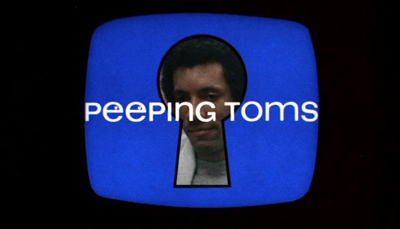
The show answers a pressing question we all face, many times a day: "What does a fella do when a pretty girl starts taking off ALL HER CLOTHES, right there in front of him?" It turns out the woman is an actress; the man is the victim of a Candid Camera type setup. The host introduces the couple (Philip and Danielle) to the audience and to each other and gives them their fabulous prizes: a set of cutlery for her:

And a free meal at an appropriate restaurant for him.
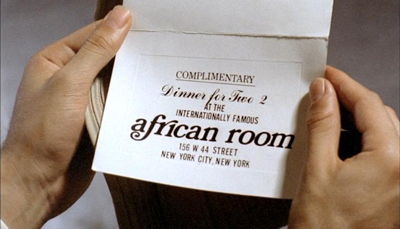
Danielle asks to come along for his dinner, and it is here that De Palma strays from the admirable subtlety he's displayed thus far. Here's the first shot of the restaurant's interior.
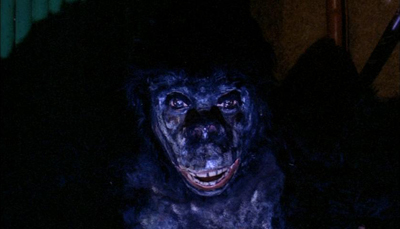
And in case that wasn't obvious enough, here's one from a little later:
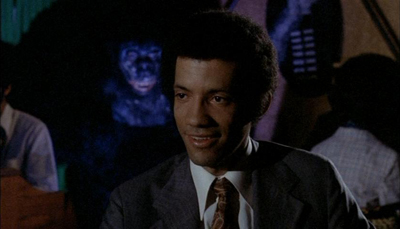
Won't someone protect our vulnerable white women?
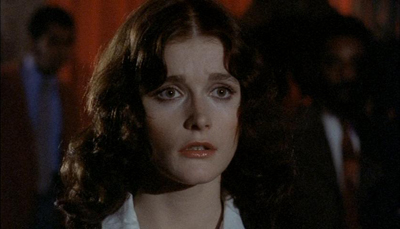
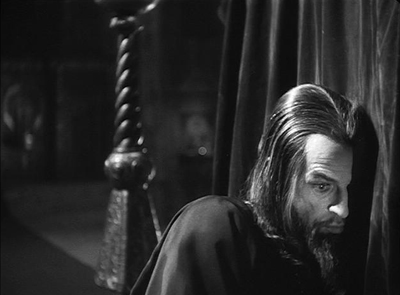
This is the point where you expect to hear someone behind you in the theater whisper "Perfectly dreadful!" in a voice that's just a little too loud. So, as with Wes Anderson, Caveat Emptor; you have to have a particular sensibility (in this case, a taste for over-the-top exploitation) or this won't be any fun for you. If that's your bag, though, De Palma has all kinds of sick sideshow pleasures in store. There's William Finley as Danielle's ex-husband, the sallowest man in the world:

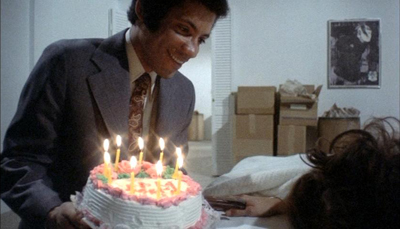
There's Philip's fatal mistake; not that he has sex with Margot Kidder, but that he decides to buy her and her sister a birthday cake:
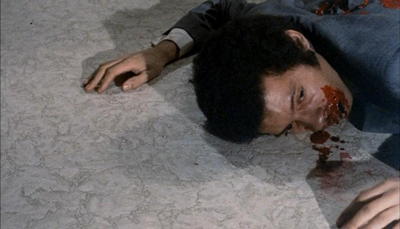
There's the fake red paint and bad prosthetics only found in the very best exploitation films:
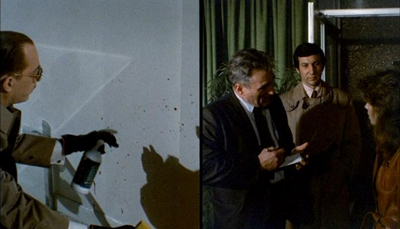
There's an imaginitive use of split-screen while William Finley cleans up the murder scene as the police draw near, like the grossest Mr. Clean ad ever made:
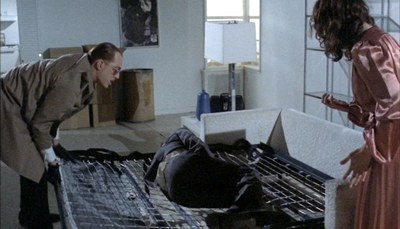
There's a mini-version of Rope that makes imaginative use of a sleeper sofa:
And that's not even the best Hitchcock recreation in the film. That award goes to De Palma's version of Rear Window, where the role of Grace Kelly:

Is played by (who else?):
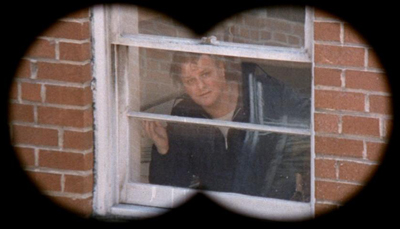
Charles Durning!

All that and I haven't even talked about the bulk of the film or introduced the main character, an intrepid girl reporter named Grace Collier, played by Jennifer Salt.
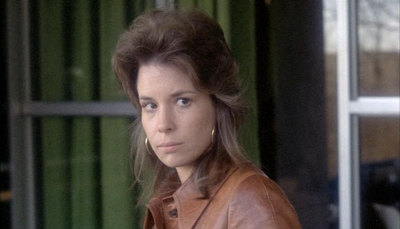
Her defining characteristic is a complete inability to get anyone in the world to take her at all seriously. Her mom is trying to marry her off to a veterenarian's assistant, her career has stalled ("I'm having lunch tomorrow with an 80-year-old ex-con who's just carved an entire replica of the Danbury Penetentiary out of soap," she complains) and her editor won't let her investigate the murder she's witnessed without hiring a private detective to babysit. Her counterargument in its entirety is "I know karate!" so you can kind of see where he's coming from; still, making her ride around in a van with Charles Durning solving mysteries seems a bit excessive.
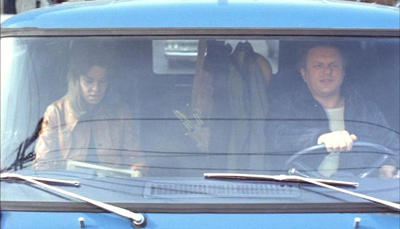
There's no talking dog, at least. Anyway, cataloguing the film like a freakshow makes it seem like a much worse movie than it is, because here's the thing: for all its crudeness, just about all of this movie works. The split-screen cleaning sequence is stylish, well-made, and tense; as much as De Palma telegraphs his surprise ending, there are still some twists that aren't predictable, and De Palma brings some things to the table Hitchcock didn't. A darker sense of humor, for one thing: not just morbid but politically charged. And a taste for squick. It's hard to imagine that North by Northwest or To Catch a Thief would have been improved by adding Robert Melvin, the Man with Two Faces or Sealo the Seal Boy to the cast, but they're right at home in Sisters.

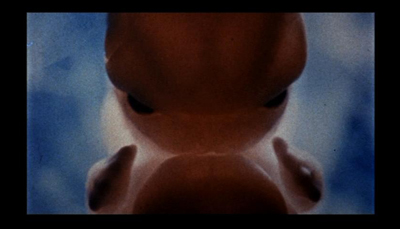
The optical effect used in that shot is a low-budget version of the central effect in Dead Ringers—I think Cronenberg owes De Palma more than is usually acknowledged. They share a Swiftian disgust at the body, and Cronenberg is the only other director I can imagine finding quite so much monstrosity in the Lennart Nilsson photographs that run over the opening credits.
There's a complicated case you can make for Sisters as an exploration of voyeurism and Nabokovian twinning, as Bruce Kawin does here, but I think any such argument is going to be more complex and elegant than the film itself. It may be the case that De Palma's later work either justifies or requires that kind of defense; I haven't seen any of his other movies in years. De Palma himself seems to have bought that hype: about ten years after making Sisters, he told Martin Amis, "I use Hitchcock’s grammar but I have a romantic vision that’s more sweeping and Wagnerian." Well, none of that sweeping Wagnerian romance is on display in Sisters: it's a blunt instrument through and through, despite its gleaming knives and scalpels. Finding depth beneath its surfaces is gilding the lily, so long as you accept that the lily is a crude, blunt, sick, and terrifically fun exploitation film. Here's to tawdry Hitchcock rip-offs.
Randoms:
- De Palma, one-time science fair winner, comes at film from a perspective that's pretty alien to an English major/screenwriter like myself ("Unfortunately, most movies derive from a literary rather than a visual intent"). This probably explains why so few of his characters are three-dimensional. But it also means that there are a few scenes that would never work on the page, but succeed on film for strictly visual reasons. Here's one of the best: De Palma opens with this framing of Jennifer Salt being questioned by a police detective.
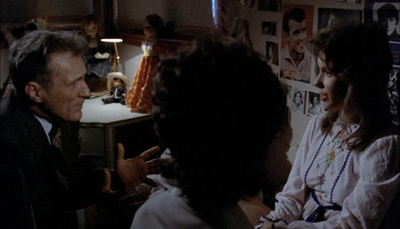
- She answers his questions kind of robotically, and then the camera starts tracking left:

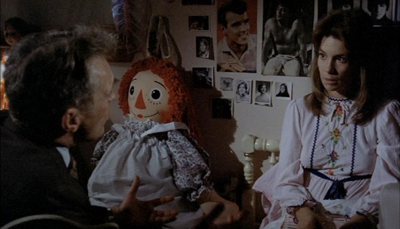
- Go ahead: try to write that joke out on the page in a way that's as creepy as the filmed version.
- De Palma got the idea for Sisters from a Life magazine article about Masha and Dasha Krivoshlyopova, Soviet cojoined twins. Here's the picture that got De Palma thinking:
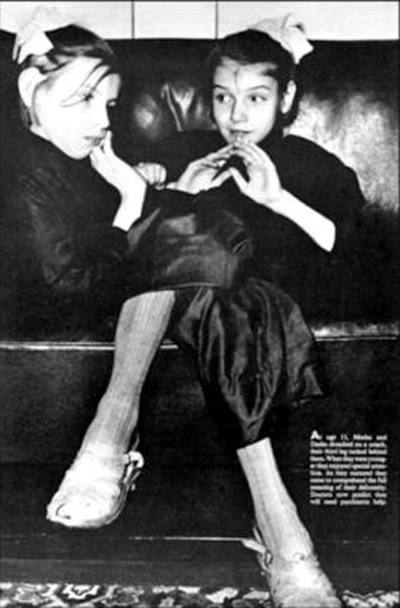
- One of the twins looks relatively happy, the other, relatively insane. It pretty much writes itself from there!
- De Palma tells the following story about working with Bernard Herrmann. After screening a rough cut, Herrmann complained:
"Nothing happens in this movie for forty minutes!" And I said, "Yes, that's the idea. There is a slow beginning—you know, like Psycho, where the murder doesn't happen until about 40 minutes into the picture." And he shouted at me, "YOU are not Hitchcock; for Hitchcock they will WAIT!"