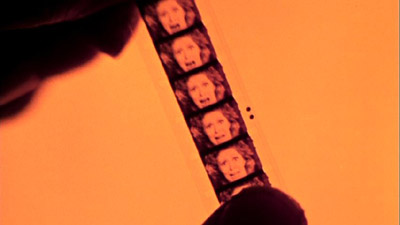
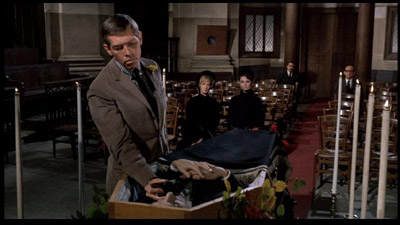
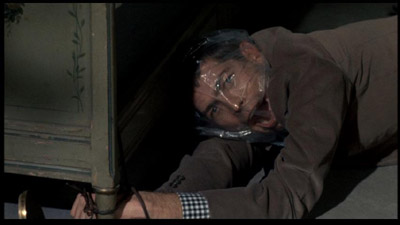
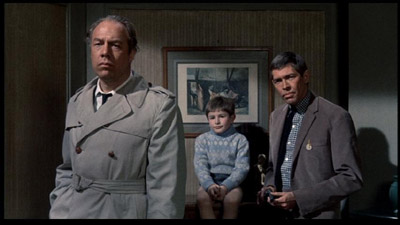
The Night Porter, 1974, directed by Liliana Cavani, screenplay by Liliana Cavani, story by Barbara Alberti, Liliana Cavani, Italo Moscati, and Amedeo Pagani.
About halfway into The Night Porter, one character says (of therapuetic "trials," of which more later), "the more shock value they have, the more effect they have." This is advice that Liliana Cavani seems to have taken to heart. And The Night Porter certainly has shock value. But I don't think it has much effect.
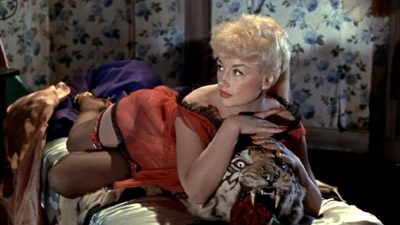
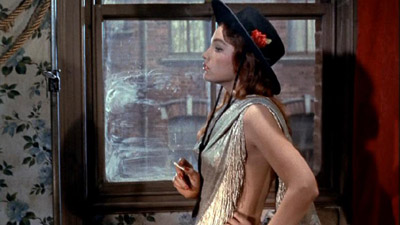
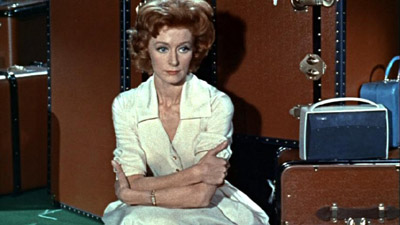
The film is set in 1957 Vienna. Charlotte Rampling plays Lucia, a wealthy young woman touring Europe with her conductor husband.
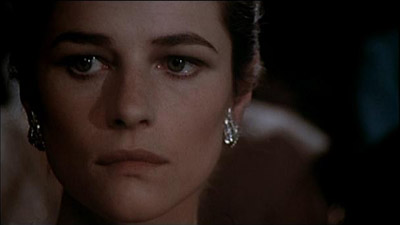
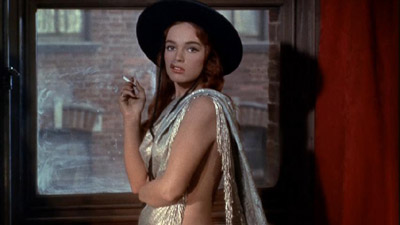
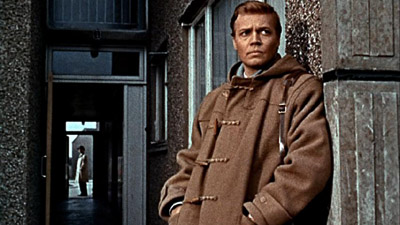
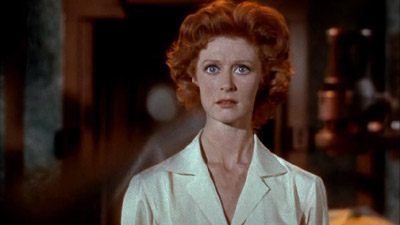
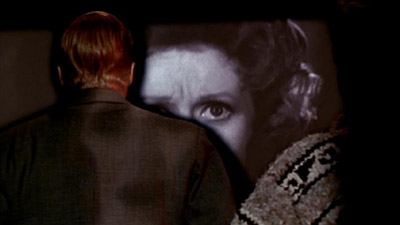
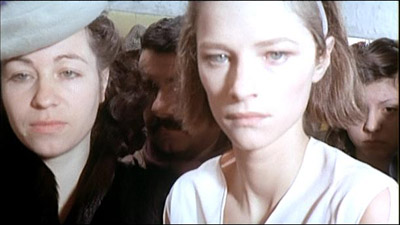
As you can tell from her expression, all is not well. Following the logic of melodramas, the happy couple stop at a hotel where Lucia's former lover, Max (Dirk Bogarde), is working as a night porter. Scenes of high emotion and tension ensue.
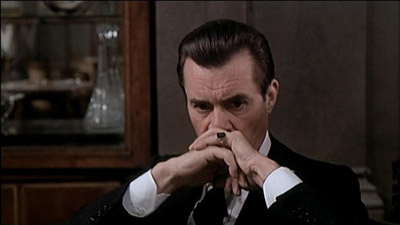
The initial premise is actually very similar to Casablanca (of all the hotels in all the towns in all the world, Lucia had to walk into Max's). But if Rick could tell Ilse that they'd always have Paris, all Max can offer is Mauthausen. Here's their love at first sight, seen in flashback:
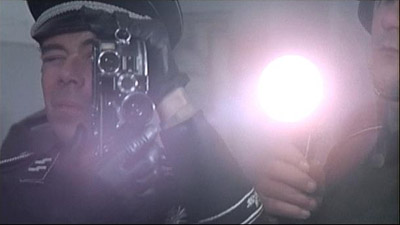
As we learn from the flashbacks, Max and Lucia had a sadomasochistic relationship while she was an inmate and he a warden; when they meet again, they pick up where they left off. This isn't a bad idea for a movie; as Roger Ebert noted:
I can imagine a serious film on this theme—on the psychological implications of shared guilt and the identification of the slave with the master—but "The Night Porter" isn't such a film.
The reason The Night Porter fails is that it is nearly completely lacking in details and characterization. The script treats its two leads so superficially that their actions seem meaningless. All we know about Lucia is that she was the daughter of a socialist and hence not necessarily Jewish, steering away from the more interesting relationship between Amon Goeth and Helen Hirsch in Schindler's List. Lucia rarely speaks throughout the film, and despite Charlotte Rampling's expressive face and eyes, we barely know her. We see a little bit more of Max, but despite Dirk Bogarde's best efforts, he doesn't add up to a complete person. At times, he is a tittering monster, the kind of man who gives his lover a severed head in a box because, as he later puts it (laughing as though he has just told an amusing story at a party), "I couldn't resist!"
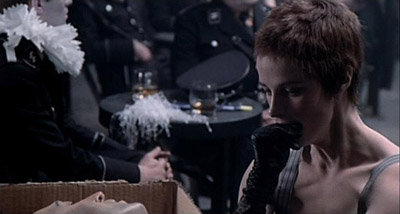
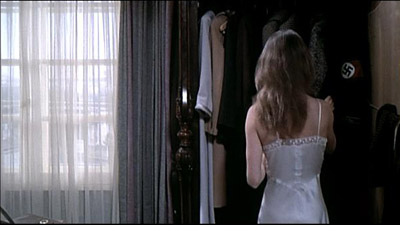
But for a man willing to recount such flamboyant violence, Max also ruthlessly protects his past—he kills a collaborator who could tie him to Lucia. He lives under an assumed name in Austria, apparently planning to fade out into the sunset "hidden away like a church mouse." We're asked to take him seriously when he says that he works nights because "I have a sense of shame in the light." That's a little hard to square with the fact that he keeps his SS dress uniform hanging in his closet, armband and all:
The end result is a shambling cartoon whose behavior seems motivated only by whatever emotion the film is trying to provoke at any given moment. Again, you could make a serious movie about the mixture of shame and pride that an ex-Nazi ("officers of the finest corps of the Third Reich," as one character puts it) would feel. But this is not that movie. I hate to say it, but Apt Pupil has more moral seriousness.
The inconsistant and poorly drawn characters at the film's center would be enough to ruin The Night Porter. But I haven't even touched on the film's most ridiculous aspect. Max belongs to a sort of ex-Nazi support group that meets and holds mock trials for its members, presenting all the evidence and witnesses against them before burning the evidence and murdering the witnesses. Here's how one member describes their aim:
We must try to understand if we are victims of guilt complexes. If so, we must be freed of them.
I can buy the idea of a group of ex-Nazis dedicated to destroying all evidence that links them with their pasts. But only in the 70's could someone make a film that asks audiences to accept a Nazi Feelgoodery aimed at curing the century's greatest murderers of their neuroses.
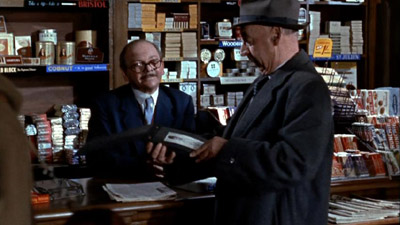
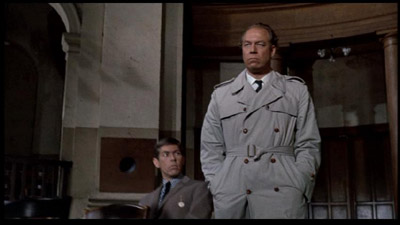
But suspend disbelief and allow the filmmakers their Nazi support group. Now ask yourself: what would the leader of such a group look like? Remember, one of their goals is not to be publically denounced as Nazis. Furthermore, one of the leader's duties is sneaking documents out of the records of the War Crimes Commission and the War Documentation Center. So close your eyes and imagine the kind of anonymous-looking man who could easily smuggle original documents out of these places. Got it? Now take a look at Klaus:
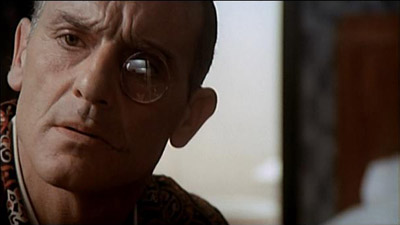
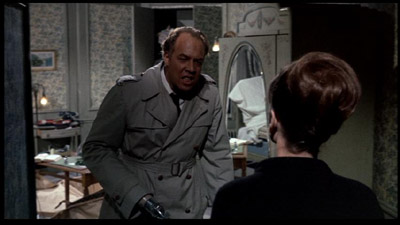
Again, remember: The Night Porter wants us to take it seriously, even as it asks us to believe that a group of Nazis in hiding would be led by a man who looks like Colonel Klink. Lest you think I chose that still unfairly, here's Klaus again, wandering around 1957 Austria in an outfit from 1944 Berlin:
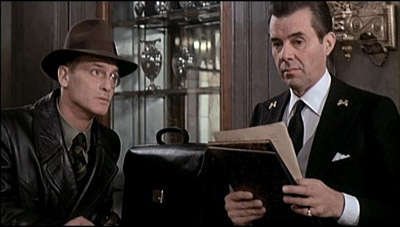
If Bogarde isn't meeting his eyes, I suspect it's so he can keep a straight face. And even if you forgive the scar, forgive the black leather jacket, forgive the fedora, forgive the monocle, consider this: Klaus can't even be bothered to wear the monocle in the same eye.
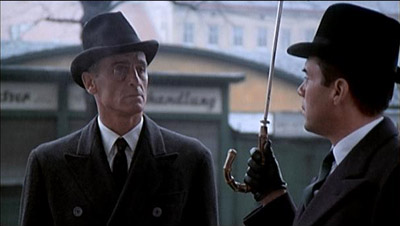
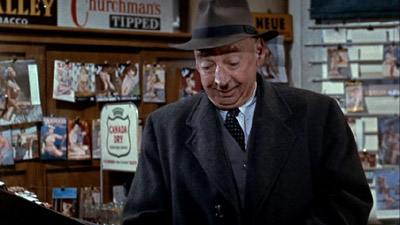
That's not a reversed negative; both coats are buttoned left-over-right and the lettering in the background is correct. Worse yet, Klaus isn't even the campiest Nazi. That title goes to Bert, who as a young man danced ballet for the amusement of the SS:
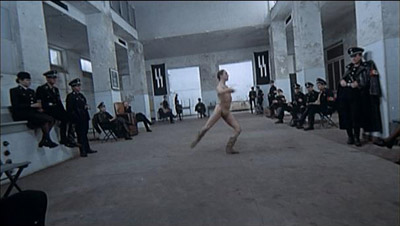
If you still think the movie has any link with reality, ask yourself, what exactly is happening in this scene? Where is this empty room, where ballet is performed under SS banners and a photo of Himmler? Exactly how many Nazis would spend their afternoon this way? Leaving that for the moment, here's how Bert avoids attention in Vienna in 1957:
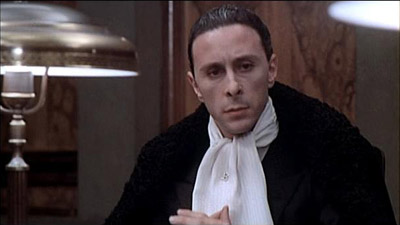
Yes, that's a diamond-encrusted "B" on his cravat. And judging from the costume and hair, it's more likely to stand for "Bela" than "Bert."
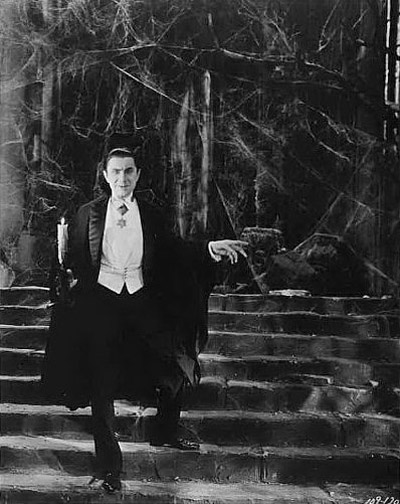
You could read the Nazi sections of the film as intentionally overblown, a counterpart to the more nuanced relationship between Max and Lucia, but the centerpiece of the movie, a flashback of Lucia performing a Marlene Dietrich song in an SS cap ("Wenn Ich Mir Was Wünschen Dürfte,"), is just as unbelievable:
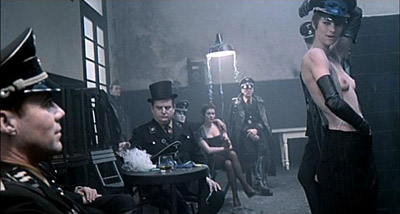
This is probably the best staged scene in the film. But the emphasis is on staged: what is this room? Why is one man wearing a top hat, and another a mask? Even Klaus shows up (his only appearance in the flashbacks), with a date that would have gotten him in trouble with his superiors:
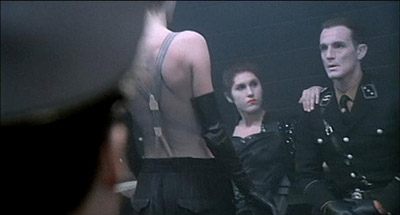
Well, Cavani was hardly the first person to link the SS's death-obsession with sexual adventurism. But the film really has no interest in what's going on in any of its character's heads. The characters aren't living or breathing, they're cardboard cutouts. I have no intrinsic problem with cardboard Nazis: I love the Indiana Jones movies. And I have no intrinsic problem with movies about sadomasochism, or exploitative relationships; I love Lolita as a novel, even if I think both filmed versions have problems (and The Night Porter consciously evokes Lolita: Max repeatedly refers to Lucia as "my little girl," and dresses her in a pink frock). So what's wrong with The Night Porter? Susan Sontag has written very eloquently about sadomasochism and fascism, in a 1975 essay in the New York Review of books:
Between sadomasochism and fascism there is a natural link. "Fascism is theater," as Genet said. As is sadomasochistic sexuality: to be involved in sadomasochism is to take part in a sexual theater, a staging of sexuality. Regulars of sadomasochistic sex are expert costumers and choreographers as well as performers, in a drama that is all the more exciting because it is forbidden to ordinary people. Sadomasochism is to sex what war is to civil life: the magnificent experience. (Riefenstahl put it: "What is purely realistic, slice of life, what is average, quotidian, doesn't interest me." As the social contract seems tame in comparison with war, so fucking and sucking come to seem merely nice, and therefore unexciting. The end to which all sexual experience tends, as Bataille insisted in a lifetime of writing, is defilement, blasphemy. To be "nice," as to be civilized, means being alienated from this savage experience—which is entirely staged.
...
The rituals of domination and enslavement being more and more practiced, the art that is more and more devoted to rendering their themes, are perhaps only a logical extension of an affluent society's tendency to turn every part of people's lives into a taste, a choice; to invite them to regard their very lives as a (life) style. In all societies up to now, sex has mostly been an activity (something to do, without thinking about it). But once sex becomes a taste, it is perhaps already on its way to becoming a self-conscious form of theater, which is what sadomasochism is about: a form of gratification that is both violent and indirect, very mental.
Sadomasochism has always been the furthest reach of the sexual experience: when sex becomes most purely sexual, that is, severed from personhood, from relationships, from love. It should not be surprising that it has become attached to Nazi symbolism in recent years. Never before was the relation of masters and slaves so consciously aestheticized. Sade had to make up his theater of punishment and delight from scratch, improvising the decor and costumes and blasphemous rites. Now there is a master scenario available to everyone. The color is black, the material is leather, the seduction is beauty, the justification is honesty, the aim is ecstasy, the fantasy is death.
Cavani knows the shock value of this "master scenario." But she evokes it so carelessly, and with so little interest in her film's characters, that the end result is not just exploitative, but boring. The Night Porter conflates the after-the-fact, theatrical embrace of Nazi symbols with their historical reality. Bert and Klaus (and Max) are a modern-day sadomasochist's version of Nazis, cartoonishly evil, props in a staged ritual of domination and submission. They're not characters; they're costumes. And yet Cavani wants us to take them so damn seriously.
Randoms:
- Despite The Night Porter's flaws, I should note that Liliana Cavani went on to direct the excellent film adaptation of Ripley's Game. It never got a theatrical release but is available on DVD.
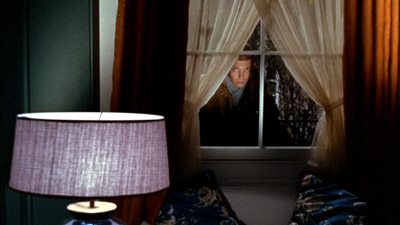
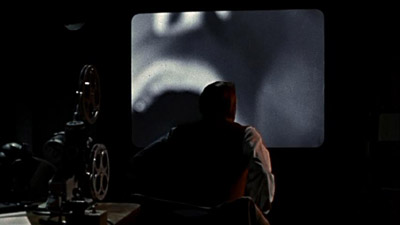
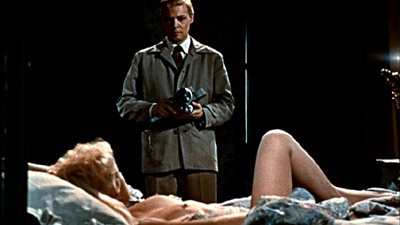
- My girlfriend pointed out that Max's predatory use of a handheld camera is reminiscent of Peeping Tom. The shots of Max filming were actually the best of the flashbacks, I thought—although I don't give the camera the same primeval power that Michael Powell did, I do think that the camera and spotlight work very well to make Max genuinely frightening here.
- The historical inaccuracies in The Night Porter are too numerous to list (and not surprising, given its cartoon Nazis). But just to start, the War Documentation Center is in Amsterdam, not Vienna, and it would have been difficult for Max to have worked in Hungary, where there were no concentration camps.