Monday, June 15, 2009

#92: Fiend Without A Face

Fiend Without A Face, 1958, directed by Arthur Crabtree, screenplay by Herbert J. Leder, from the short story "The Thought Monster" by Amelia Reynolds Long.

Some movies are brilliant from the first frame to the last. Some are irredeemable drek all the way through. And some have flashes of greatness. Fiend Without A Face falls into the last category, although it's not so much a flash as a splatter.

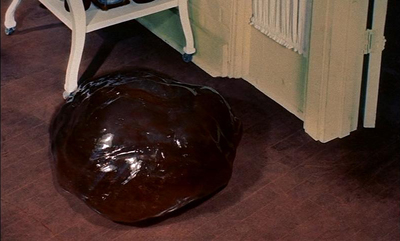
That's one of the eponymous fiends, the physical manifestation of a human thought, in its death throes. Yes, in this movie, human thoughts are represented as giant brains with attached prehensile spinal columns. With eyes on stalks. When shot, vast quantities of raspberry jam squirt out of them with horrible burbling noises. They eat brains. They're powered by atomic radiation. And they can fly. More or less what Pascal wrote about in Pensées, if I remember it correctly.

As awesome as flying, brain-eating brains sound (and they are pretty awesome), the fiends don't actually appear for the first hour of the movie. So the audience has to wade through the obligatory "mysterious string of deaths in a small town" section to get to the good stuff. The first hour has its compensations: a pre-Doktari Marshall Thompson is very, very serious in uniform:

And Kim Parker, as Thompson's love interest, does what she can to help with the marketing campaign:

That shower scene is completely gratuitous and not very risqué, but it was featured in every advertisement and poster for the film. So if you don't get to see women's legs or shoulders in your day-to-day life, Fiend Without A Face has that going for it. But there's only so much narrative interest you can squeeze out of a whodunnit where Kynaston Reeves' character is clearly, obviously, a mad scientist.

People address him as "Professor Walgate," though he doesn't teach! He does that fist-clenching thing that only mad scientists do! No one in town understands his research! Worst of all, he's written prop books: the ominously titled The Energy of Thought and the ominously spelled Sibonetics: The Application of Logic To Electronics.
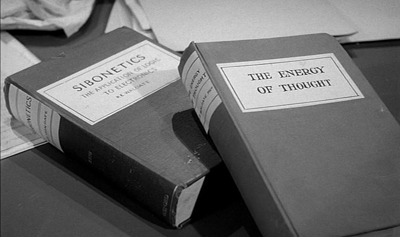
The misspelled title, the peeling label on the spine, the fact that the spine of Sibonetics has embossed printing everywhere but the title: all of this screams "crackpot." The local citizenry can't believe one of their own could be behind the mysterious disappearances, especially when there's a more obvious scapegoat: nearby Stock Footage Air Force Base, pictured below:

They appear to be about as well-staffed as Professor Walgate's publisher; this is the most personnel in any shot, during a test of an experimental radar system:

It's worth noting that there are more personnel here than there are at the nuclear plant that powers the base:
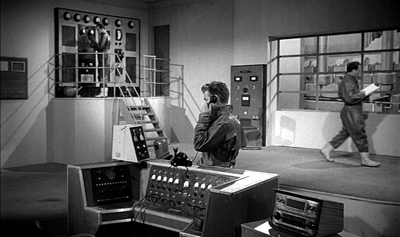
What's more, apparently radar stations and nuclear plants are controlled with the same equipment, an early example of modular design. Note that although you need four more telephones to control a radar test, the consoles are otherwise identical.

Nobody sees a movie like Fiend Without a Face for the set design or snappy dialogue, though, and within the realm of B-sci-fi/horror, this is a fun little movie. It's certainly better than The Blob, even without Steve McQueen. Crabtree knows how to shoot suspense, especially in the sequences where the fiends are still invisible. They move around with a distinctive thumping, slurping sound that is surprisingly creepy. There are decent "stuck in the house alone with the monster" sequences (especially the mayor's death). And as on-the-nose as much of the dialogue is, it's hard not to love a film that introduces us to the main character by showing him smoking and popping pills at his desk, while his subordinate asks him, "You ever think of trying sleep instead of Benzedrine? You know, you might like it."

So, yeah, there's some goofy charm here. But the movie's not famous for goofy charm, and it would have long faded into B-movie obscurity were it not for the over-the-top gross-out fest that is the final fifteen minutes. Actually, it would probably have been famous even without the special effects, because without the "locked in a house frantically boarding up windows while countless horrors try to get in" sequence, we would not have had The Birds or Night of the Living Dead.
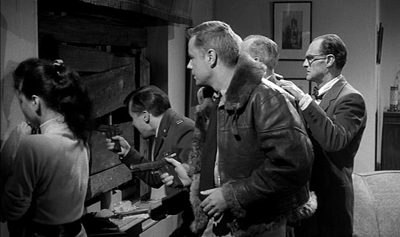
On the other hand, without Fiend Without A Face, we might have all been spared Gore-Met, Zombie Chef From Hell and basically any other schlock horror that ignores the uncanny in favor of the abject. Because:

And furthermore:
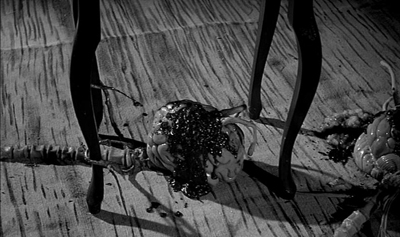
The fiends' deaths aren't just grosser than anything that came before, they're grosser than just about anything that came after, at least until Cronenberg. No, the stop-motion animation isn't very convincing, and yes, they're kind of silly looking to begin with, but there's something about the burbling noise they make as the goop squirts out of them that's completely stomach turning. Inducing nausea isn't enough to make a movie great (look at Salò), and this isn't a great movie. But even a cursory glance at the horror and sci-fi that followed it will show that, for better and for worse, Fiend Without A Face has cast a much longer shadow than your typical Z-grade horror. For a movie made for almost nothing by a producer whose greatest goal was to build England's answer to American International Pictures, that counts as an extraordinary success.

Randoms:

  • I wasn't kidding about England's answer to American International. Producer Richard Gordon's brother Alex worked at American International and literally plucked "The Thought Monster" from their pile of rejected submissions.

  • The best dialogue in the film is not the Benzedrine line, believe it or not. It's when Professor Walgate announces, "We're facing a new form of life that nobody understands. I believe it feeds no the radiation from your atomic plant, and that it's evil."

  • The highly-trained professionals at the Air Force base know exactly what to do when they discover that the fiends feed on atomic radiation. Like anyone with a great deal of experience with nuclear energy would, they put as much TNT as they can find in the control room and blow the whole building up. As the scientists in the audience know, destroying the cooling system and control rods for a controlled nuclear reaction causes the whole thing to gracefully shut itself down, with no long term effects on the surrounding area.

  • You can learn an awful lot about budget filmmaking from studying this movie closely, both from the missteps (like the control console noted above) and the successes. Crabtree stages his nuclear plant explosion by showing a static shot of the "plant":
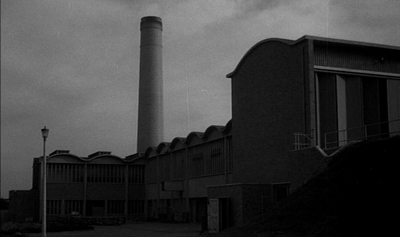
    He follows this by flickering a few single-frame inserts of all white:

    And then cuts to stock footage of a model exploding that is clearly not the same building, if you look at the first frames of it going up:
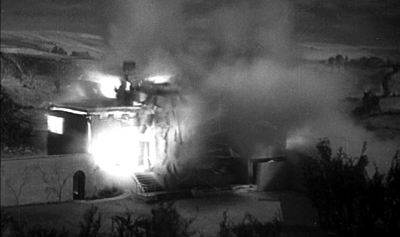
    But since the "building" is obliterated in just a few frames, and the flying debris that follows could be from just about anything:
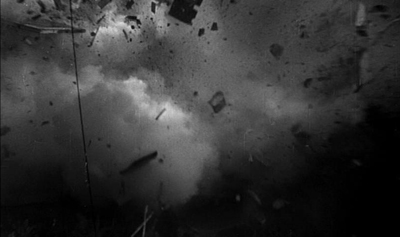
    The effect viewed at normal speed isn't half-bad. And must have cost approximatelly nothing. Which is a long way of saying I'm planning on using a lot of footage from Roland Emmerich movies in anything I do going forward.

  • MGM distributed Fiend Without A Face domestically, as a double feature with another John Croyden/Richard Gordon production, The Haunted Strangler (also in the Criterion Collection). It had a very nice run at the Rialto on Times Square:
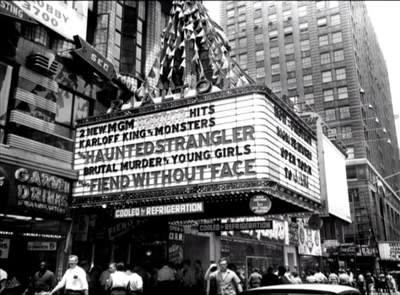
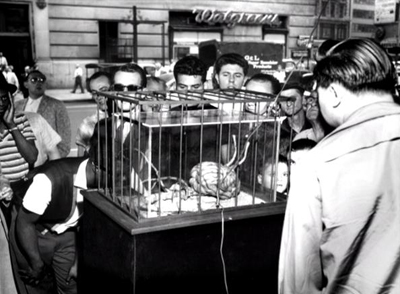
    In 1958, it was the place to show horror films in New York City, complete with Arclight-style lobby exhibits on the sidewalk itself:
    That's the right kind of theater for Fiend Without A Face, but it's not where it premiered. The geniuses at MGM sent it for a tryout, along with The Haunted Strangler, to Detroit's Adams Theater, which was MGM's prestige house in the area. Before Fiend, it was showing Gigi, and the theater manager was less than enthused with Richard Croydon's suggestion that they promote the upcoming films by setting up a coffin with a body in it in the lobby. Things didn't go well for the theater after that; it was finally demolished just this summer, but didn't age gracefully. It did a stint as a porn theater, tried unsucessfully to go back to legitimate movies, but was finally sunk when it was the site of a homocide and a shootout (separate incidents!) in 1988. Here's the auditorium circa 2005. Which just goes to show: no good will come of inadequately promoting a Karloff picture.

  • No good will come of adequately promoting a Karloff picture either; the Rialto was torn down in 1998 to make way for the Reuters building. It did its time as an adult theater too; its last incarnation was for one of those hydraulic seat attractions called Cinema 3-D. So maybe the best thing is not to have anything to do with Karloff pictures at all.


Sunday, May 03, 2009

#91: The Blob

The Blob, 1958, directed by Irwin S. Yeaworth, Jr., screenplay by Kate Phillips and Theodore Simonson, from an idea by Irvine Millgate.

It's an article of faith among film critics that the schlock sci-fi of the fifties can be mapped onto the fears of the era: Godzilla is about fear of the atomic bomb, Invasion of the Body Snatchers is about fear of conformity, and Forbidden Planet is about fear of Leslie Neilsen movies. So it's not too surprising that people look at The Blob and try to find a deeper subtext. Maybe it's about Communism. Or Korea. Or the Republican Party. Bruce Kawin makes the best guess, pinning the blame on post-war consumerism. You can make a case for that, and Kawin does, but I think it's probably apophenic to find too much deep cultural significance in a film that was inspired by the Sherwin Williams logo:

The Blob is, as Kawin notes, pretty unique among fifties movie monsters for being completely devoid of human characteristics. It's just exactly what you'd think it is from the title.

Found inside a crashed meteorite by a crazy hermit, the blob is a transparent goo that grows as it eats. And it eats people. It's a great idea that's kind of indifferently executed, because Yeaworth and company were as interested in making an antidote to teenage delinquency movies as they were interested in a monster movie. So for every scene of the blob creeping up behind an unsuspecting victim, you're guaranteed a scene of good-hearted teenagers trying to convince the town's authority figures that they're being honest about the monster they keep reporting. So why has the film outlived contemporaries like The Crawling Eye or The Giant Claw? I can answer that in three words:

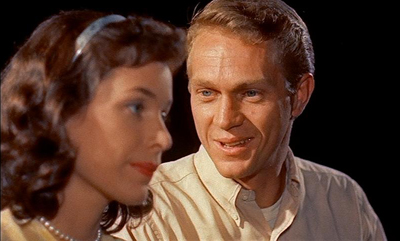
This was McQueen's first starring role in a feature, and not a moment too soon. He was 27 when this was filmed and looked every last day of it.

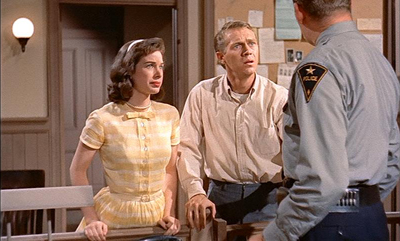
I'm more likely to believe that a semi-sentient man-eating gelatin could crash-land on earth than that McQueen or his co-star Aneta Corsaut are in high school. Maybe that's smart, in terms of distracting the audience from all of the film's other implausibilities, but this was not McQueen's finest hour. He hadn't really developed the persona that made him famous, and Bullit was years away. So The Blob is a rare opportunity to see one of the coolest movie stars in film history play a dork. We're talking shirt-tucked-in-no-belt, people.

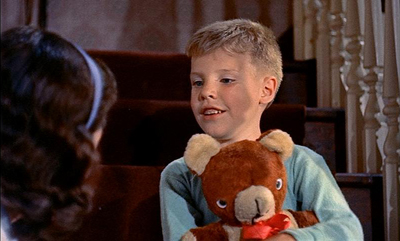
McQueen does an acceptable job of playing a guy who is not very cool by any modern standard, but he gets completely left in the dust by an actor named Kieth Almoney. Cast as Corsaut's younger brother, Almoney made the bold choice to portray him as the tragic victim of a brain parasite.

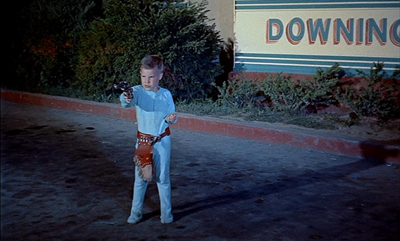
It's hard to choose a single favorite thing about Almoney's magical onscreen presence: when you deliver each line like Homestar Runner, everything you do makes an impression. His one-man toy pistol assault on the Blob is probably the high point.

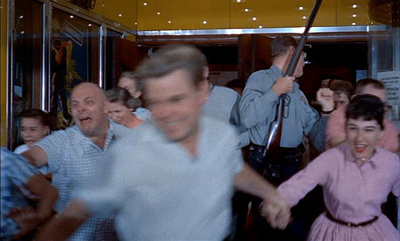
Almoney's performance betrays The Blob's origins; it was independently produced by a band of amateurs, far from Hollywood. Jack H. Harris was an independent distributor fed up with trying to sell poverty row Westerns to audiences who wanted Technicolor. He put the film together for virtually nothing at Valley Forge Studios in Pennsylvania, with a director and crew trained in producing religious shorts. Kate Philips had written for television, and Yeaworth mentions hiring an experienced editor after some false starts (although no one in the editorial department has previous credits on IMDB), but everyone else was brand new to the feature world. In fact, Kieth Almoney, like several other cast members and all of the extras, was recruited from Yeaworth's church. When something's that homegrown, it's easier to forgive things like the happy grins on the faces of the crowd fleeing the Colonial Theater in terror: they're gonna be in the movies.

As far as casting the main roles goes, Harris made the financially smart decision to shell out for experienced actors in minor roles, while giving the leads to cheaper unknowns. Of course, when you luck into hiring Steve McQueen as an unknown (and pay him all of $3,000), the success of your film doesn't really depend on the audience finding Alden Chase's face reassuringly familiar.

Harris's modest goal with The Blob was the same as every scrub at Sundance: get studio distribution. Fortunately, Paramount needed something to fill out the bottom of a double bill with I Married A Monster From Outer Space, so Harris got his wish. Yeaworth and some of the other crew seem to have believed they'd made a work of gothic horror, but the Paramount executives knew what they'd bought: the first thing they did was cut the ominous opening-credits music (over Saul-Bass inspired titles) and replace it with a novelty single called "Beware of the Blob," written by Burt Bacharach and Hal David. The single charted in Los Angeles, Carson made a joke about it on-the-air, Paramount gave The Blob top billing (and re-released it once McQueen was a star), and there's no Criterion edition of I Married a Monster from Outer Space. Maybe there should be.

Randoms:

  • This is probably the only Criterion Collection DVD to use the word "superstud" on the back of the DVD case. The exact usage ("THE BLOB helped launch the careers of superstud Steve McQueen and composer Bert Bacharach") should piss off composers and Burt Bacharach fans everywhere.

  • Superstud or no, McQueen was apparently impossible to deal with on set. Harris talks on the commentary track about having to drive from Philadelphia to the set several times to coax him back on set. Smoke drifts up incongruously over his shoulder in one shot because he wouldn't put out his cigarette while filming a close-up. He apparently borrowed Yeaworth's car (the only new car he ever owned), drove it to New York City, and returned it with unexplained scratches all over the roof. His behavior was abysmal enough that Harris, who'd signed him for a three-picture deal, released him completely.

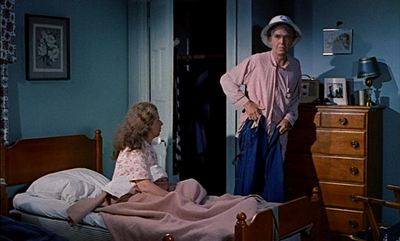
  • Many of the minor roles were cast from the performers of the Hedgerow Theatre, a repertory group based in nearby Rose Valley. The company's founder, Jasper Deeter, has one of the only funny-on-its-own-terms scenes in the film, as an aged Civil Defense volunteer and volunteer fireman who can't decide which helmet is best suited for Blob-fighting.

  • Among all the inappropriately smiling extras, the gentleman in the checked shirt in this still clearly deserves some recognition for his performance. He's not only the only extra who looks unhappy, he genuinely looks horrified.

  • Robert Fields, who went on to a distinguished film career of his own, contributes a pretty amusing commentary track. He would have been 19 when this was shot, and basically remembers it as "the summer I hung out with Steve McQueen and unsuccessfully tried to score with one of the actresses." Actors usually talk about their jobs at a certain remove, but Fields sounds like anyone else seeing footage of their summer job when they were 19: he remembers virtually all of it in terms of personal relationships, and clearly the experience of being rejected that summer still burns him a little. On the other hand, though he doesn't remember her name (I would bet it's Molly Anne Bourne or Diane Tabben, both of whom are credited as "Teenager" on the IMDB) he does remember that she was engaged, so it's probably for the best. Here she is, sitting next to him in pink:

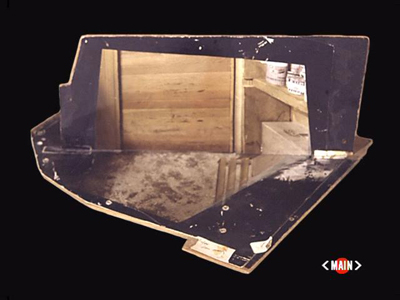
  • Most of the effects shots depend on plywood constructions with forced-perspective scenery, like this:

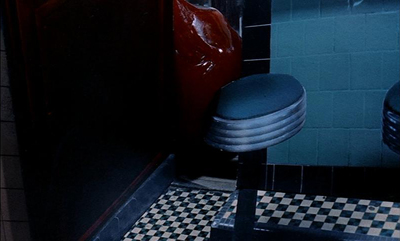
    The Blob (colored silicone, in its pre-implant days) would then roll toward the camera when the set was tilted. When it works, the effect looks fine, but when anything's wrong with the perspective, things go very badly. Take a look at the M. C. Escher inspired angle on the diner stool:

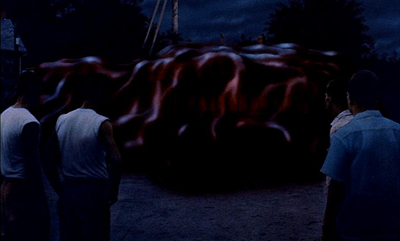
  • For shots that wouldn't work with forced-perspective models, the filmmakers used rotoscoping, and sometimes resorted to straight cell-animation. This is about as convincing as you might imagine:

    That said, there's a single shot of the teenagers looking at the Blob enveloping the Downingtown Diner that goes right around past bad to good and ends up looking like something Miguel Calderón would hire someone else to paint:

    I would absolutely buy the original.

  • The DVD includes images of posters for the film from various releases and rereleases. Most use some variation of the original key art:

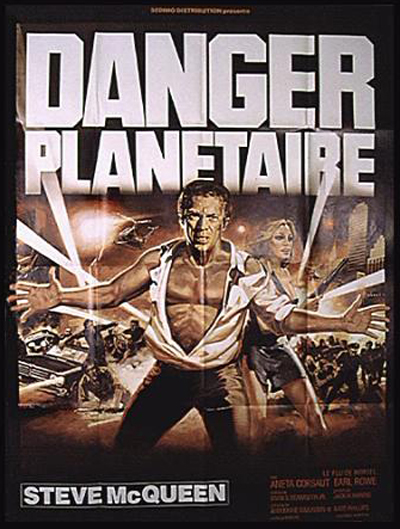
    Say what you will about the art style, you know what you're getting. And then there's the French. One thing to remember about The Blob is that McQueen is never shirtless in the film. What's more, since it was made in 1958, there aren't any cars from the mid-60's in it. Nor are there helicopters. Or skyscrapers. And McQueen's costar is a brunette, not a shotgun-wielding blonde. So the French poster might lead you to draw some incorrect conclusions:

    Ah, La France! If Danger Planetaire existed, I'd watch it more often than The Blob.

Wednesday, March 25, 2009

#90: Kwaidan

Kwaidan, 1965, directed by Masaki Kobayashi, screenplay by Yôko Mizuki, from short stories written by Lafcadio Hearn.

In American horror films, one of the obligatory shots for building tension is a tracking shot down a hallway to an unopened door. Jonathan Demme talks about it in the commentary to The Silence of the Lambs, and there's a version of it in just about any slasher or horror film you can name. For Japanese horror, there's an equivalent shot: a slow track in on a woman, seen from behind, with long black hair obscuring her face.

Both shots work on the same principle: vital information is withheld, while the tracking in tells us that the information we're not getting is really important, and undoubtedly horrifying. The fact that the Japanese version features a woman instead of the American hallway probably says something about Japanese attitudes toward women and American attitudes toward hallways (or American sublimation of attitudes toward women, &c.), but it's not a line of thought I'm interested in pursuing much further. I'm just too terrified by hallways. The point is, that's an iconic Japanese horror shot, and it's iconic because it works. Ringu marked its apotheoisis:

You can track in on Sadako Yamamura all you want, you're never going to see anything but more hair. Kwaidan fits squarely into the tradition of Japanese horror: its emphasis on the weird more than the disgusting, the importance of the unseen, and, of course, the idea that the dead rarely rest easy. It's an anthology film, based on the work of Lafcadio Hearn, one of the first Westerners to collect Japanese folklore. Kwaidan presents four separate stories. The first, appropriately enough, is titled "The Black Hair."

It's the story of a callous samurai who leaves his wife for the daughter of an aristocrat who can give him more money and a better social position. Of course, dating an aristocrat means putting up with ohaguro and hikimaru, neither of which was exactly fashion's finest hour:

Not too surprisingly, the samurai starts pining for his old, non-aristocrat wife, with white teeth and normal eyebrows. But a word to the wise: if you've done someone wrong and decide to make amends, and when you return to your old home, you find her just as you left her, apparently glad to see you—despite the weeds that have grown up through the floor and the caved-in roof—you should probably not sleep with her, no matter how nostalgic you both feel. You're setting yourself up for the worst coyote morning ever.

That's a pretty traditional ghost story, but it's made creepier by a wildly non-traditional score by Tôru Takemitsu. The climactic scene plays with hardly any music, only the sounds of boards and bundles of sticks being snapped in half. There should be diagetic noises of boards breaking; the samurai throws himself through a door and the floor caves in beneath him, but that happens silently. Playing the "things are so wrong and supernatural that the audio track has become unglued from reality" card is a risky move, but Kobayashi and Takemitsu make it work here, mostly because the soundtrack is creepy and startling in its own right. The Carol-Reed-style camera angles don't hurt, either.

"The Black Hair" doesn't just have the Platonic ideal of a Japanese horror film title, it's also the most frightening of the four stories in the anthology. "The Woman of the Snow," the second story, has moments as creepy as "The Black Hair," but the emphasis is on unease and weirdness rather than horror, and that's the mood for the rest of the film. As with "The Black Hair," a woman is the focus of all of the terror, but "The Woman of the Snow" is more or less the film's moral inverse; in "The Black Hair," Michiyo Aratama is playing a basically good woman who is sinned against. In "The Woman of the Snow," Keiko Kishi plays... something else.

She's a yuki-onna, an ice ghost, who freezes men to death and bleeds them dry. The sexual politics are left as an exercise for the reader, but the cinematic ways Kobayashi makes her eerie and inhuman are worth studying. The main trick is lighting:

You can see how carefully the light on her white kimono is aimed to keep her face icy blue. Also note the strange way Kishi is carrying herself; there's a shot later that uses Cocteau's technique of putting an actor on a dolly so they seem to glide along without walking. I originally believed that was being done in this sequence, but it isn't; Keiko Kishi just walks that way. This is also the most expressionistic of the stories, with completely unreal outdoor sets that heighten the sense of weirdness. For no apparent reason, there are eyes in the sky:

That kind of painterly, surrealistic set is more associated with theater than film (probably because it's built around a backdrop), and I have to confess, I love it. That's winter: eyes staring balefully at you from the sky (that's why I moved to Los Angeles). But summer doesn't look much more inviting:

Expressionism serves the second story well, but it doesn't rise to the same level of horror as "The Black Hair," simply because it doesn't have the same queasy undertones of guilt and repression. The protagonist is more or less blameless: a good-looking innocent who grows up to be a loving father and husband. If "The Woman of the Snow" has a message, it's that there are considerably stranger things going on beneath the surface of most other people than you might imagine. Which is true, but a lot more comfortable to think about than regret and betrayal.

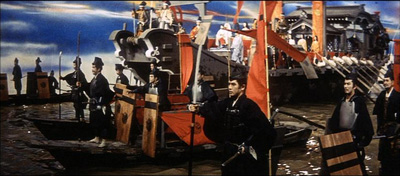
The third story, "Hoichi the Earless," despite having the most arresting visual image, is probably the least frightening, unless you're terrified by biwa music. It opens with a recreation of the battle of Dan-no-ura that looks like a producer's nightmare.

I would have loved to be at the meeting between Kobayashi and the Toho execs where he explained that he needed to stage a 12th century naval battle, with period ships and costumes, and he needed to do it indoors. I suppose this was always seen as a prestige project, rather than the kind of exploitation we associate with horror films in the states, but still, this must have been expensive.

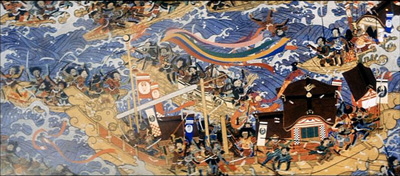
Which is not to say that Kobayashi didn't do it as cheaply as possible; many of the tricks in Roger Corman's playbook are on display here. You'll notice lots of medium shots and no wide shots, which means the same extras can be used more than once. In place of wide shots, Kobayashi uses the educational film trick of panning over a historical painting of the battle, which is surprisingly effective, since part of the point of the sequence is that it happened a very long time ago. I wouldn't recommend this technique if you're trying to shoot a space battle, however.

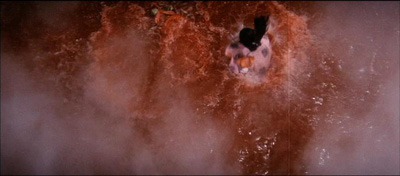
You can see that the skies are not as expressionistic as the ones in "The Woman of the Snow," but rest assured, the shots of the Emperor's attendants throwing themselves into the blood-stained sea are just as striking.

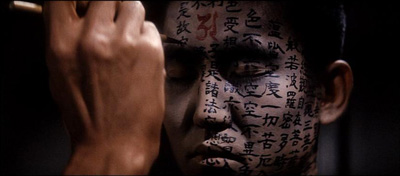
The Battle of Dan-no-ura is just prologue, however, and I must regretfully inform readers that the main story of "Hoichi the Earless" involves a great deal of biwa music. This is certainly apt: the story is about a blind biwa player who becomes renowned for his version of "The Tale of the Heike," an epic poem that was traditionally sung. Word of his version reaches the underworld, and the principles of the original battle arrange a command performance (they probably think the song is about them). So, yeah, there's diagetic and non-diagetic biwa a-plenty in this chapter, and I just don't have an ear for traditional Japanese music. The visuals nearly make up for it, however, especially at the end. Hoichi can only escape the ghosts who want him to perform for them by having prayers written on his body.

There's a semiotics thesis just waiting to be written there, if it hasn't been already.

The final story, "In A Cup of Tea," was a very odd choice for inclusion in the film. The Lafcadio Hearn version is kind of a trick story about narrative expectations, and not exactly screaming out for a film adaptaton. Hearn presents a story that—he informs us before he begins—was left unfinished. Despite the warning, anyone reading will get caught up in the story-within-the-story, about a samurai who starts seeing a ghostly reflection whenever he sees water.

All the elements of a great ghost story are there except the ending, which Hearn chides the reader Nabokov-style for expecting:

I am able to imagine several possible endings, but none of them would satisfy an Occidental imagination.

It's a nice little bit of metafiction, and it works pretty well on film, but Kobayashi, maybe sensing that this finale would be something of a letdown for an audience that had been watching Kwaidan for the previous three hours, makes a critical change to Hearn's structure that I don't think works. He doesn't do the worst thing: he doesn't resolve the story-within-a-story any more than Hearn does. But he does attempt to link that story and its framing device, in a way that plays like a traditional ending. I can understand the impulse, but if he wanted to have a satisfying narrative conclusion to his anthology (the sort of conclusion that Hearn derides as being typical of the "Occidental imagination"), then maybe "In A Cup of Tea" wasn't the best story to end with. It seems perverse to tack a sort of metafictional resolution onto a story that is very deliberately about (and against) the desire for narrative resolution. Of course, if you haven't read the story, all you'll notice is an ending that's a little too clever for its own good.

So how does the whole thing play, in all it's sprawling glory? Not badly at all, although the stories seem to be arranged in order of diminishing emotional affect. Anthology films can be hard to judge in their entirety: does the creepiness of "The Black Hair," or "The Woman of the Snow" make up for the slow pace of "Hoichi the Earless?" Clearly, "In a Cup of Tea" is an attempt to tie the whole enterprise together by making the movie about storytelling itself. That's all to the good, except that "In a Cup of Tea" doesn't quite have the courage of its own convictions. We're left with two excellent ghost stories, one average one, and one that doesn't quite work. Two out of four ain't bad.

Randoms:

  • Lafcadio Hearn led an almost comically adventurous life. Born in Greece to Irish parents, he was raised in Dublin, became a reporter in Cincinatti, Ohio, scandalously married a black woman, lived in New Orleans for ten years, where he was one of the early recorders of Creole cuisine, lived in the West Indies on assignment for two years, moved from there to Japan, changed his name, married a Japanese woman, became a citizen, and collected Japanese folklore for Western audiences for the first time. He has more than a little to do with Asian culture's exoticism in the West, but my main reaction to his biography is envy. If he'd lived till the 1960s, he would probably have become an astronaut.

  • A 1907 edition of Kwaidan is available on Google Books. It begins with an introduction from an earlier edition explaining the importance of Hearn's work in light of the Russo-Japanese war and ends with a truly insane essay about Herbert Spencer and the possibility of a human society modeled on ant colonies, wherein "a more highly evolved humanity would cheerfully sacrifice a large proportion of its sex-life for the common weal, particularly in view of certain advantages to be gained." So we can give Hearn credit for not only Kwaidan, but also Equilibrium.

Tuesday, January 27, 2009

A Winner Is Everybody!

So you're no longer reading the Criterion Contraption, a blog by Matthew Dessem. Say hello to the award-winning Criterion Contraption, an award-wining blog by award-winning blogger Matthew Dessem. That's right; thanks to your votes, the Criterion Contraption was named the Best Cult Blog in the www.totalfilm.com Movie Blog Awards, 2009. The official award logo will be up as soon as I'm back at a computer with Photoshop, but in the meantime, this will do:

Thanks for your votes! Next up: Kwaidan.

Friday, January 16, 2009

It's An Honor Not To Make The Obligatory Joke About It Being An Honor To Be Nominated

The Criterion Contraption has been nominated for a Totalfilm.com 2009 Movie Blog Award in the "Cult" category. So shave your heads, dear readers, and let's get ready for that sweet, sweet flying saucer to heaven. I'll make kool-aid. In any event, I'm currently running a respectable second place. With seven votes. If you'd like to be lucky number eight, you can vote here, until January 25.

As long as you're going to Total Film anyway, I recommend their roundup of the 17 worst movie posters of 2009. They're based in the UK,1 so I hadn't even seen some of the posters.

1Which raises the question of how their readers could watch Criterion Collection DVDs anyway...