Sunday, July 02, 2006

#57: Charade

Charade, 1963, directed by Stanley Donen, screenplay by Peter Stone, story by Peter Stone and Mark Behm.

Studios and critics have alternated between celebrating and excoriating the Hollywood star system since Florence Lawrence first got her name in lights. For the purposes of this blog, I'm going to ignore the economic considerations of casting a star. This is really the only part of the whole thing that matters to studios, of course: casting someone who can open a movie is more important than finding a director or a script. As with everything else in Hollywood, the star system is all about mental real estate, shortcuts for the marketing department and so on. (And the only non-actor the unwashed masses remember is Steven Spielberg). But assume the battle is already won: the marketing department has ushered you at gunpoint to your seat and you're watching a movie with a star. When they appear on screen, whether it's Humphrey Bogart or Jim Carrey, you're seeing an amalgamation of the role that they're playing and their carefully designed persona. Don't get me started on the way stars protect their images to the detriment of playing interesting characters (see the differences between Skjoldbjærg and Nolan's versions of Insomnia for a vivid example). But sometimes filmmakers beat the system; if you know what you're doing, manipulating stars' images can be at least as interesting as debating whether or not Carrey or Cruise are worth 20 million.

Nobody understood this better than Alfred Hitchcock, who made some of the smartest casting decisions of any filmmaker. He's able to make Cary Grant an absolute bastard to Ingrid Bergman without losing our sympathy in Notorious because, well, he's Cary Grant. Jimmy Stewart's creepiness is a surprise every time in Vertigo, and although Anthony Perkins doesn't strike anyone as a young romantic lead anymore, that was his image until Hitchcock smashed it in Psycho. Shrewd manipulation of audience expectations of stars is one thing, and it's well represented throughout the Criterion Collection. But it wouldn't work at all if not for the vast body of movies that trade in on stars' personas without challenging them. That's where Charade fits in. Charade isn't a movie where stars play against type or where their personas are deconstructed. Rather, it's a giddy exercise in what William Goldman would call "stars as audiences want to see them." Appropriately enough, it looks a lot like a Hitchcock movie.

Like The 39 Steps, this movie is a mixture of thriller and romantic comedy. Stanley Donen was fortunate enough to get two of the most beautiful and beloved actors of their respective generations to play the romantic leads. Here they steal a moment together in the midst of chaos for a romantic meal:
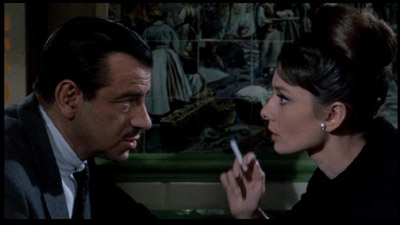
As you can see, from the first frame, audiences wonder only one thing: how will these two lovebirds end up together? Ok, I apologize; that was ridiculous. Here's the real still:
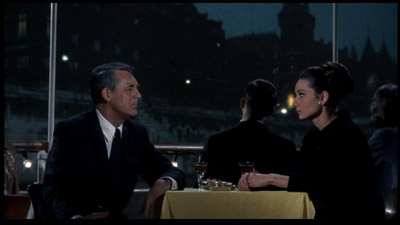
With Cary Grant and Audrey Hepburn on screen together, you don't really have to do too much to make a great movie, or at least a fun one. Donen has a serviceable plot, with more than the required number of turnarounds. Hepburn, unhappily married, returns home to find her husband was not the man he claimed to be. Furthermore, she discovers he has sold all her possessions and gotten himself killed while fleeing France by train. It seems that the couple's wealth (a) was stolen from the United States government as part of a World War II pact and (b) has disappeared completely. This puts Hepburn in kind of an awkward position, since the other people who helped her husband steal the money are convinced that she has it. Fortunately, Cary Grant shows up out of virtually nowhere to help her outwit her husband's former army buddies. And when it comes to outwitting, nobody was ever better than Grant. Although Hepburn hadn't played the kind of character she plays in this movie before, anyone who's seen Wait Until Dark knows she can do one hell of a resourceful-in-a-crisis damsel in distress. One can imagine making this movie and having both actors play against type. But I don't want to see that hypothetical movie as much as I want to see the two of them being funny and charming. Basically being, you know, Cary Grant and Audrey Hepburn. Charade is an ideal star vehicle for these two, drawing heavily from Hitchcock's movies (all the way back to The 39 Steps, as Charles Taylor has noted) for its particular mixture of genres. The trailer memorably categorizes Charade as something crafted in a blender:
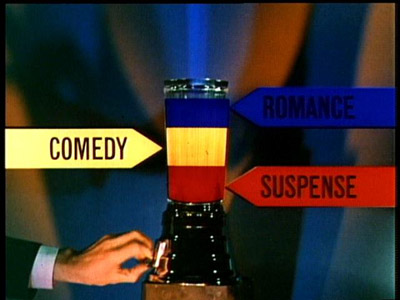
The slight craziness of that image gives you a pretty good sense of the tone of the film. Donen was the director of Singin' in the Rain, which to me was always the best example of a film that works because of sheer over-the-top commitment. When Donald O'Connor starts singing "Make 'Em Laugh," it's not that funny. But nobody in the history of the human race has made it through the backflips that end that sequence without laughing; he's just so damn earnest about the whole thing. There's at least one sequence in Charade that has the same earnest goofiness, a bizarre set piece where Cary Grant takes a shower fully clothed.
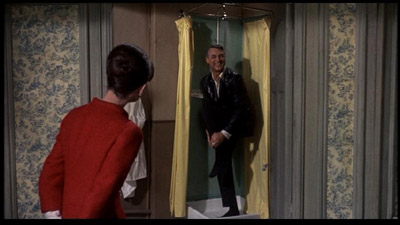
It's not much of a gag but he sells it as wholeheartedly as Donald O'Connor (and I think there's an echo of Singin' In The Rain's raincoats in that Technicolor shower curtain). In fact, the scene could be lifted and set right in the middle of Singin' in the Rain and nobody would notice. But I invite you to find a place in Singin' in the Rain for the pre-credit shot in which we're introduced to Hepburn's husband:

The surprised expression and lacerations seem too grim for a Hitchcock movie. In fact, the violence in Charade is not really of a piece with the rest of the film, as early viewers noted. Bowsley Crowther's original review in the Times devotes five of nine paragraphs to warning about how sudden and grisly the violence in the film is (at times, he sounds as though he doesn't think his readers believe he's telling the truth: "I tell you, this lighthearted picture is full of such gruesome violence.") But although they seem at times to be from a different movie, for the most part, these scenes and sequences stand on their own as sick, funny set pieces. The highlight is Hepburn's husband's funeral: no one but the detective investigating his murder is there at first. But one by one, his army buddies show up, each trying in less and less subtle ways to verify that he is really dead. Here's James Coburn holding a mirror under his nose to see if it frosts:
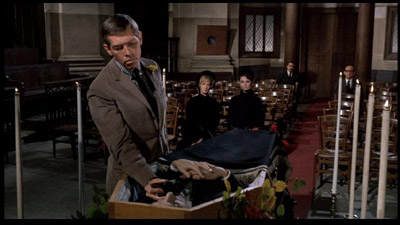
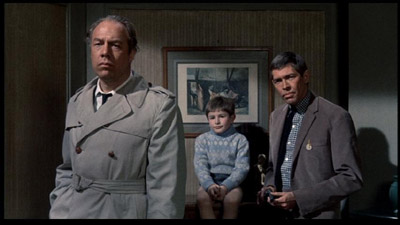
This scene is a masterpiece of black humor and economy. Economy because it's your introduction to the villains of the movie, and roughly lets you rank their level of threat based on their behavior at the funeral. Black humor cause, well, you know, it's a funeral. The last to enter is George Kennedy, looking approximately ten feet tall:
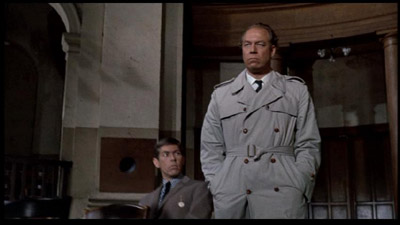
I love the expression on James Coburn's face—when even Coburn is unnerved, you know you're in trouble. Kennedy doesn't even sit down—just slams the door open, stalks to the front of the room, jabs a hatpin in the corpse's hand, verifies that he doesn't flinch, and stalks right back out. No respect for the dead, that man; not one to trust. But then the movie doesn't have much respect for the dead either: the other steady progression through the film is the increasingly Byzantine ways the villains are killed. Here, for example, is how James Coburn's body is discovered:
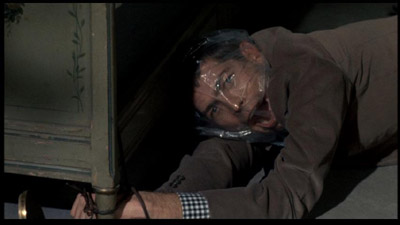
As someone who has always thought the "do not put a plastic bag on your baby's head, or your own, especially if you're planning on choking yourself" icons were hilarious, I wholeheartedly approve of this shot. (For reference only:
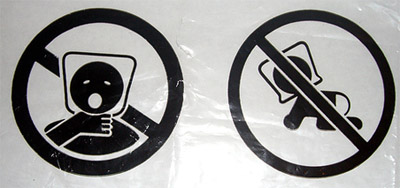
See? Hilarious!) It's not for nothing Charles Taylor compared the murders in this play with the illustrations in a Charles Addams book. And in fact, the murders are shown almost exclusively in static shots; you see the bodies but not the deaths themselves. This lends the whole proceeding a sort of ironic detachment; the corpses are punchlines.

Grant and Hepburn pick up on this tone—Taylor called their performances "high deadpan," which seems about right. They deliver impossible lines in a very stylized way, and your reaction to it will depend on whether or not you enjoy Grant and Hepburn's screen persona in other movies. Of course, it's difficult to imagine reading most of Peter Stone's script in any tone other than arch detachment—the dialogue has little to do with what actual people would say in the situations Grant and Hepburn find themselves. To pick just one example, Hepburn tells Walter Matthau's CIA agent, "Mr. Bartholomew, if you're trying to frighten me..." with an unphaseable expression, then changes to a scared rabbit look to finish the sentence, "you're doing a first-rate job!" I'd tip my hat to any actor who can give that line a method reading, but I wouldn't hire them for this film.

Charade is much more playful than Hitchcock's thriller-romances, at least in the lead actors' performances. Presumably the genre conventions were laid down well enough by 1963 for audiences to respond to a movie this self-aware. But while the movie feels breezily ahead of its time in many regards, Hepburn and Grant's romance seems to be taken from a 1930's romantic comedy, not a film from the sixties—or even the fifties or forties, as a comparison to North By Northwest or Notorious will quickly show). Partly this was because of Grant's fear that he would look ridiculous pursuing someone Hepburn's age; he required that their scenes be rewritten so that she pursues him exclusively. The problem is, one of the major engines of the plot is whether Grant is a threat to Hepburn. It's hard to give him the requisite air of sexual menace when he doesn't kiss Hepburn back, and then says, "Oh, no. The doctor said it was bad for my... thermostat." Suddenly we're back in Bringing Up Baby mode, which is fair enough, but pretty clearly separates Grant from the other villains. One thing about George Kennedy's character I didn't mention by way of illustration: he's missing an arm, and has a habit of attacking people with his prosthesis:
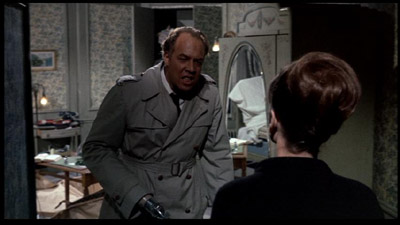
Yes, that's as much of a joke as Grant's thermostat line, but Kennedy's missing hand is a sick joke (and one it's fun to imagine trying to get into a major studio movie today), and the tones don't entirely gel.

But who really cares if Charade is a masterpiece where every frame comes together to create a perfect, unified whole? It's got Cary Grant and Audrey Hepburn, being charming, arch, and good looking. I love movies where the director carefully subverts a star's image as much as the next guy. But if you're going to appreciate that, it seems to me that you should also have some appreciation for the movies that cash in on that image in a relatively unironic fashion. Or to put it another way:
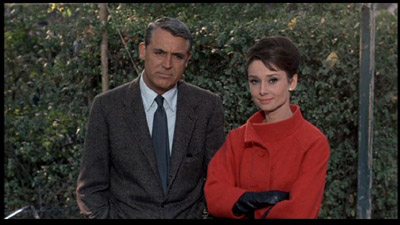
Randoms:

  • The commentary track, with Peter Stone and Stanley Donen, is crawling with arguments. It was hard to tell whether Stone and Donen were just being crotchety or genuinely have some bad blood between them. Whichever it is, Stone hardly says anything that Donen doesn't contradict, even when it profits neither of them to argue. The best is a two minute fight over whether the French equivalent of Punch & Judy shows is called Guignol or Guignolet. Donen thinks it's Guignolet, Stone is of the Guignol camp. The confusion comes from the Théâtre du Vrai Guignolet:
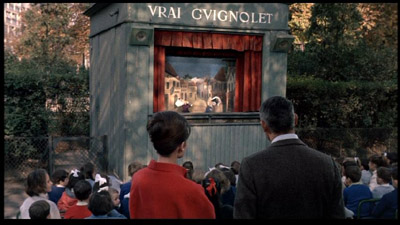
    The name of the theater nonwithstanding, Stone is right and Donen is wrong.

  • It wasn't entirely fair of me to choose Grant's "thermostat" line as an example of his tone being out of synch with the rest of the film. That line wasn't in the screenplay, but Grant insisted that he have some "Cary Grant lines" and wrote that one himself. Thirty years later, Stone still laments it. Nevertheless, there are many other examples of Grant being goofy in ways that cut against his character's status as potential villain.

  • If you know me, you know that this part of the film was more or less wasted on me, but fashonistas should see this movie on the basis of Audrey Hepburn's clothes alone. The joke is that the movie opens with her husband leaving her destitute; all she has is in a few suitcases. But from those suitcases comes Givenchy, Givenchy, and Givenchy, one outfit after another. With the caveat that I know next to nothing about clothes, this was my favorite:
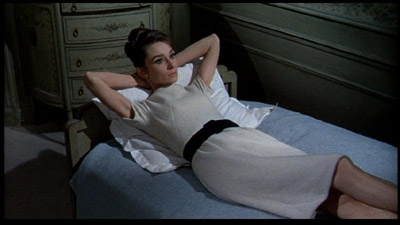
    That's apparently what the well-dressed woman wore to lay on a pauper's cot and think pensively about their dire situation, circa 1963. Classic!

  • This isn't a film with a lot of flashy camerawork. I did like the corpse-eye view of the morgue drawer closing on Hepburn's late husband, however:
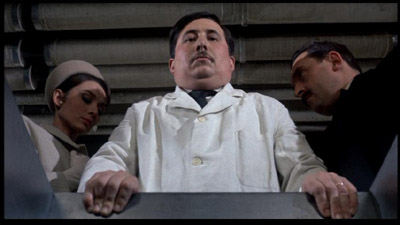
    It's a little self-conscious, particularly in a film that doesn't have Hitchcock-style camera movement anywhere else. But that mortician's face is so perfect from that angle (and there's a nice match cut to a hand closing a desk drawer in the next scene) that I find it hard to hold it against anyone.

  • Henry Mancini's score for this is exceptionally cool, at least when it's in the opening-credits arrangement, with wood blocks and surf guitars, and not the Johnny Mercer ballad version. Those opening credits are also noteworthy for their epileptic-unfriendly animations and garish colors:
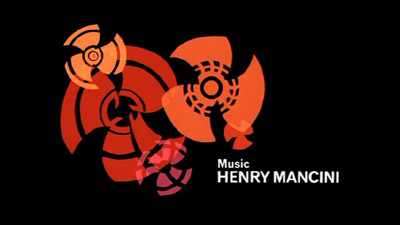
    Yes, those animated flowers are rotating about once every three frames. The titles were done by Maurice Binder, who also designed all the Bond title sequences through License to Kill. Charade doesn't have any naked women as major features of the titles, however. Oh, and if you're wondering why there's a Johnny Mercer version of the title theme in the movie, it's so it could qualify for an Academy Award for "Best Song"—you have to have lyrics to be eligible. Charade was nominated, but lost (to the well-remembered and universally loved "Call Me Irresponsible," from Papa's Delicate Condition).

  • Peter Stone wrote Charade as a screenplay at first, and when it was rejected by every studio, he rewrote it as a novel (and not a very good one, by his own admission). However, it was good enough to serialize in Redbook, which got him enough attention to sell the movie rights, then resell the original script as his "adaptation" of his own novel. Another illustration of the mental real estate principle there: an original screenplay is nothing, but if it's an adaptation, well, that's something else.

  • And speaking of gaming the studios, Donen and Stone only touch on this briefly, but it seems that the film was set up at Fox, went into turnaround when Grant dropped out, was picked up by Universal, and then Grant came back, much to Universal's dismay. I'm not sure, but I think Donen (who produced) may have made a great deal of money by switching studios. Unfortunately, Variety's online archives don't go back far enough to see what the deal was.

  • According to the IMDB, Charade is in the public domain because of a copyright screwup at Universal. This seems borne out by the number of different editions available on Amazon, but the Criterion DVD lists it as "Under exclusive license from Universal Studios Home Video, Inc. © 1963 Universal Pictures Company, Inc. & Stanley Donen Films, Inc., All rights reserved." A little research reveals that the controversy comes down to this frame:
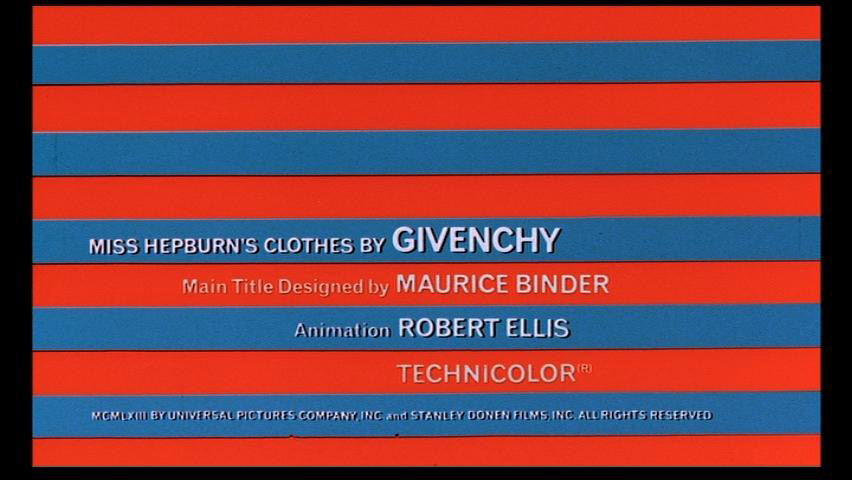

(Click the image for an easier to read full-resolution version).

    The copyright notice in Binder's title sequence does not include the copyright symbol, "©," which was apparently required by law until 1989 for a work to be copywritten. So for a long time, anyone who wanted to release a video or DVD of Charade just had to get their hands on a print and do a transfer. This doesn't mean it was ok to copy the official Universal DVD (under separate copyright as a derivative work), and I bet the studio wouldn't have been too happy if I'd walked up wanting to "borrow" the negatives for a few days. However, recently studios have been doing all they can to remove movies from the public domain through back-door legal arguments. In the case of Charade, Universal still owns the copyright on Mancini's score, and they've taken to enforcing this claim. So it seems that for all intents an purposes, is not in the public domain any longer. Too bad, because I had a nice four disc set planned for a fall 2007 release...

  • I kind of enjoyed that misleading Matthau/Hepburn still at the beginning of this essay. So here's one more, a bit of a spoiler. This is the shot in which the mastermind behind the criminal plot is revealed, as he coldheartedly orders his henchmen to murder Hepburn:


  • Wait for it...


    Wait for it...


    One of these days I'm going to write an essay about one of these movies no one is likely to watch, and every last "fact" will be completely made up.

Friday, June 09, 2006

#56: The 39 Steps

The 39 Steps, 1935, directed by Alfred Hitchcock, adaptation by Charles Bennett, dialogue by Ian Hay, from the novel by John Buchan.
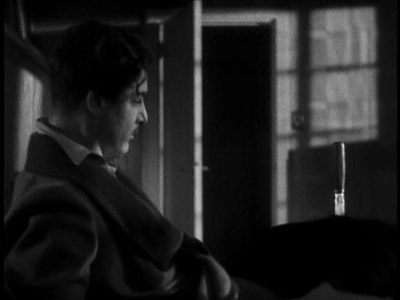
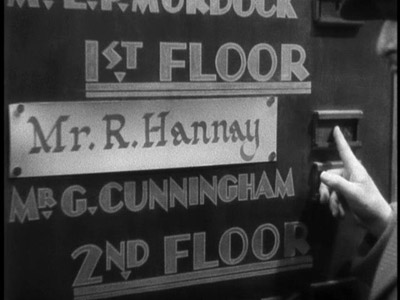
Nobody but paranoiacs goes to see a paranoid thriller for penetrating insights into the inner lives of the characters. There's no sense in this kind of movie wasting any time putting the characters into mortal peril; nobody wants a long scene of Roger Thornhill pitching a new ad campaign. But no other thriller streamlines the main character's life as drastically as The 39 Steps. Robert Donat plays the main character, Richard Hannay, who is in the wrong music hall at the wrong time, and ends up, as Hitchcock heroes tend to, on the run from both criminals and the law. Everything we know about Hannay's life emphasizes how sketchily drawn and temporary his life is before the movie begins, from cardboard letters in his apartment lobby:

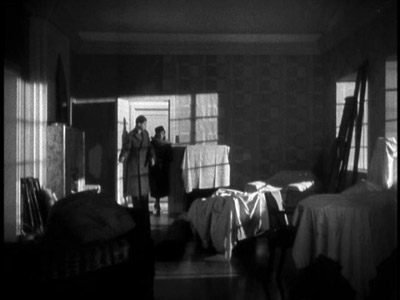
To the apartment itself, where the furniture is still covered in sheets:

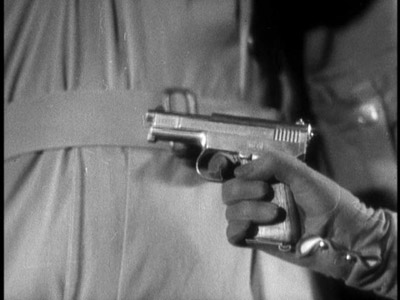
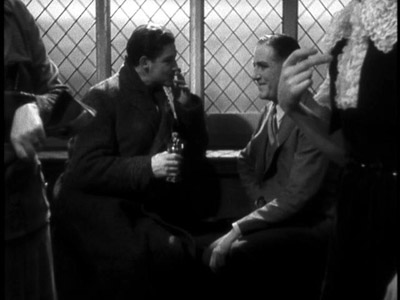
All the movie tells us about him is he's in town for a short time on business and he's Canadian. But as you can see from the sets, Hitchcock does everything he can to impress upon us that Hannay isn't carrying much of a back story with him. Hannay's life really begins when the movie does, at a music hall performance of an impresario named "Mr. Memory." Mr. Memory gets only a few minutes into his act before someone pulls a gun:

Unfortunately for Richard Hannay, the gun is only seen in a tight shot—so when Lucie Mannheim asks if she can come home with him after the show, he thinks it's just because he's so damn charming.

Actually, it's not clear what Hannay thinks, or why he agrees to bring a stranger home with him; he doesn't seem to want to sleep with her (though he does serve her fried haddock, which may be some sort of British code: "so I fried up a haddock, and I'd only met her that night, wot wot!"). Anyway, she tells him, through a thick German accent, that her name is "Annabella Smith," and she's being pursued by men who want to kill her. She adds "something which is not very healthy to know:" unless she can stop it, a vital Air Ministry secret is about to be smuggled out of the country. Hannay, so trusting when it comes to inviting strangers to his apartment, doesn't believe a word of her story. But she proves most of it (particularly the "not very healthy to know" part) that night by staggering through his door and collapsing with a knife in her back.

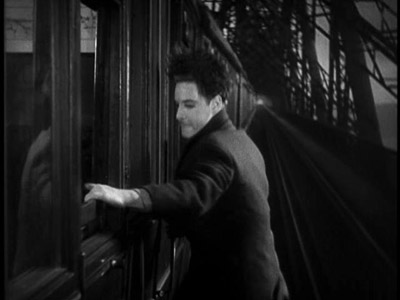
Yes, this is a movie where someone staggers through a door and collapses with a knife in their back. Hannay quite sensibly goes on the lam, and the rest of the movie is basically an extended chase scene, where nobody is quite what they seem and one safe haven after another turns out to be perilous. The first section of Hannay's flight relies almost entirely on paranoid thrills. There's a standout action sequence as the Flying Scotsman crosses the Forth Bridge:

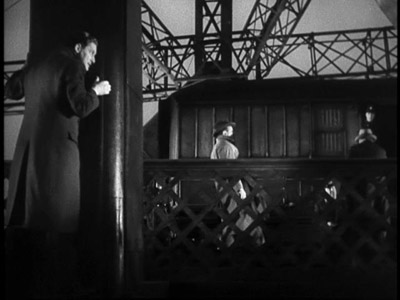
The dominant tone here is not the Indiana Jones-style action that the still above would imply, though; more frequently Hitchcock goes for the kind of tension you can see in this shot, later in the same sequence:

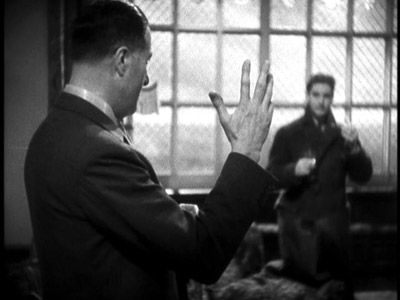
Will they see him? Will he fall? This shot is interesting, actually, because the framing is very self-conscious in deliberately denying the audience important information. Hitchcock tracks right with the train, and when he tracks back to the girder, Hannay is gone; we never find out exactly how he got off the bridge. It's a very self-conscious use of the camera. As with the tight shot of the gun, you can't help but be aware that you're being told the story in a particular way, by a particular narrator, because the framing is so obviously limiting. And if you think of the camera as a narrator, then you have to admit that this one is Nabokovian in terms of sheer manipulativeness. Manipulative is an apt word, actually, because the most obvious example is a long shot at a party where the appearance of one character's hand is a significant clue. The first time you see the scene, you don't notice anything strange about it, right up to the reveal shot:

But the second time you see the sequence, you notice how oddly a lot of it is framed to include other people's hands:

It's the cinematic equivalent of Pnin's birthday (O careless reader!)—like Nabokov's narrators, whoever is controlling the camera here knows there's a clue you're not paying attention to, and is not above taunting you a little. Hitchcock's obvious presence in this film was almost enough to induce me to follow the bouncing ball from privileging mise en scène to embracing auteur theory. But there's a reason Hitchcock's thrillers are so beloved of auteurists: thrillers aren't character studies, and a director has a great deal more control over how and when visual clues are given in a movie where the plot depends on reveal shots. It's easier to be an auteur if you work in a genre that minimizes the contributions of writers and actors.

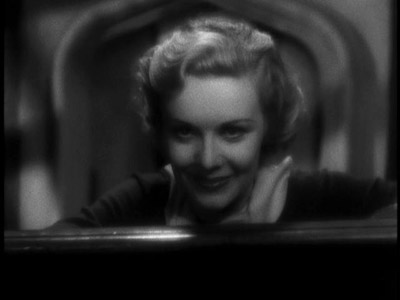
That's not to say the actors don't turn in great performances, just that this is the kind of movie where actors must be unflappable and charming, not necessarily insightful. Basically, it's the kind of movie you want to cast stars in. That's right, I said stars, plural; there's a romantic female lead in the movie too, Madeleine Carroll:

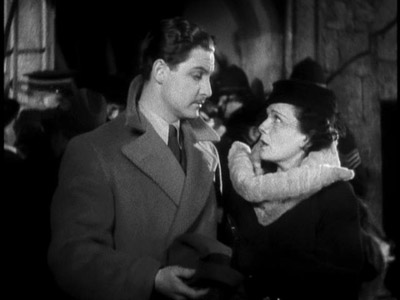
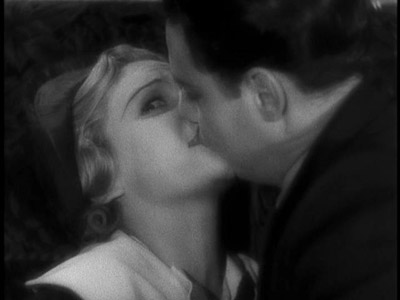
You might be wondering why I haven't mentioned her before. It's because she doesn't show up at all until 25 minutes into the film, when Hannay ducks into her compartment on the Flying Scotsman, kissing her passionately so the cops will walk by. You can tell by the look in her eyes that this tactic is going to have... limited utility:

This scene prefigures Eve Kendall's voracious seduction of Thornhill on the 20th Century Limited in North By Northwest, but Hannay could take a few pointers from Cary Grant. Hannay's approach is nearly charmless, and Carroll turns him in as soon as she can. In fact, you could plausibly retitle The 39 Steps as The Importance of Being Charming, because Hannay only succeeds when he's being charmingly dishonest; nearly every time he's honest about anything, he immediately falls into worse trouble.

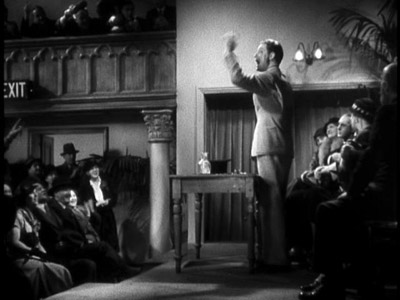
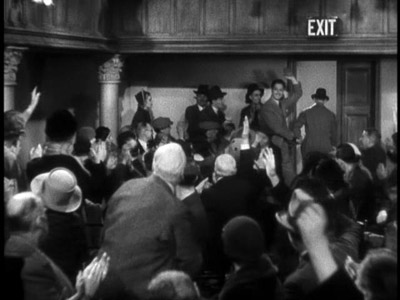
The movie itself gets a lot more charming when Madeleine Carroll reappears (after the train incident, which lasts maybe sixty seconds, she takes a half-hour vacation from the movie). Up to that point, it's a paranoid thriller with some hints of tragedy (I'm thinking here of Peggy Ashcroft's brief turn as a beaten-down wife, the most nuanced performance in the film). Once Carroll comes back, it undergoes a sudden transformation into a romantic comedy. This change isn't completely abrupt; Hitchcock leads into it with a comedic scene where Hannay hides out in an assembly hall, is mistaken for a visiting speaker, and gives a passionate oration:

This is probably my single favorite scene in the movie. The speech Donat gives is hilarious ("I know what it is to feel lonely and helpless and to have the whole world against me, and those are things that no man or woman ought to feel!"); this is the point where he quits worrying and just starts enjoying the ride. You can see that when he's escorted out handcuffed to a detective, cheerfully waving to the audience.

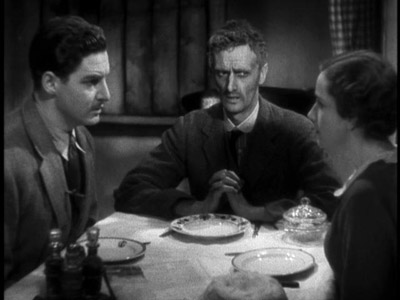
So it's not completely tonally unprecedented when the last half hour of the movie becomes primarily about Donat and Carroll bickering and fighting and falling in love. There's no denying it's a shift in tone, though. It's a long way from this shot of Hannay at the most tense and suspicious dinner ever:

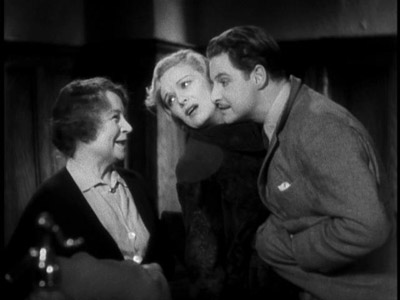
To the screwball comedy aspects of Hannay and Pamela's completely unconvincing impersonation of newlyweds:

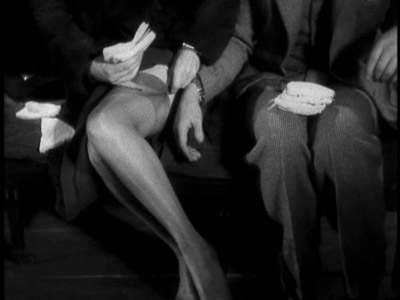
It shouldn't work to have such a dramatic shift in tone two-thirds of the way in, but it all kind of hangs together. For one thing, the last third is a good screwball comedy. Though they're handcuffed together, Carroll always looks that terrified, Hannay always looks that phony, and he's obviously holding a gun against her, the old woman they're fooling is thrilled. For another thing, some of the complications of being handcuffed together are not just funny but sexy. Take Hannay's hand on Carroll's leg when she removes her wet stockings:

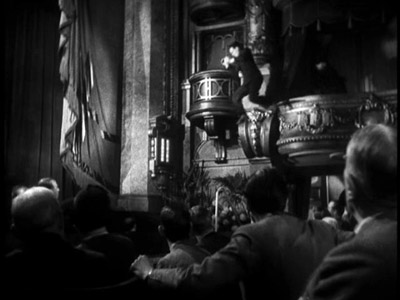
Finally, the tone changes back again by the end, a giant, tense, finale of a set piece. Fittingly, it's at another music hall, and comes complete with a John-Wilkes-Booth-style leap from the balcony:

When people praise thrillers, they often describe them as "tight." You can't say that about The 39 Steps. The plot's kind of shambling, characters appear and disappear, one of the leads is only in about a third of the movie, the tone varies wildly, and nobody seems to care too much about the murder that the movie opens with or the government secret that closes it. But it goes from paranoid and strange to charming and funny and back again so smoothly that you don't notice a change, the plot is surprising the first time you see it and the jokes are funny the seventh, and you could write a book about the deliberate way Hitchcock places and moves his camera. The 39 Steps is genre filmmaking at its best (and I love genre films). For one thing, when it comes to thriller/romantic comedies (for further examples see North By Northwest and Charade), this is the movie that invented the genre.

Randoms:

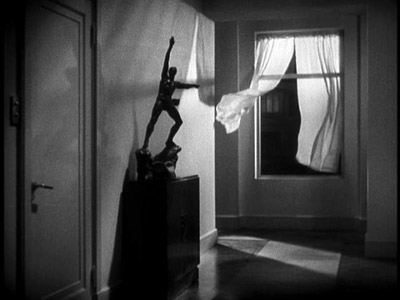
  • Hitchcock shot his first movie at UFA and there's a German Expressionist influence in this film. Like this bizarre shot of Richard Hannay's hallway, where the statue points at the window the murderer has just fled through:

    Or the closeup of Mr. Memory:

    Not much else to say about those except yeah, they're German Expressionist looking, all right.

  • Pay special attention to the sequence where Annabella Smith dies for what may be the earliest use of an unanswered phone as a device to build tension. The desire to answer the phone is so Pavlovian that it can make an already tense sequence nearly unbearable.

  • The DVD also includes the Lux Radio Theater production of the movie. Lux Radio Theater was a weekly program that presented radio versions of Hollywood movies. There's something really fun about seeing how they compressed the movie into a short radio program and attempted (more or less unsuccessfully) to translate the visual language of the movie into radio (hint: sound effects!). Still more fun is the intermission. Cecil B. DeMille, the show's producer, interviews Major C. E. Russell, a retired spy (whose book is still in print). The interview quite deliberately devolves into an ad for Lux soap, thusly:
    Russell: There's a machine recently developed in this country...it could etch a map of the entire country on a single Lux flake. And that's probably the finest thinnest, and most fragile thing that I can think of for the moment.

    DeMille: I know that you can read through a flake of Lux, Major! It's actually only two one thousandths of an inch thick!

    Russell: I see! Almost as amazing as this machine I'm speaking of!
    Simpler times, simpler product placement.

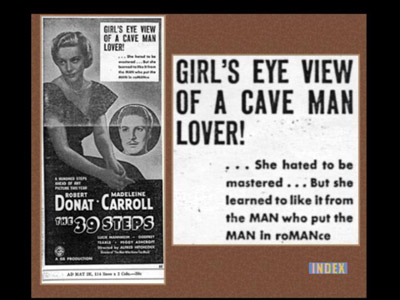
  • And speaking of simpler advertising, the advertising for The 39 Steps really is something to behold. The DVD reproduces the original press book, complete with all the film's taglines. Now remember, the movie's about a man who is falsely accused of murder and flees across the country, trying to expose a ring of spies. See if you can tell what's strange about this poster:

    Donat is the MAN who put the MAN in roMANce because he had just starred in The Count of Monte Cristo. That wasn't even the most misleading tagline; that honor goes to this gem: "She Loathed Him... He Despised Her... And So They Were Married." Well, no. No, they weren't, unless you read a lot more into them holding hands at the end than I think is warranted. Apparently, marketing teams had just as much trouble selling genre bending movies in 1935 as they do now.

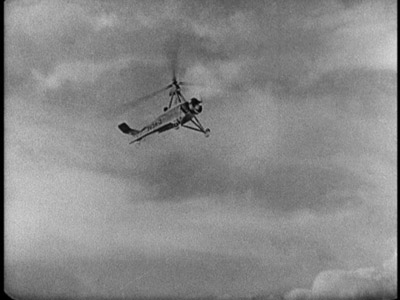
  • The most unintentionally funny shot is the stock footage of an autogyro chasing Hannay across the moors:

    If that's the secret "vital to England's air defense" that people are dying to keep out of enemy hands, I say they just let it go.

Thursday, May 25, 2006

#55: The Unbearable Lightness of Being

The Unbearable Lightness of Being, 1988, directed by Philip Kaufman, screenplay by Jean-Claude Carrière and Philip Kaufman, from the novel by Milan Kundera.

The back of the Criterion edition of The Unbearable Lightness of Being refers to the movie as "the screen version of Milan Kundera's 'unfilmable' novel." The Unbearable Lightness of Being isn't the most unfilmable novel ever written, but it's pretty damn impossible to imagine it on film while you're reading it. (What is the most unfilmable novel ever written? Beckett's The Unnamable, with honorable mentions for Gravity's Rainbow, Pale Fire, and of course Ulysses—noting for the record that there are two (!) films of Ulysses).

So what makes a novel unfilmable? Structural complexity and stylistic experimentation don't help, but in the right hands they can be as great on screen as on the page. Novels of ideas aren't easy, but they can also be cinematic; think of A Clockwork Orange. The Unbearable Lightness of Being is a structurally complex, stylistically experimental novel of ideas, but that's not what makes it unfilmable. To give you a sense of the problem, here's the complete second chapter:

If every second of our lives recurs an infinite number of times, we are nailed to eternity as Jesus Christ was nailed to the cross. It is a terrifying prospect. In the world of eternal return the weight of unbearable responsibility lies heavy on every mood we make. That is why Nietzsche called the idea of eternal return the heaviest of burdens (das schwerste Gewicht).

If eternal return is the heaviest of burdens, then our lives can stand out against it in all their splendid lightness.

But is heaviness truly deplorable and lightness splendid?

The heaviest of burdens crushes us, we sink beneath it, it pins us to the ground. But in the love poetry of every age, the woman longs to be weighed down by the man's body. The heaviest of burdens is therefore simultaneously an image of life's most intense fulfillment. The heavier the burden, the closer our lives come to the earth, the more real and truthful they become.

Conversely, the absolute absence of a burden causes man to be lighter than air, to soar into the heights, take leave of the earth and his earthly being, and become only half real, his movements as free as they are insignificant.

What then shall we choose? Weight or lightness?

Parmenides posed this very question in the sixth century before Christ. He saw the world divided into pairs of opposites: light/darkness, fineness/coarseness, warmth/cold, being/nonbeing. One half of the opposition he called positive (light, fineness, warmth, being), the other negative. We might find this division into positive and negative poles childishly simple except for one difficulty: which one is positive, weight or lightness?

Parmenides responded: lightness is positive, weight negative.

Was he correct or not? That is the question. The only certainty is: the lightness/weight opposition is the most mysterious, most ambiguous of all.

So imagine you're Philip Kaufman or Jean-Claude Carrière. How do you film this? It's not completely impossible to include something like this in a film: you could put it in a voiceover, or have a Dan Brown-style "conversation between experts," or have a character give an academic lecture (another of Brown's favorite "techniques"). But such solutions make awkward the kind of discursiveness that seems natural in a novel (which makes Dan Brown's use of them all the more baffling). But as much as I'd love to spend the rest of this essay talking about how terrible The Da Vinci Code is, I'm going to back away from the precipice. Unlike certain pulp authors I could name, Kundera is verbal more than visual, which doesn't make for easy adaptation. You can't film an essay.

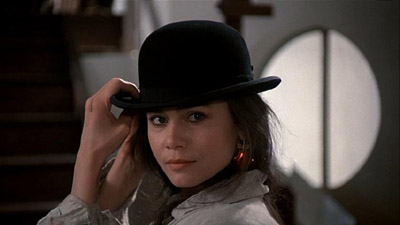
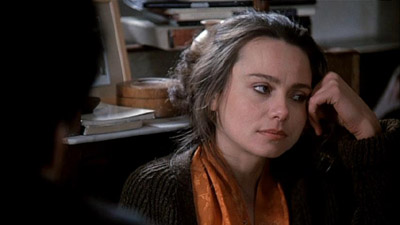
Kaufman and Carrière's solution is to cut virtually all of Kundera's philosphical asides, rearrange the events of the novel in chronological order, eliminate the narrator entirely, cut one of the four main characters down to a few minutes of screentime, and in general turn the movie into something that could be mistaken for a conventional love story. So what's left after this radical surgery? Lena Olin, to start.

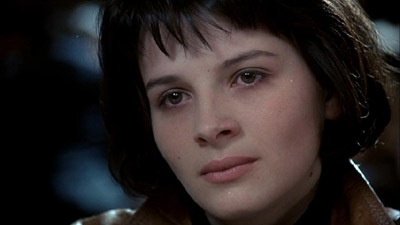
And Juliete Binoche.

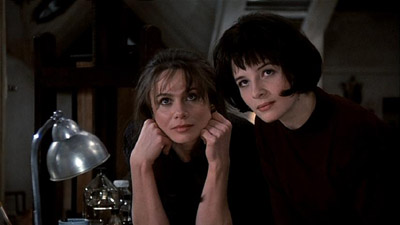
Also, Lena Olin and Juliet Binoche.

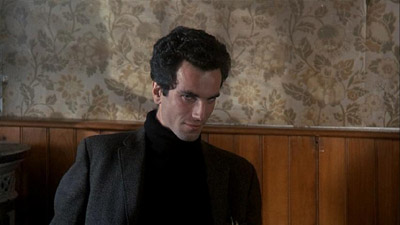
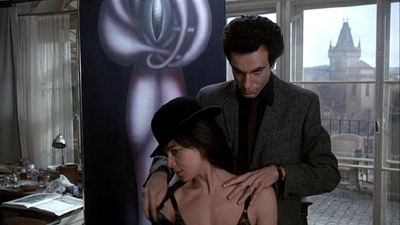
The good news about Kundera's novel is that even after you've turned it into a linear narrative, you still have strong characters and at least one iconic visual (a woman in a bowler). And it doesn't hurt to have two of the most accomplished actresses in the world making their English-language debuts. Lena Olin plays Sabina, one of the main character's (many) mistresses; Binoche is Tereza, the woman he finally settles down with. The main character, Tomas, is played by Daniel Day-Lewis at his most trustworthy and reliable:

The film, like the novel, follows Tomas from 1968 through fall of 1969, if I have the chronology right. The dates are indistinct except for the central event of the novel: the Soviet invasion of Czechoslovakia in August of 1968. It's worth brushing up on this before watching the movie, because unlike most films that deal with parts of history Americans don't know too well (everything except World War II, in other words), The Unbearable Lightness of Being doesn't spend much time on exposition. And to be honest, it doesn't spend much time on politics either, which is strange for a movie with an invasion at its center. I was talking with my friend Angela about Good Bye Lenin! (which I highly recommend) and she said she really likes "stories where major world-changing events are always just an element in someone's life and not the only one." The Unbearable Lightness of Being is definitely one of those stories, but sometimes I think Kaufman gives short shrift to these events, which are essential to the novel. On the commentary, Carrière says something about how happy he is that the sex scenes in the movie aren't ornamental, as they are in most studio films. He's right; the movie handles eroticism very frankly and realistically. But by focusing on the central love triangle above all, Kaufman risks making world history seem ornamental.

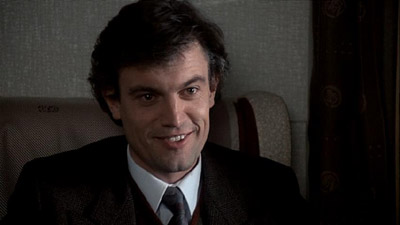
If you know the novel, you'll know it's strange to describe it as a love "triangle." Also missing in this adaptation is the fourth character in Kundera's quartet, Sabina's lover Franz. He still makes an appearance, and Derek de Lint does a fine job playing him, so guilelessly that it's immediately apparent that Sabina is going to break his heart:

But Franz has very little screen time; the first two-thirds of the film are framed like a traditional love triangle between Tomas, Tereza, and Sabina. In the novel, Franz's overly optimistic leftism and naïveté provides a lightness to balance the weight of the other character's actual experience of communism. But without knowing his politics, or his wife, or seeing his tragicomic end in Cambodia, Franz seems out of place, a minor character that we spend too much time with. The result is, unfortunately, to make Sabina's betrayal seem cruel.

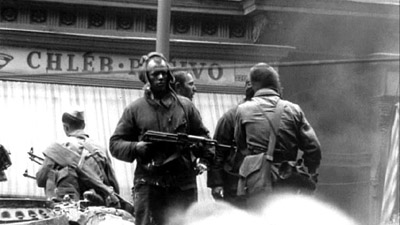
On the other hand, the movie clocks in at 172 minutes as is, so it seems unrealistic to wish more of the novel was there. And even without context, the Soviet invasion of Czechoslovakia is spectacular:

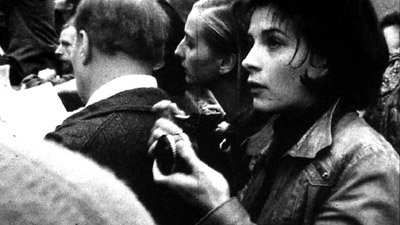
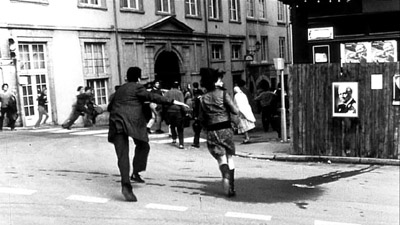
If you think that shot looks a little expensive for an art house movie, you're right. During the actual invasion, students at the Prague film school shot everything they could, and Kaufman uses this stock footage liberally. It's a textbook case of making something amazing on a budget: cutting from Tereza taking a photograph:

To what she's photographing:

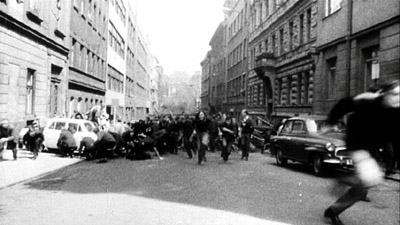
Or cutting from a crowd fleeing tanks:

To Tereza and Tomas reacting and running away themselves:

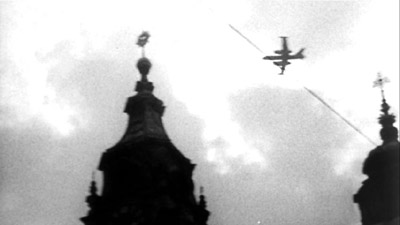
Presented just as stills, it sounds like something Ed Wood would do, but the cuts are very fast and the sequence feels seamless. I didn't realize that any stock footage was being used (and was wondering how on earth they'd staged some of the things I was seeing) until this shot:

You couldn't fly a vintage Soviet recon plane over St. Vitus Cathedral in 1986, and an elaborate model shot for two seconds of film would have been excessive. As great as this sequence is on its own, in the rest of the film the Soviet invasion is sometimes treated as just another obstacle for Tereza and Tomas to overcome (and Carrière explicitly refers to it as such on the commentary). As the IMDB puts it, "In 1968, a Czech doctor with an active sex life meets a woman who wants monogamy, and then the Soviet invasion further disrupts their lives." That's a lot like the summary of the 1953 version of Titanic I discovered while writing about A Night To Remember: "Their problems soon seem minor when the ship hits an iceberg."

But look: as the excerpt from the novel shows, you couldn't possibly make a movie that was "faithful to the book." The novel's main concerns aren't historical anyway, they're philosophical. And nobody's made a good movie about philosophy yet. Kaufman and Carrière chose to focus on three of the novel's characters, and they got brilliant performances from everyone involved. And the tone is right throughout; "everything is illuminated by the aura of nostalgia," to quote the novel. Evaluated as a character-based love story, the movie succeeds; all three of the characters are wonderfully fleshed out, and by the end, as Roger Ebert noted, you have a sense of the rhythms of their lives. And the ending itself, the one time the film breaks chronology, is perfect, both in tone and execution.

It's hard to criticize the filmmakers for recognizing what works on film and what doesn't. If you're going to make a movie about sex, politics, and philosophy, guess which parts are going to work best on screen? There's one scene that crystallized this for me. Tomas is telling Sabina why he hasn't thrown Tereza out of his apartment (up to this point he's had a no-overnight-guests rule).

If I had two lives, in one life I could invite her to stay at my place, and in the second life I could kick her out. Then I could compare and see which had been the best thing to do. But we only live once. Life's so light. Like an outline we can't ever fill in or correct... make any better. It's frightening.

Tomas's line here is one of the points where the film is closest in its concerns to the novel. Sabina listens to Tomas for a minute and then, mid-sentence, rolls her eyes.

The camera stays on Lena Olin.

Randoms:

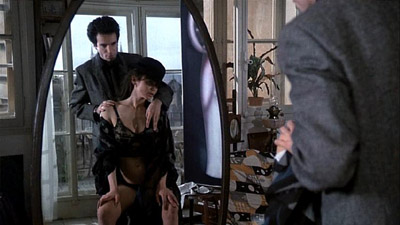
  • The commentary track is well worth listening to for practical advice about editing. Walter Murch was one of the commenters and for the most part talks about specific techniques he used when cutting the movie, most of them useful and all of them interesting. Just one example: love scenes between Tomas and Sabina feature a lot of mirrors. When you're cutting between a shot in a mirror and the real world, of course, the image reverses itself. It takes the brain about a half-second to parse this, so if you're cutting on an action, you need to have some overlap to cover the cut, or the action doesn't seem continuous. For example, in the two shots below, Tomas is pulling Sabina's robe off her right shoulder in one continuous motion. In this frame, the robe is nearly off her shoulder entirely:

    But in the next frame, after the cut to a mirror image, his hand is back near her collarbone and the action repeats.

    If Murch had cut to the next frame of motion instead of overlapping, the action would have looked jerky, but as it is, the brain processes it like any other cut on motion, and Tomas's hand moves smoothly. This overlap must have made the sound synchronization a lot of trouble, but Murch was sound editor on The Conversation so I doubt it phased him too much.

  • Murch also seems to have a very good sense of the novel's structure. I wonder more generally if editors are more sensitive to structure in novels, since they're used to cutting and restructuring film. In any event, he was the one person on the commentary who mentioned the way the novel retells the key events in different ways and from different characters' perspectives. And he seems to have had a great deal of creative influence. Take the scene where Tereza, angry at Tomas, sleeps with a patron of the bar where she's working. Kaufman shot coverage of both Tereza and her lover; it was Murch who decided to cut the scene using only shots where her lover's face is obscured, to give a sense of what Tereza thinks anonymous sex must be like for her husband. I don't know if this kind of influence is typical but I suspect it isn't.

  • At the risk of turning this section into the Walter Murch hour, I should note that he has one other piece of advice for editors: never visit the set. Murch edited Apocalypse Now, and I guess anybody who could stay off that set did. But he has another reason to recommend this. If you see the difficulties involved in getting a particular shot to work, you may prize it more highly than you should; if it takes all day to get the light just right, you might not notice that the result is boring. By the same token, if you know what footage is just people goofing around, you might assume nothing in it is good and miss something great to use. The editor is the only person who can provide a new perspective that late in the creative process, and it's good to have that. However, I doubt Murch was able to take his own advice; the last scenes with Sabina were shot at his house.

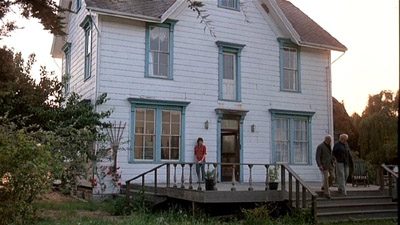
    And the old man walking down the front stairs is Niven Busch, who was a co-writer on the screenplay for The Postman Always Rings Twice and the novel Duel in the Sun. What's he doing in a minor role in this movie? Your guess is as good as mine.

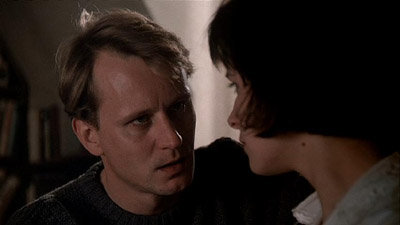
  • Speaking of minor roles, the engineer who Tereza sleeps with during her one experiment in infidelity is played by Stellan Skarsgård, who had already mastered the creepiness that would serve him so well in Insomnia.

  • Not all of the destruction in the Soviet invasion sequence is from stock footage. The production rented a few vintage Soviet tanks from a French general who collected them. I don't know the model of tank, but the plane flying over St. Vitus appears to be a YAK25-RV, a high-altitude recon craft. What it's doing at low altitude over Prague I don't know, but it's the only plane that has that wing shape. (Yes, I'm obsessive enough to try to ID the plane).

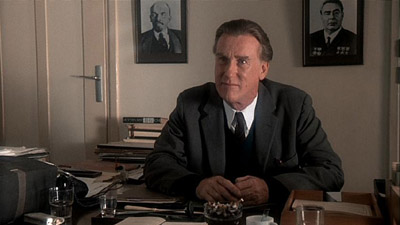
  • The shot below seemed very familiar to me but I can't remember what it reminded me of.

    I'm thinking specifically of the photos on the wall on either side of the head of the man at the desk. I want to say it's from 8½ or Harold and Maude, not that those two are particularly linked anywhere but my troubled mind. Or The 400 Blows?

    Update: I figured it out; it's from Harold and Maude; but it isn't quite the way I remembered it. See the comments for details.

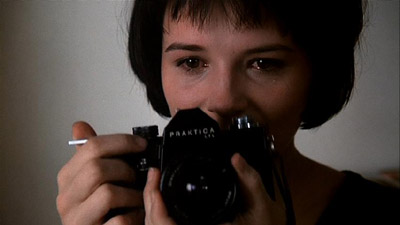
  • Kaufman tells a great story about Stanley Kubrick on the commentary. There's a scene in the middle of the film where Sabina poses nude for Tereza to photograph and vice-versa. It is, as you would expect, pretty remarkable. Kubrick apparently complimented Kaufman on the film in general, and that sequence in particular. Because he was impressed by the vintage Praktica LTL camera that Tereza uses to photograph. Only Kubrick would see something like this:

    and find his eye irresistibly drawn to the camera. (By the way, the camera isn't just vintage, but anachronistic; the Praktica LTL didn't start production until December 1970—and yes, I'm just the kind of dork who would try to answer Kubrick's question—but I sure wasn't thinking about it while I was watching the movie).

  • Worst pun you could make when writing about a Kundera adaptation that, despite being unfaithful to the novel, is still a very good film: "C'est magnifique, mais ce n'est pas Kundera!" Thank you, thank you, I'm here all week.