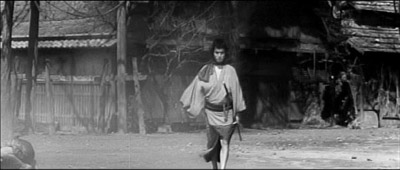
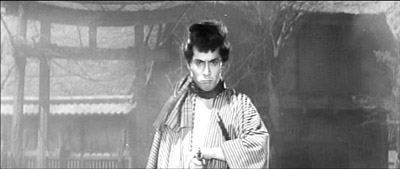
Thursday, May 25, 2006

#55: The Unbearable Lightness of Being

The Unbearable Lightness of Being, 1988, directed by Philip Kaufman, screenplay by Jean-Claude Carrière and Philip Kaufman, from the novel by Milan Kundera.

The back of the Criterion edition of The Unbearable Lightness of Being refers to the movie as "the screen version of Milan Kundera's 'unfilmable' novel." The Unbearable Lightness of Being isn't the most unfilmable novel ever written, but it's pretty damn impossible to imagine it on film while you're reading it. (What is the most unfilmable novel ever written? Beckett's The Unnamable, with honorable mentions for Gravity's Rainbow, Pale Fire, and of course Ulysses—noting for the record that there are two (!) films of Ulysses).

So what makes a novel unfilmable? Structural complexity and stylistic experimentation don't help, but in the right hands they can be as great on screen as on the page. Novels of ideas aren't easy, but they can also be cinematic; think of A Clockwork Orange. The Unbearable Lightness of Being is a structurally complex, stylistically experimental novel of ideas, but that's not what makes it unfilmable. To give you a sense of the problem, here's the complete second chapter:

If every second of our lives recurs an infinite number of times, we are nailed to eternity as Jesus Christ was nailed to the cross. It is a terrifying prospect. In the world of eternal return the weight of unbearable responsibility lies heavy on every mood we make. That is why Nietzsche called the idea of eternal return the heaviest of burdens (das schwerste Gewicht).

If eternal return is the heaviest of burdens, then our lives can stand out against it in all their splendid lightness.

But is heaviness truly deplorable and lightness splendid?

The heaviest of burdens crushes us, we sink beneath it, it pins us to the ground. But in the love poetry of every age, the woman longs to be weighed down by the man's body. The heaviest of burdens is therefore simultaneously an image of life's most intense fulfillment. The heavier the burden, the closer our lives come to the earth, the more real and truthful they become.

Conversely, the absolute absence of a burden causes man to be lighter than air, to soar into the heights, take leave of the earth and his earthly being, and become only half real, his movements as free as they are insignificant.

What then shall we choose? Weight or lightness?

Parmenides posed this very question in the sixth century before Christ. He saw the world divided into pairs of opposites: light/darkness, fineness/coarseness, warmth/cold, being/nonbeing. One half of the opposition he called positive (light, fineness, warmth, being), the other negative. We might find this division into positive and negative poles childishly simple except for one difficulty: which one is positive, weight or lightness?

Parmenides responded: lightness is positive, weight negative.

Was he correct or not? That is the question. The only certainty is: the lightness/weight opposition is the most mysterious, most ambiguous of all.

So imagine you're Philip Kaufman or Jean-Claude Carrière. How do you film this? It's not completely impossible to include something like this in a film: you could put it in a voiceover, or have a Dan Brown-style "conversation between experts," or have a character give an academic lecture (another of Brown's favorite "techniques"). But such solutions make awkward the kind of discursiveness that seems natural in a novel (which makes Dan Brown's use of them all the more baffling). But as much as I'd love to spend the rest of this essay talking about how terrible The Da Vinci Code is, I'm going to back away from the precipice. Unlike certain pulp authors I could name, Kundera is verbal more than visual, which doesn't make for easy adaptation. You can't film an essay.

Kaufman and Carrière's solution is to cut virtually all of Kundera's philosphical asides, rearrange the events of the novel in chronological order, eliminate the narrator entirely, cut one of the four main characters down to a few minutes of screentime, and in general turn the movie into something that could be mistaken for a conventional love story. So what's left after this radical surgery? Lena Olin, to start.
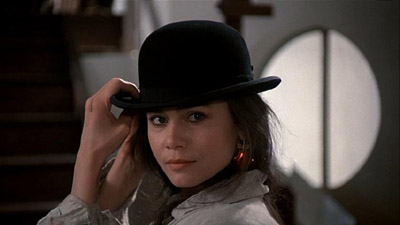
And Juliete Binoche.
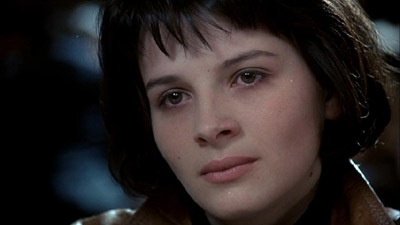
Also, Lena Olin and Juliet Binoche.
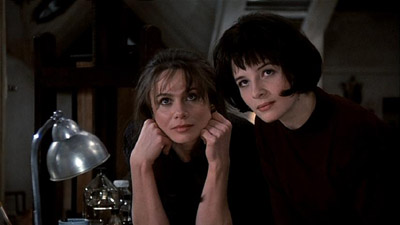
The good news about Kundera's novel is that even after you've turned it into a linear narrative, you still have strong characters and at least one iconic visual (a woman in a bowler). And it doesn't hurt to have two of the most accomplished actresses in the world making their English-language debuts. Lena Olin plays Sabina, one of the main character's (many) mistresses; Binoche is Tereza, the woman he finally settles down with. The main character, Tomas, is played by Daniel Day-Lewis at his most trustworthy and reliable:
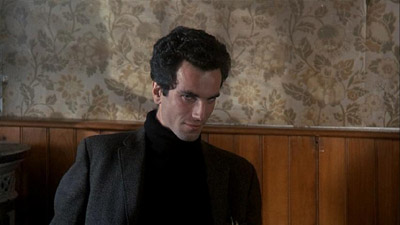
The film, like the novel, follows Tomas from 1968 through fall of 1969, if I have the chronology right. The dates are indistinct except for the central event of the novel: the Soviet invasion of Czechoslovakia in August of 1968. It's worth brushing up on this before watching the movie, because unlike most films that deal with parts of history Americans don't know too well (everything except World War II, in other words), The Unbearable Lightness of Being doesn't spend much time on exposition. And to be honest, it doesn't spend much time on politics either, which is strange for a movie with an invasion at its center. I was talking with my friend Angela about Good Bye Lenin! (which I highly recommend) and she said she really likes "stories where major world-changing events are always just an element in someone's life and not the only one." The Unbearable Lightness of Being is definitely one of those stories, but sometimes I think Kaufman gives short shrift to these events, which are essential to the novel. On the commentary, Carrière says something about how happy he is that the sex scenes in the movie aren't ornamental, as they are in most studio films. He's right; the movie handles eroticism very frankly and realistically. But by focusing on the central love triangle above all, Kaufman risks making world history seem ornamental.

If you know the novel, you'll know it's strange to describe it as a love "triangle." Also missing in this adaptation is the fourth character in Kundera's quartet, Sabina's lover Franz. He still makes an appearance, and Derek de Lint does a fine job playing him, so guilelessly that it's immediately apparent that Sabina is going to break his heart:
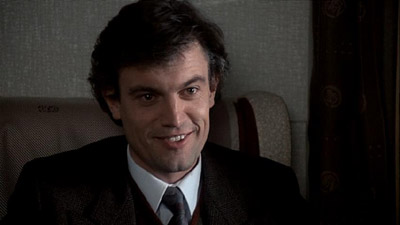
But Franz has very little screen time; the first two-thirds of the film are framed like a traditional love triangle between Tomas, Tereza, and Sabina. In the novel, Franz's overly optimistic leftism and naïveté provides a lightness to balance the weight of the other character's actual experience of communism. But without knowing his politics, or his wife, or seeing his tragicomic end in Cambodia, Franz seems out of place, a minor character that we spend too much time with. The result is, unfortunately, to make Sabina's betrayal seem cruel.

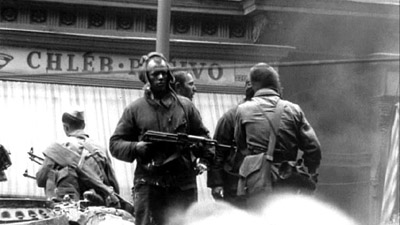
On the other hand, the movie clocks in at 172 minutes as is, so it seems unrealistic to wish more of the novel was there. And even without context, the Soviet invasion of Czechoslovakia is spectacular:

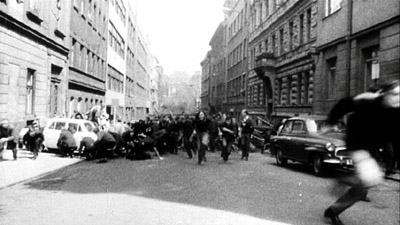
If you think that shot looks a little expensive for an art house movie, you're right. During the actual invasion, students at the Prague film school shot everything they could, and Kaufman uses this stock footage liberally. It's a textbook case of making something amazing on a budget: cutting from Tereza taking a photograph:
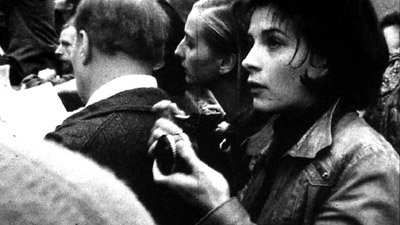
To what she's photographing:
Or cutting from a crowd fleeing tanks:
To Tereza and Tomas reacting and running away themselves:
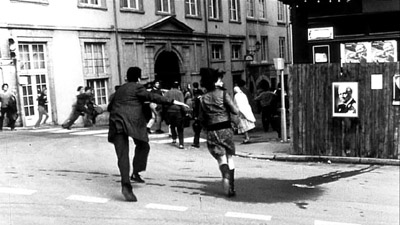
Presented just as stills, it sounds like something Ed Wood would do, but the cuts are very fast and the sequence feels seamless. I didn't realize that any stock footage was being used (and was wondering how on earth they'd staged some of the things I was seeing) until this shot:
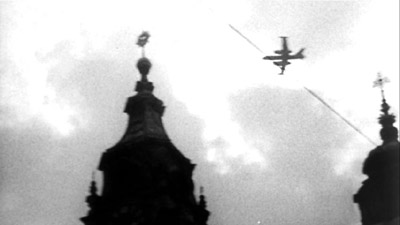
You couldn't fly a vintage Soviet recon plane over St. Vitus Cathedral in 1986, and an elaborate model shot for two seconds of film would have been excessive. As great as this sequence is on its own, in the rest of the film the Soviet invasion is sometimes treated as just another obstacle for Tereza and Tomas to overcome (and Carrière explicitly refers to it as such on the commentary). As the IMDB puts it, "In 1968, a Czech doctor with an active sex life meets a woman who wants monogamy, and then the Soviet invasion further disrupts their lives." That's a lot like the summary of the 1953 version of Titanic I discovered while writing about A Night To Remember: "Their problems soon seem minor when the ship hits an iceberg."

But look: as the excerpt from the novel shows, you couldn't possibly make a movie that was "faithful to the book." The novel's main concerns aren't historical anyway, they're philosophical. And nobody's made a good movie about philosophy yet. Kaufman and Carrière chose to focus on three of the novel's characters, and they got brilliant performances from everyone involved. And the tone is right throughout; "everything is illuminated by the aura of nostalgia," to quote the novel. Evaluated as a character-based love story, the movie succeeds; all three of the characters are wonderfully fleshed out, and by the end, as Roger Ebert noted, you have a sense of the rhythms of their lives. And the ending itself, the one time the film breaks chronology, is perfect, both in tone and execution.

It's hard to criticize the filmmakers for recognizing what works on film and what doesn't. If you're going to make a movie about sex, politics, and philosophy, guess which parts are going to work best on screen? There's one scene that crystallized this for me. Tomas is telling Sabina why he hasn't thrown Tereza out of his apartment (up to this point he's had a no-overnight-guests rule).

If I had two lives, in one life I could invite her to stay at my place, and in the second life I could kick her out. Then I could compare and see which had been the best thing to do. But we only live once. Life's so light. Like an outline we can't ever fill in or correct... make any better. It's frightening.

Tomas's line here is one of the points where the film is closest in its concerns to the novel. Sabina listens to Tomas for a minute and then, mid-sentence, rolls her eyes.
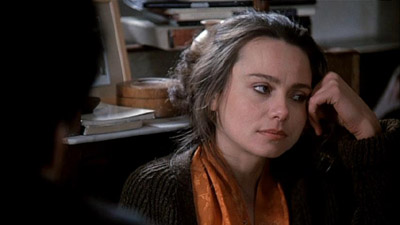
The camera stays on Lena Olin.

Randoms:

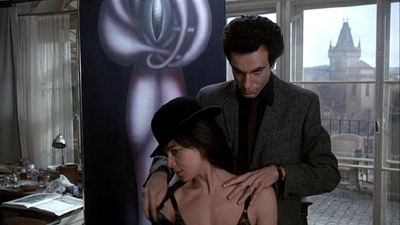
  • The commentary track is well worth listening to for practical advice about editing. Walter Murch was one of the commenters and for the most part talks about specific techniques he used when cutting the movie, most of them useful and all of them interesting. Just one example: love scenes between Tomas and Sabina feature a lot of mirrors. When you're cutting between a shot in a mirror and the real world, of course, the image reverses itself. It takes the brain about a half-second to parse this, so if you're cutting on an action, you need to have some overlap to cover the cut, or the action doesn't seem continuous. For example, in the two shots below, Tomas is pulling Sabina's robe off her right shoulder in one continuous motion. In this frame, the robe is nearly off her shoulder entirely:
    But in the next frame, after the cut to a mirror image, his hand is back near her collarbone and the action repeats.
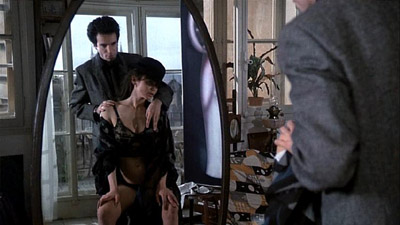
    If Murch had cut to the next frame of motion instead of overlapping, the action would have looked jerky, but as it is, the brain processes it like any other cut on motion, and Tomas's hand moves smoothly. This overlap must have made the sound synchronization a lot of trouble, but Murch was sound editor on The Conversation so I doubt it phased him too much.

  • Murch also seems to have a very good sense of the novel's structure. I wonder more generally if editors are more sensitive to structure in novels, since they're used to cutting and restructuring film. In any event, he was the one person on the commentary who mentioned the way the novel retells the key events in different ways and from different characters' perspectives. And he seems to have had a great deal of creative influence. Take the scene where Tereza, angry at Tomas, sleeps with a patron of the bar where she's working. Kaufman shot coverage of both Tereza and her lover; it was Murch who decided to cut the scene using only shots where her lover's face is obscured, to give a sense of what Tereza thinks anonymous sex must be like for her husband. I don't know if this kind of influence is typical but I suspect it isn't.

  • At the risk of turning this section into the Walter Murch hour, I should note that he has one other piece of advice for editors: never visit the set. Murch edited Apocalypse Now, and I guess anybody who could stay off that set did. But he has another reason to recommend this. If you see the difficulties involved in getting a particular shot to work, you may prize it more highly than you should; if it takes all day to get the light just right, you might not notice that the result is boring. By the same token, if you know what footage is just people goofing around, you might assume nothing in it is good and miss something great to use. The editor is the only person who can provide a new perspective that late in the creative process, and it's good to have that. However, I doubt Murch was able to take his own advice; the last scenes with Sabina were shot at his house.
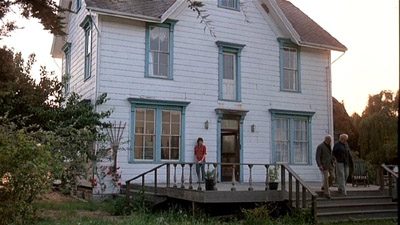
    And the old man walking down the front stairs is Niven Busch, who was a co-writer on the screenplay for The Postman Always Rings Twice and the novel Duel in the Sun. What's he doing in a minor role in this movie? Your guess is as good as mine.

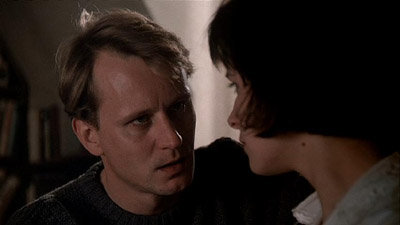
  • Speaking of minor roles, the engineer who Tereza sleeps with during her one experiment in infidelity is played by Stellan Skarsgård, who had already mastered the creepiness that would serve him so well in Insomnia.
  • Not all of the destruction in the Soviet invasion sequence is from stock footage. The production rented a few vintage Soviet tanks from a French general who collected them. I don't know the model of tank, but the plane flying over St. Vitus appears to be a YAK25-RV, a high-altitude recon craft. What it's doing at low altitude over Prague I don't know, but it's the only plane that has that wing shape. (Yes, I'm obsessive enough to try to ID the plane).

  • The shot below seemed very familiar to me but I can't remember what it reminded me of.
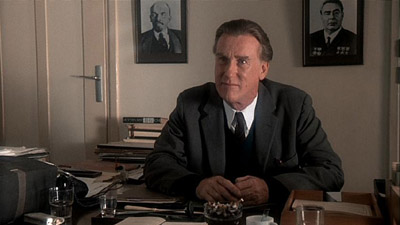
    I'm thinking specifically of the photos on the wall on either side of the head of the man at the desk. I want to say it's from 8½ or Harold and Maude, not that those two are particularly linked anywhere but my troubled mind. Or The 400 Blows?

    Update: I figured it out; it's from Harold and Maude; but it isn't quite the way I remembered it. See the comments for details.
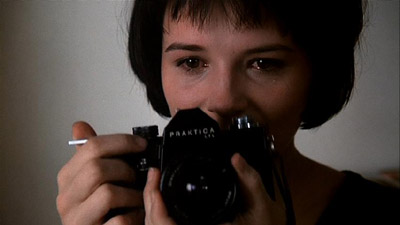
  • Kaufman tells a great story about Stanley Kubrick on the commentary. There's a scene in the middle of the film where Sabina poses nude for Tereza to photograph and vice-versa. It is, as you would expect, pretty remarkable. Kubrick apparently complimented Kaufman on the film in general, and that sequence in particular. Because he was impressed by the vintage Praktica LTL camera that Tereza uses to photograph. Only Kubrick would see something like this:

    and find his eye irresistibly drawn to the camera. (By the way, the camera isn't just vintage, but anachronistic; the Praktica LTL didn't start production until December 1970—and yes, I'm just the kind of dork who would try to answer Kubrick's question—but I sure wasn't thinking about it while I was watching the movie).

  • Worst pun you could make when writing about a Kundera adaptation that, despite being unfaithful to the novel, is still a very good film: "C'est magnifique, mais ce n'est pas Kundera!" Thank you, thank you, I'm here all week.

Sunday, April 23, 2006

#54: For All Mankind

For All Mankind, 1989, directed by Al Reinert.

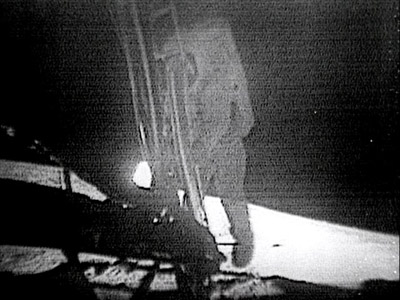
In the "America in the 60's" montage that used to play in my head when someone mentioned the era, the moon landing got about five seconds. And you know exactly what five seconds they were; the blurry television feed we've all seen of Neil Armstrong dropping the last few feet to the moon's surface.

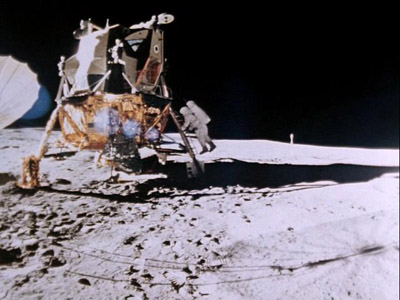
Altamont got more screen time than Neil, because Gimme Shelter isn't grainy video footage. But it turns out that the astronauts shot on film, too, and For All Mankind is Al Reinert's painstaking compilation of that footage. Here, for example, is a still from the movie of Alan Bean taking his first steps on the moon (during the second moon landing):

That's a little bit better looking, even with the lens flare, no? For All Mankind pretty definitively replaced that grainy footage of Armstrong with much stranger, much more haunting imagery.

Reinert's film is not a traditional documentary by any stretch of the imagination. The movie opens with the following titles:

During the four years between December 1968 and November 1972, there were nine manned flights to the Moon.

Twenty-four men made the journey. They were the first human beings to leave the planet Earth for another world.

This is the film they brought back...

...and these are their words.

That's all the context For All Mankind gives you; there's no stentorian narrator or subtitles identifying who or what you're seeing. Which is still not that strange for a documentary, although it's rare for a documentary about science, history, or both. In a typical vérité documentary, however, the filmmakers usually go for the appearance of unmediated reality; events in the order they actually happened. Reinert's movie isn't like that. Instead of presenting a history of the Apollo program, or profiles of the men who made it happen, his movie is a string of basically contextless images accompanied by sound from interviews with the (unidentified) Apollo astronauts. They've been edited together not in chronological order, but into a sort of composite moon mission, from liftoff to splashdown, that uses footage from all nine missions (and other missions entirely). So, for example, you might see a shot of the Apollo 17 astronauts boarding an elevator and cut to the Apollo 16 astronauts exiting the same elevator eight months earlier. I've never seen a documentary entirely like this one; it's not based on the facts so much as a subjective recreation of a moon mission.

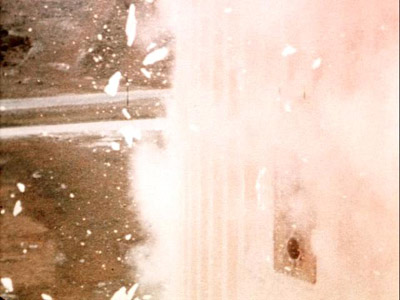
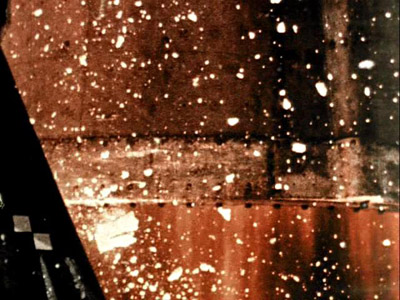
Reinert's style has implications both good and bad. On the positive side of the scale, he is able to use the best possible shots of any stage of a moon mission he wants to show. On the negative side, jumping around in time means there's very little room for character. The astronauts blur into a kind of composite person, as do the NASA employees in Mission Control; there's very little human interest in the movie as a whole. What's strange is that I enjoyed it; my taste in documentaries usually runs to work that's exclusively human interest (Errol Morris, for example). I'll make an exception to that rule in the case of For All Mankind, because the footage Reinert uses is so strange and beautiful. For me, a lot of the pleasure of this movie came from the unexpected details, like the ice falling off the outside of the Saturn V rocket during launch.

In retrospect, it seems obvious that a rocket that carries vast quantities of liquid oxygen and hydrogen would quickly be covered with frozen condensation, but I hadn't put together what that would actually mean until I saw For All Mankind's footage of ice dropping from the rocket into the inferno beneath its engines.

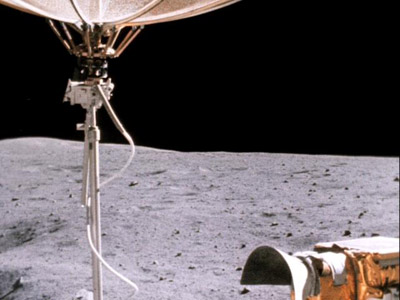
Another obvious-in-retrospect detail is the way lighting works in a vacuum. On Earth, objects have a certain warmth that I guess comes from light hitting the never-wholly-transparent atmosphere. Which isn't something that's noticeable at all until you see film shot on the surface of the moon:

Look at the absolute blackness of the sky in contrast to the brightly-lit surface: this is lunar day. But there's nothing above the surface to diffuse the light, so the sky is pitch black. You can't really see the effect on video footage, but on film I found this combination of harsh sunlight and absolute darkness endlessly fascinating.

More familiar, but just as striking, are the film's images of earth from space. I think everyone's been overexposed to these images, but they're worth reconsidering anew. For example, look at the strange glow the clouds have here:

Perhaps part of the beauty I rediscovered in these images came from seeing them as motion footage instead of stills; perhaps it was Brian Eno's excellent score; perhaps it was seeing them in the context of what it took to bring this footage back. But I found myself moved by even old chestnuts like this shot of the earth (which I saw every day for a year; it was on the cover of one of my high school textbooks):

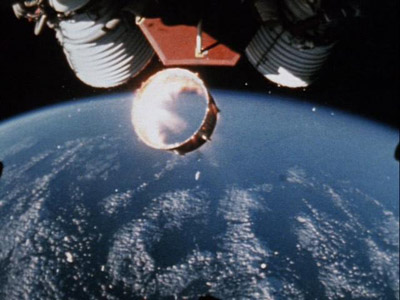
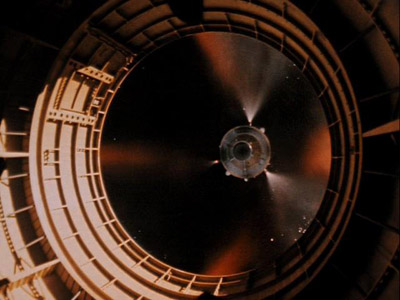
Part of it is certainly presentation; Reinert blew everything up from 16mm to 35mm, and corrected for camera jitter and film speed (it was shot with variable speed cameras, usually at speeds slower than 24 fps). None of these images have ever looked better. And some of them had never been seen before, as in the following two shots of rocket stages separating:

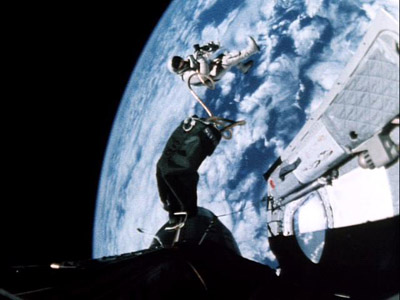
Now that's camerawork even Bruckheimer would have a difficult time recreating. As you can see, in the first shot the camera is outside the top part of the rocket—and in the second shot we're looking up from inside a lower stage as it begins spiraling back to earth. Which raises the question of how this could possibly have been shot; the answer is weirder than the footage itself. The cameras that shot this were designed to burn up on reentry, just like the rocket stages they were attached to, but not before they ejected their heat-shielded, parachute equipped film canisters. The exposed film was then caught in mid-air by C-130 transport planes dragging huge nets behind them. The idea was to let engineers study the film if anything went wrong with staging. Given the exceptional quality of these images, and the extraordinary effort required to bring them back to earth, it seems churlish to criticize Reinert for presenting them as though they are from a moon mission (they're actually from an unmanned Saturn V test flight, as he explains on the commentary).

In fact, For All Mankind is filled with footage that's not what it seems to be: the trans-lunar burn is actually reentry footage, all the spacewalk footage is from Gemini missions, and of course the moon-landing footage was shot on a sound stage in Arizona. Well, I'm just kidding about the last one (I think), but there are enough misrepresentations in the movie to give the people who pick apart Michael Moore's films years of work to do. Reinert points them out on the commentary track, as well as his reasons for using footage from other missions where he did. The spacewalk footage, for example, is from the Gemini missions because those rockets had larger windows (Reinert uses this point in the commentary to rail, amusingly, against the tiny windows on the Space Shuttle). The commentary is interesting, because it's obvious Reinart is remarkably unconcerned with accuracy (even going so far as to stage a shot of the moon through an Apollo command module window). His goal, instead, is to produce something much more subjective than a standard documentary. And that's what the subject demands; we've all seen enough photos from space that only a radical recontextualization like this film can command our attention.

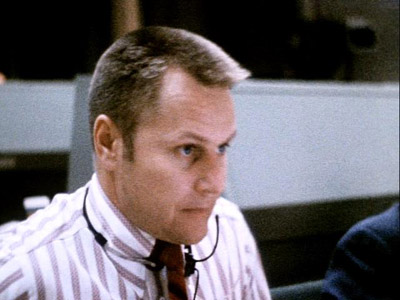
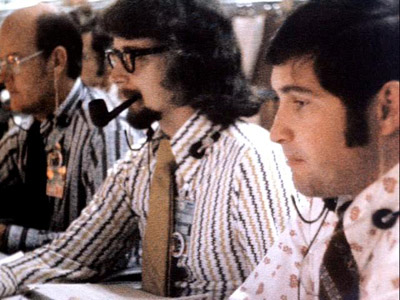
So far, I've written about For All Mankind as though it was as arid and alien as the moon itself. This isn't entirely true. Reinert includes a lot of footage of Mission Control, and interesting human and period details creep in almost despite the way the film is cut. You do see the stereotypical NASA employees with crewcuts, looking sternly at monitors, as in a thousand movies:

But there are things about Mission Control that have somehow not made it into the collective unconscious. For one thing, everyone smokes. For another, the NASA dress code was a little more lax by the end of the program:

Coolest. Mission Control Guy. Ever. The footage of the astronauts themselves is less interesting; once you've seen one guy do a zero-g somersault you've pretty much seen them all. There's an interesting section about the music the astronauts took with them: Reinert includes Buck Owens and Merle Haggard on the soundtrack, with recordings that seem to have been made especially for the Apollo astronauts. Other than that, however, since the film gives you next to no information about the astronauts you're seeing, the sections inside the ship didn't do much for me. And unfortunately, the voiceover doesn't have a lot to recommend it either.

There's one exception, an account of a dream one of the astronauts had about finding a pair of astronaut doppelgängers on the moon, in identical space suits, who'd been there for thousands of years. Reinert pairs this with a particularly haunting cue from Brian Eno, and footage from a rover of the empty lunar surface. It's a moment where the whole film comes together, and you're forcefully hit with the weirdness of the whole thing. Nearly 40 years ago, we shot men in rockets to the moon. Then we stopped. Reinert tells you very little about why we did this. But with such a unique moment in human history, having a record of what it looked like is invaluable. That's what For All Mankind provides.

Randoms:

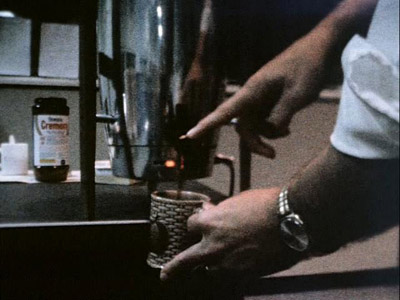
  • All was not fun and games for the bearded, long haired hippies running Mission Control, as this still chillingly reveals:

    Only a space program run by an ex-Nazi like von Braun would feed its employees Cremora.

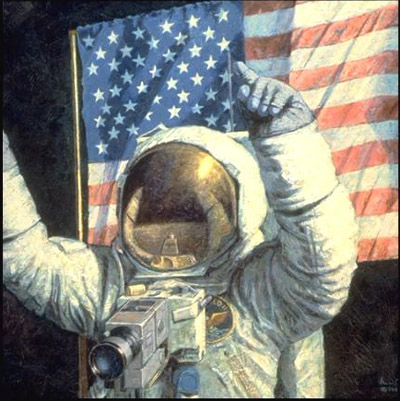
  • For All Mankind has one of the weirdest special features ever: a gallery of astronaut Alan Bean's paintings of the space program. Here, for example, is a painting entitled "America's Team... We're #1":

    The DVD has no fewer than 24 of these paintings, each with audio commentary.

  • The DVD also features launch footage of each of the precursor rockets to the Saturn V. For the record, that's the Mercury Redstone, the Mercury Atlas, the Gemini Titan, and the Saturn 1B. My dad had models of all of these in his childhood room; I hadn't thought of them since I was eleven or twelve, but when I was little I used to love taking apart the stages of the Saturn V model. Not that that's of much interest to anyone but me.

  • There's just a little bit of the Apollo 13 near-disaster in For All Mankind, and like most of what you see, it's presented without context or explanation. Al Reinert returned to the topic later, however; he went on to write the screenplay for Apollo 13 (with William Broyles Jr., from Jim Lovell and Jeffery Kluger's book Lost Moon) .

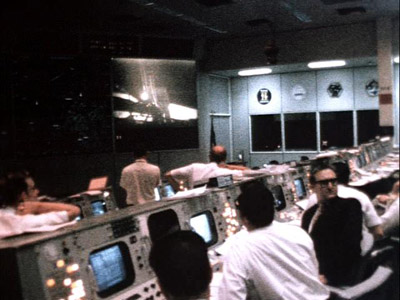
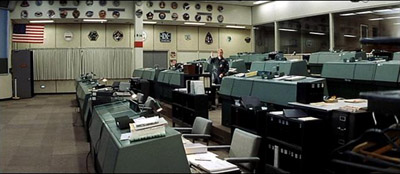
  • For All Mankind is the second Criterion film to use NASA's actual Mission Control room as a location. Here's Mission Control launching men to the moon:

    And here's the same room launching Owen Wilson into the hearts of moviegoers everywhere:

    I'm not sure which mission accomplished more for humanity, but even with Michael Bay at the helm, Armageddon cost less.

Monday, April 10, 2006

#53: Sanjuro

Sanjuro, 1962, directed by Akira Kurosawa, screenplay by Ryuzo Kikushima, Akira Kurosawa, and Hideo Oguni, from the novel Peaceful Days, by Shugoro Yamamoto.

I don't envy anyone who works in film marketing. Most companies have years to build up a customer base and a brand. But a studio might sell fifteen different movies in a year, and the marketing department has to build an audience out of nothing for all of them. It's no wonder that sequels are popular with studios; most of the marketing work is already done for them. Since an audience that has some familiarity with the original film knows pretty much what they can expect from the sequel, advertising campaigns have less work to do. So it's rare that a sequel varies much in tone from the original movie; it's counterproductive. (For a recent example of why this is a bad idea, take a look at Son of the Mask). Sanjuro, the sequel to Yojimbo, is an exception to this rule. Yojimbo is a dark comedy; it has its moments of levity but you can still see its roots in hard-boiled fiction. Sanjuro, on the other hand, is nearly a straight comedy. The difference in tone comes from the fact that the sequel is an adaptation of a novel that had nothing to do with the original. Kurosawa had been working on an adaptation of Peaceful Days when Yojimbo succeeded—at the studio's request, he rewrote it with the Sanjuro character from Yojimbo at its center. It was released only eight months after the original; I don't know when the decision to make a sequel was made, but this must have been a very fast production. So it's not too surprising that some of the seams show.

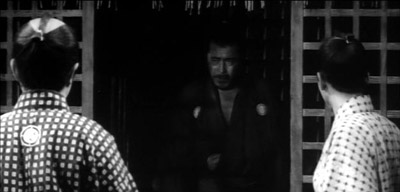
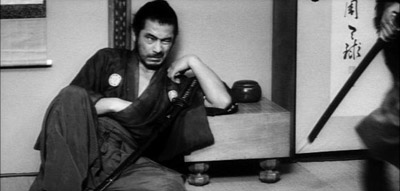
The marketing department aren't the only people who can take shortcuts in the sequel. Because the audience already knows the characters (or in this case, the character), the filmmakers can spend less time on exposition. I wrote earlier about how the opening credits of Yojimbo go out of their way to impress viewers with Sanjuro's heroic stature. Kurosawa needed to do this work because for most of the rest of the movie, Sanjuro doesn't seem particularly heroic. In Sanjuro, however, the audience already knows Mifune's character, and is waiting for him to show up. So the movie opens in a way that would have been suicide if this were the first in the series: with a lengthy conversation, without context, between nine samurai about their local government's corruption. Four dull minutes later, Mifune swaggers out of the shadows behind them. The effect is something like a recurring character on a sitcom entering to canned audience applause.

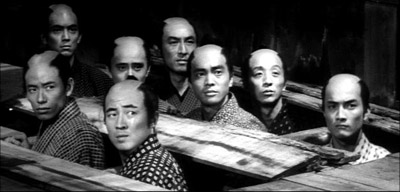
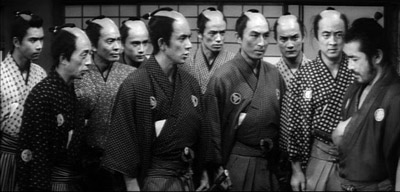
In Yojimbo, a large part of the suspense was waiting for Sanjuro to start acting like a hero. In the sequel, Kurosawa doesn't spend any time on this; the movie opens with Sanjuro saving the life of the nine hapless samurais he's overheard. And when I say "hapless," I mean it:

They don't exactly project an air of competence. For the rest of the movie, Sanjuro does his best to keep these guys alive, despite their almost limitless ability to screw up. Where the comedy in Yojimbo came from Sanjuro's ruthlessness, Sanjuro depends on the physical humor that comes from these nine stooges. They move and react as a group, and a great deal of the movie's appeal rests on Sanjuro's reaction to their incompetence. That reaction is pretty well encapsulated in the following still, from their first surveillance mission:

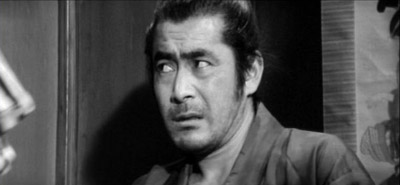
Yes: they seem to cause him physical pain. Depending on whether you believe the subtitles in the film itself or in the trailer, he's either telling them that they can't walk around like a centipede, or criticizing them for following him like dung follows a goldfish. Either way, he's not happy. Another highlight is a mini-montage of Sanjuro trying to sleep while the samurai keep giving each other updates on the movements of their enemies. There are a lot of great reaction shots of Toshirô Mifune looking unhappy to have been awakened, but here's one of the best:

There's something about a hero that's not a morning person that's immediately appealing to me. At the end of that sequence, the samurai come up with a half-baked plan to capture their enemies; Sanjuro's response ("Not a good idea. But it may keep me awake.") is for the ages.

Sanjuro isn't just different in tone and structure from Yojimbo. In Yojimbo, Sanjuro is a little morally better than the men he is killing, but they all seem to operate from more or less the same position of ruthlessness. In Sanjuro, in contrast, the nine hapless samurai are very good at observing the formalities of honor, which is continually compared unfavorably to Sanjuro's slovenly appearance and rude behavior. Also, Sanjuro looks at least a little bit at the psychological cost the main character pays for his status as outcast. Here's Sanjuro's reaction to a group of prostitutes dancing from Yojimbo:

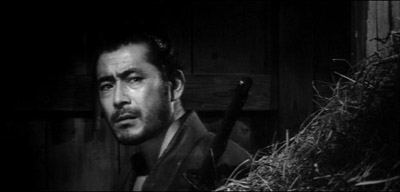
A still doesn't capture it, but alarm and distaste both come to mind. Compare that to the longing and curiosity he displays in Sanjuro, observing two women laughing with each other:

There's real pain there. What's more, in Sanjuro, Mifune's character genuinely regrets killing when he doesn't have to; he's furious when the incompetence of the samurai he's protecting means he has to slaughter a room full of guards (and the killing itself is treated differently—he's shown chasing down men hiding behind doors and whimpering). Compare that to the man who kills three gamblers without provocation as sort of a job interview in the first movie.

Strangely, most people seem to write about Sanjuro as though it were psychologically less interesting than Yojimbo. As best as I can tell, this stems from two things. First, the minor characters in Yojimbo are all morally compromised, whereas in Sanjuro there are several characters who are trying to do the right thing. But to this I would argue that all the characters except for Sanjuro himself are cartoons, in both films. So the movie where he has some doubts and regrets about the path he's chosen seems realer to me.

The second reason is something that has always driven me slightly mad about film criticism: the closer a movie is to a comedy, the less likely it is that critics will allow that it has anything of value to say about the human condition. Sanjuro is more lighthearted than Yojimbo; ergo Yojimbo is the better movie. To paraphrase Martin Amis, if a movie isn't funny, it must be serious. This has always struck me as ludicrous, but I can find no other explanation for people who believe that Crash is a more insightful movie than The 40-Year-Old Virgin. The difference between Sanjuro and Yojimbo isn't that great, of course. And Sanjuro has its own problems—the structure is just kind of one-thing-after-another, the nine samurai are completely indistinguishable, it's hard to keep track of the plots and counterplots. But Mifune's character seems more complicated and interesting to me in this film than in Yojimbo. And you can't ask much more from a quickie sequel.

Randoms:

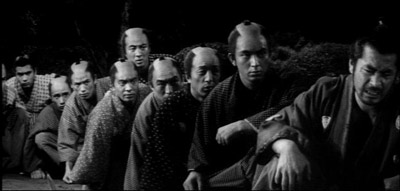
  • As you can imagine, having nine samurai (ten, counting Sanjuro) on screen simultaneously poses unique problems of composition. Kurosawa always sets Sanjuro apart from the others; look how immediately your eye is drawn to Mifune in this shot, for example, just by making him face the other direction:

    You can also get a since from this shot of just how indistinguishable the nine samurai are; it's interesting to compare this to Seven Samurai, where Kurosawa makes a large group of characters unique and distinguishable. Of course, he takes two hours longer to do this, and the Sanjuro movies are really unconcerned with characters other than Sanjuro himself. In any event, if you're a cinematographer looking for unique ways to draw the eye to one person in a large group, this movie is worth studying carefully.

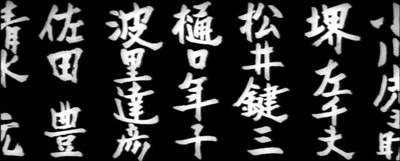
  • Given how important composition is in this film, it's incomprehensible to me why Criterion would crop the image. But they did. If you look at the still above where Mifune is followed by the other nine samurai in a line, you can see that part of his face is missing, and only eight of the other samurai are visible. I'm not certain that the ninth samurai is actually in the shot, but I am quite sure that they've botched the transfer. For one thing, the aspect ratio comes out to about 2.08:1, not 2.35:1. For another, take a look at these opening titles:

    I'm no expert in Kanji but it looks to me like parts of the image on the left and right are missing (the missing image on top and bottom is my own cropping error; black titles + black letterboxing = mistakes!). Of course, at the time they did the transfer, apparently the only available version was fullscreen, so it's definitely an improvement. But here's hoping Criterion redoes this transfer at some point in the future. (Update: They did).

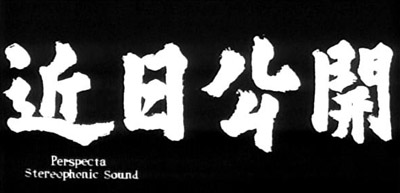
  • And while I'm complaining about the quality of the DVD, its technical specs list it as Dolby Digital Mono, while the trailer promises "Perspecta Stereophonic Sound."

    Which is it, mono or stereo? (Update: It turns out it was a little of both. Perspecta was a mono-to-simulated-stereo system that went out of use in the states by 1957. You can read more about it here).

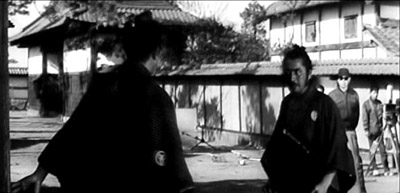
  • The trailer bears one earmark of a quickly thrown-together sequel: production footage instead of actual footage from the film. This would probably have been done when scenes had not yet been edited. I believe Kurosawa is the man in sunglasses in this shot.

    The crew's clothing is a little jarring behind the samurai garb in the foreground.

  • I won't spoil the surprise with a still, but watch for a shot of spurting blood that makes Tokyo Drifter look understated. Actually, it makes Dead Alive look understated.

  • Adapting a previously-written script to become a sequel is not as rare as you might imagine. The most recent example (which I have not seen) is Saw II, which was a script that had been turned down all over town for being too much like Saw, until the Monday after Saw opened. A few drafts later they were ready to shoot... and cinematic history was made!

Monday, April 03, 2006

#52: Yojimbo

Yojimbo, 1961, directed by Akira Kurosawa, written by Ryuzo Kikushima and Akira Kurosawa.

I've always had a sentimental affection for antiheroes, from Nic Cage's Yuri Orlov straight back to Milton's Satan. It's no surprise, then, that I enjoyed Yojimbo, Akira Kurosawa's skillful fusion of archetypes from gangster movies and Westerns. Toshirô Mifune plays Sanjuro, a samurai with no master, and from the first shot, you know he's going to be something of a Byronic hero.

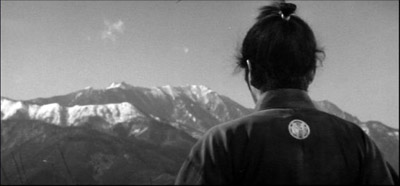
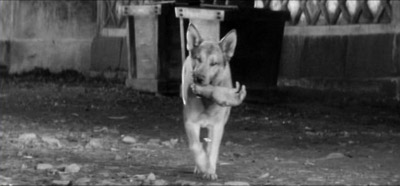
Kurosawa follows him with the camera from behind all through the credits. He towers over the mountains! To gaze upon his face is to gaze into the abyss! And so on. By the time he turns around, he's gotten the heroic stature he'll keep throughout the film. Which is not to say he's a conventional hero. At the film's opening, he more or less randomly wanders into a town with, shall we say, something of a violence problem. Townspeople watch him walk down the main street from behind windows, but no one's outside. No one, that is, except for the happiest dog in the world, bounding down the street:

Yes, that's a human hand. And yes, David Lynch stole this for Wild at Heart. The great thing about the dog eating the hand is this: it's a joke. One person jokes about it briefly afterwards, but that's it. As far as I could tell, you never see whoever had their hand cut off. It seems Tarantino didn't completely invent referenceless violence.

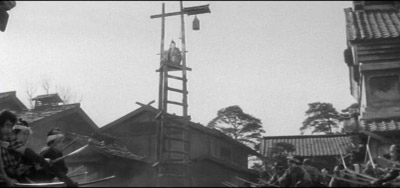
In the samurai movies I've seen so far, where there's a town in trouble, bandits can't be far behind. Yojimbo is different; the town is tearing itself apart. There are two warring groups of criminals, and nearly everyone is associated with one or the other (the two exceptions are a man who runs a restaurant of sorts, and the coffin-maker). Rather than trying to save anyone from anything, Sanjuro sticks around because, as he puts it, "In this town, I'll get paid for killing. And this town is full of men who'd be better off dead." Then he gleefully plays both sides against each other for his own profit. You can see visually what he's up to here:

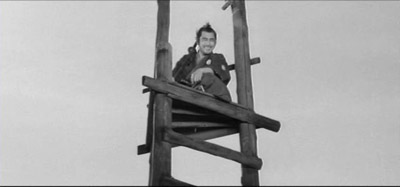
That's Sanjuro at the top of the tower, watching both sides preparing to kill each other (they don't--they're interrupted). And you can see how he feels about the prospect of observing this kind of slaughter in closeup:

He could be watching the best circus in the world. As you can see, he's not a hero in the Shane mold, the kind who's slow to rile, but uses violence when absolutely necessary. This is a man who introduces himself to the townspeople by killing three men for no good reason; he resorts to violence early and often, and he takes genuine pleasure in it.

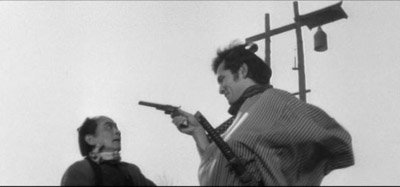
Things go according to his plans for the first half of the movie (which is to say, both factions gear up to annihilate each other and offer him increasing amounts of money to side with them), until the unexpected arrival of Unosuke, a more valuable fighter than Yojimbo. See if you can figure out why he's such a terror on the battlefield:

I'm not sure why Unosuke has a sword as well as a revolver, but as you can see, Sanjuro's swords are outclassed. Is Unosuke an honorable fighter, there to remind Sanjuro of the ideals he betrayed by becoming a mercenary?

Not so much, it turns out. Unosuke complicates the balance of power, but he doesn't add any moral complexity. The rest of the movie more or less follows traditional stereotypes of the Western: Sanjuro, against his better judgement, helps out a poor family; this act of kindness leads to his capture and torture, until he escapes and takes on his enemies in a showdown in the town's main street. The difference here is that by the time Sanjuro defeats his enemies, everything of value in the town has been destroyed, and the population is down to three citizens, all old men (Sanjuro surveys the situation and says, "Now it'll be quiet in this town"). It works as a Western or a black comedy—take your pick. As Bowsley Crothers pointed out at the time (calling it a "forthright travesty"), the only thing it's not is a samurai movie; there's nothing Japanese about it except the cast and crew.

Yojimbo may be predictable, but a movie built around a Byronic hero like Sanjuro doesn't need to have a fresh plot to succeed. It just needs to make sure that its antihero is fun to watch. Toshirô Mifune's performance is truly exceptional, and saves the movie. He has a kind of lazy cool about him that owes more to gangster movies than Westerns. Check out his expression below: the man closest to him has just said, "Kill me, if you can!"

Mifune chews on his toothpick, looks at him with the "are you sure?" expression you see in the still, and deadpans, "It'll hurt..." The man draws his sword, Sanjuro shrugs his shoulders, remarks, "No cure for fools." Then he kills the man and two of his friends. And a new screenwriting cliché was born, the "action-hero-wisecrack-before-slaughtering-enemies" so beloved of the Die Hard movies. I suppose it's unfair to blame Kurosawa for John McClane (though it would make a great dissertation). Mifune's performance is such swaggering fun you can forgive Yojimbo its excesses, its cartoonish characters, its unlikely plot turns. The pleasures this film has to offer are all on the surface; no one will ever call it insightful or penetrating. But if you're willing to spend a few hours coasting on the surface of things, you could do worse than watching Toshirô Mifune destroy a town for fun and profit.

Randoms:

  • Donald Ritchie believes this is the best photographed of all of Kurosawa's films. There are a lot of striking compositions, most having to do with objects in both foreground and background. Here's a shot that struck me: the head of one of the warring factions, his wife, and their son are arguing. Look how claustrophobic he makes the normally expansive 2.35:1 frame here.

    The cinematography is by Kazuo Miyagawa, who also shot Rashomon.

  • While we're on the subject of Miyagawa, his C.V. includes a movie called Zatôichi to Yôjinbô (Zatôichi Meets Yojimbo), which would appear to be in the tradition of the Godzilla movies (or the Abbott and Costello ones, for that matter), pairing heroes from past films. Toshirô Mifune apparently reprises his role from the original Yojimbo, although this time his character is named "Sassa" instead of Sanjuro. Zatôichi, by the way, was a blind swordsman played by Shintarô Katsu in at least 25 films and a television series. It sounds pretty shameless—has anyone seen it?

  • It's not unusual for a trailer to have footage that doesn't end up in the final film; trailers are usually cut before the film is locked. But the trailer for Yojimbo seems to have footage from a complete alternate version of the final scene. In the finished film, Sanjuro faces off against all the surviving bad guys, who approach him in a large group:

    But in the trailer, the same footage of Toshirô Mifune is paired with shots of Tatsuya Nakadai approaching alone, like this:

    This makes it appear that the final standoff is a one-on-one contest between Sanjuro and Unosuke. And the trailer ends with this Great Train Robbery shot, which I also don't remember being in the final film:

    It looks like Kurosawa shot an alternate version of the final fight—and I can only imagine he did it exclusively for the trailer, since it wouldn't make sense to have Unosuke alone in this scene.

  • Yojimbo has pretty culturally varied ancestors and progeny. Kurosawa was supposedly inspired by Red Harvest, a Dashiell Hammet novel in which the Sanjuro character is a detective playing gangs off each other. Kurosawa set it in Japan, Sergio Leone set it in the west (as A Fistfull of Dollars) and Walter Hill set it back in gangland territory for New Line Cinema's Last Man Standing. Apparently there's something about setting up evil people to kill each other that transcends cultural differences.