Sunday, January 02, 2011

#103: The Lady Eve

The Lady Eve, 1941, written and directed by Preston Sturges, from a story by Monckton Hoffe.

It's nearly impossible to write about The Lady Eve without violating Richard Brody's dictum that "the past should be used to nourish the present, not bludgeon it." In the general case, I think Brody's skepticism toward the TCM Industrial Complex is salutary: nostalgia for classical Hollywood cinema is usually more tribal signifier than reasoned aesthetic.1 Unfortunately, this isn't the general case, it's The Lady Eve, so please forgive me some light bludgeoning. I grant that Preston Sturges films depend on social mores that we're well rid of, but of all the films I saw in 2010, the only one that gave me more pleasure than The Lady Eve was Trouble In Paradise. Well, it's no shame losing to Lubitsch.

The world isn't exactly waiting with bated breath for another essay about how witty, humane, and generally hilarious Preston Sturges movies are, and adding my voice to the chorus seems about as useful as trying to find something totally new about Silas Marner.2 So, yeah, The Lady Eve is phenomenal: if you're looking for an appreciation of what's so great about it, I recommend starting here and moving on to, well, basically every other word anyone's written about it. If you're interested in how the film works, this is on point, and this is definitive. Adding my own words to the pile feels like proudly showing a professional con artist how to palm a card.

If by some misfortune you haven't yet seen The Lady Eve, I think giving the film-critic-Cliff's-Notes version here would be doing you a disservice, and urge you to watch it as soon as possible. But to continue my tradition of deferring to better critics, here's the plot in haiku form, courtesy of Matt Zoller Seitz3:

A snake expert and
A hustling Eve find love in
A shipboard Eden

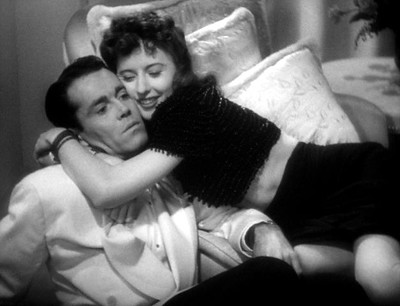
And here's the film in a single image:

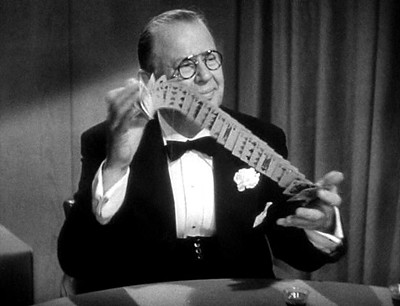
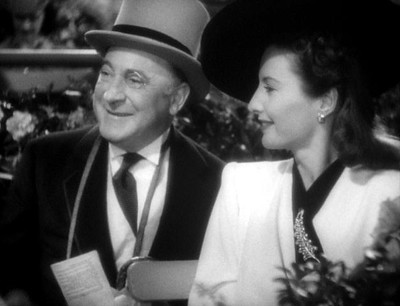
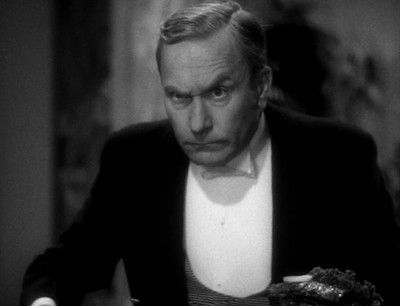
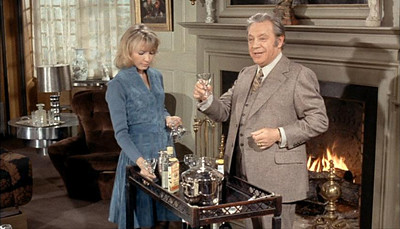
The one thing I will say is that Stanwyck and Fonda are so good in this film that too little attention is paid to supporting performances that, in any other movie, would be scene stealers. So raise a glass of Pike's Pale Ale to Charles Coburn:

Eric Blore:

William Demarest:

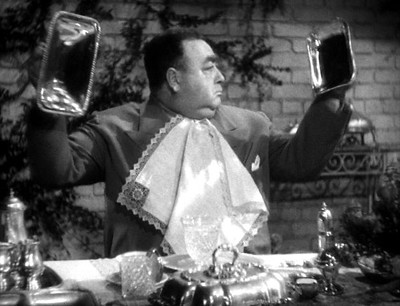
And especially Eugene Pallete, who has a pretty deep voice for an infant:

I'll stop before this turns completely into an episode of The Chris Farley Show. Tune in next week, when we'll confront the mountain of critical work that has undoubtedly already been written about Masahiro Shinoda's beloved Bunraku puppet-play adaptation Double Suicide!

Randoms

  • Eugene Pallette is probably the only actor who appeared in silent films, and talkies, and set up a private "mountain fortress" in Oregon to wait out the coming nuclear apocalypse. If he'd lived long enough, he would undoubtedly have been stunt-casted in Dr. Strangelove and The Terminator. (Also, Wikipedia, in the future, please remove the Cheetos wrapper from the Hollywood Walk of Fame star before you take the picture).

  • Eric Blore's appearance in The Lady Eve is a good enough pretext for me to urge you to watch Top Hat and Swing Time, both of which are wonderful. Or to be more precise, wonderful, with the exception of the blackface sequence in Swing Time.

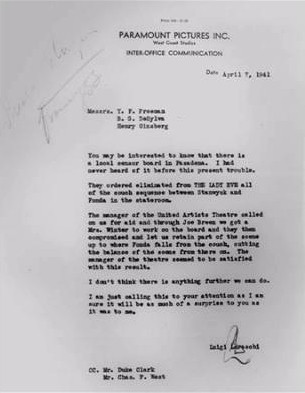
  • You may be interested to know that there was a local censor board in Pasadena.

    They had about as much taste as you would imagine, since they apparently tried to cut "all of the couch sequence between Stanwyck and Fonda in the stateroom." If you saw The Lady Eve in 1941 in Pasadena, it's time for a second viewing.

1With the exception of the Janeites, there's no analog in the world of literature. The difference, I think, is marketing: as soon as Turner showed the studios how to extract money from their libraries, they've been selling the idea of Hollywood's Golden Age relentlessly. Any day now, they're going to resurrect Photoplay.

2Does anything evoke the mid-nineties as immediately as setting the "key passage" of Dunst's paper in Chicago?

3In addition to his brilliant video essays and prodigious writing for Salon.com, on Fridays Zoller Seitz writes haikus on topics chosen by his Twitter followers. He doesn't really need to—it's just virtuosity.

Monday, November 01, 2010

#102: The Discreet Charm of the Bourgeoisie

The Discreet Charm of the Bourgeoisie, 1972, directed by Luis Buñuel, written by Luis Buñuel and Jean-Claude Carrière.

It's a truism that the 1970's were a golden age for mainstream recognition of difficult films. But if you want to really demonstrate to someone exactly what that means, don't sit them down in front of Mean Streets or The Conversation. Put in The Discreet Charm of the Bourgeoisie and tell them that the Academy of Motion Picture Arts and Sciences—the same stodgy, conservative voters who chose Ordinary People over Raging Bull just a few years later—named The Discreet Charm of the Bourgeoisie Best Foreign Language Film of 1972. It's impossible to imagine it even getting distribution today.

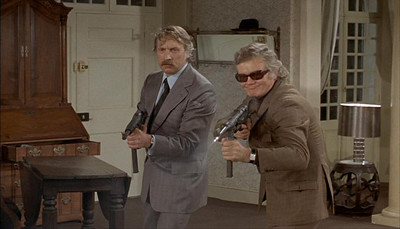
If you had to, maybe you could sell it with a clever bait-and-switch trailer, because stripped of tone and context, the onscreen events don't seem that far from, say, The Secret in Their Eyes. Consider the following plot points. The minister of a corrupt South American country uses his diplomatic pouch to smuggle cocaine. One revolutionary is dragged off by the secret police; another is tortured with an electrified piano. A young boy poisons his stepfather's nightly glass of milk. A priest gives a dying man absolution and then shoots him in the head with a shotgun. One dinner party ends with a duel, the next with the guests lined up against the wall and machine gunned. And there are more dreams-within-dreams than Inception. But because this is Buñuel, the only thing anyone wants to talk about are their dinner plans.

It's hard to imagine for a film with so many events, but The Discreet Charm of the Bourgeoisie doesn't have much of a plot—or to be more precise, there isn't any causal relationship between one event and the next. To be clear, Buñuel does have something on his mind here: no matter how loosely connected and absurd the film's sequences may be, they are all thematically linked. Each section of the film is built around a failed attempt by the main characters to eat dinner together, and each meal is interrupted by something good members of the striving classes don't discuss at the table: death, sex, religion, crime, the military. And, of course, South American death squads.

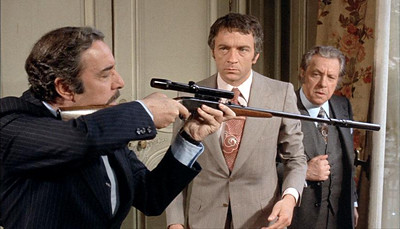
Strivers denying their animal natures—that's the kind of thematic material that could quickly become boring and pretentious, especially in a film as uninterested in Hollywood narrative conventions as this one. But Buñuel manages to avoid this with a remarkably deft comic touch and precise control of the film's tone, which is never strident or humorless (nor, on the other hand, too forgiving). Consider the scene where Don Rafael Acosta—representative of South American kleptocracy Miranda—pulls out a sniper rifle and starts taking potshots at a young woman out his office window.

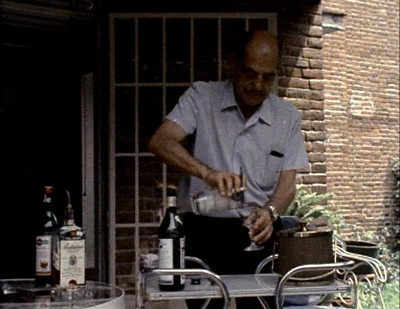
Fernando Rey plays Acosta; the other bourgeoisie in that shot are Jean-Pierre Cassel (Vincent's father) as Henri Sénéchal and Paul Frankeur as M. Thevenot. In a pretentious version of Discreet Charm, Sénéchal and Thevenot would be unmoved, or would enthusiastically help Acosta out. In Buñuel's version, they're a little put out and concerned, but only a little—they're certainly not going to make a fuss about it. That's the tightrope Buñuel successfully walks in scene after scene: as horrible as his characters are, he's not unsympathetic. After all, how can you hate people who make such wonderful Martinis?1

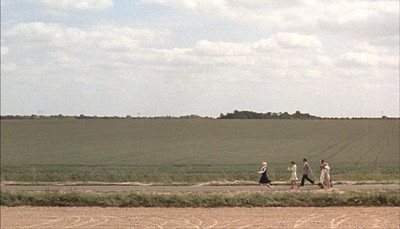
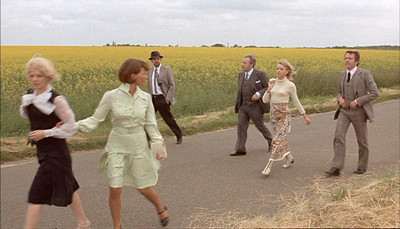
A little sympathy is the difference between an effective satirist and a strident bore, and the film as a whole is a useful reminder that the opposite of "funny" is not "serious." Between failures, social humiliations, duels, murders, gardening, and garden variety adultery, Buñuel repeatedly cuts to shots of the principal cast walking down the road through open countryside.

The film's Wikipedia article says that in these shots, the characters are lost and wandering, but I don't see it. They're always moving at a good clip, lapping the miles, never moving backward, devouring the future like locusts. No one in The Discreet Charm of the Bourgeoisie would ever see The Discreet Charm of the Bourgeoisie. Guess who's running the studios?

Randoms

  • I'm going to be much less wordy going forward, at the cost of being less thorough. The whole point of this project, for me, was to see a lot of great movies, and one a month isn't going to cut it. So I'm certain there will be many things I leave out (nothing here about the film's women, all of whom are marvelous—especially Stéphane Audran's steely hostess? For shame!) Perhaps we can discuss things in more detail in the comments.

  • The DVD features an excellent documentary about Buñuel's life and work, including his early years bumming around with Dalí and Garcia Lorca. Most interestingly, there's a short film called El náufrago de la calle de Providencia, which has footage of him enthusiastically explaining how to make various cocktails. Apparently he appreciated a good Martini just as much as Thevenot.

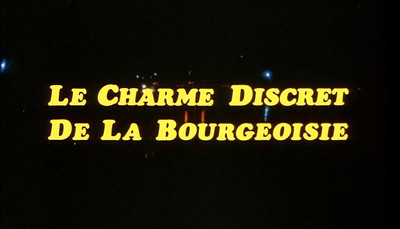
  • It seems that Cooper Black was the Trajan of 1972 (or at least the Futura). It's in the opening credits of The Discreet Charm of the Bourgeoisie, and also John Huston's marvelous Fat City. Which is kind of strange if you're used to seeing it on iron-on t-shirts. Here's the strangely inappropriate title screen:

1Or claim to make wonderful Martinis, anyway; I didn't notice him shaking it to waltz time.

Tuesday, October 05, 2010

#101: Cries and Whispers

Cries and Whispers, 1972, written and directed by Ingmar Bergman.

In Harold Pinter's marvelous play Moonlight, a woman tells her terminally ill husband, "Death will be your new horizon." It's the most quietly chilling sentence I know, and it would have made the perfect epigraph for Cries and Whispers. The film is concerned with the business of dying, and not in an abstract way. Harriet Andersson plays Agnes, a woman who is rapidly losing a battle with cancer, and for the first forty-five minutes Bergman mostly makes us watch her die. Her performance reminds you just how much the movies have always lied to us about death: Agnes doesn't have one of those terminal disease where you have a touching final conversation, then drift off to sleep as flights of angels sing you to your rest. She's clearly aware that her body is destroying itself from the inside, and her performance lets you know exactly what that must feel like.

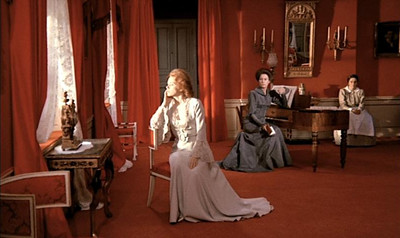
Her battle has nothing in common with a chess game. Agnes is attended by her two sisters, Maria (Liv Ullmann) and Karin (Ingrid Thulin), as well as her live-in maid, Anna. Here they all are, in one of Sven Nykvist's typically soothing compositions:

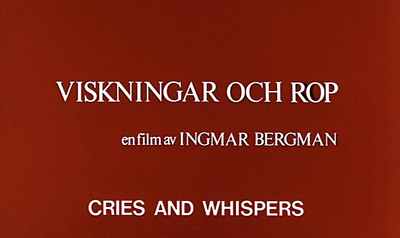
Nykvist uses that jarring, intestinal red throughout the film, starting with the opening titles.

Never underestimate the cumulative effect of an unsettling palette that unsettling. Even without the colors, and even if you got rid of Agnes entirely, Cries and Whispers wouldn't exactly be a cakewalk, because Maria and Karin are so miserable to watch. What, you thought this was going to be a Bergman film where familial relations weren't a swamp of guilt and sorrow? Maria's flagrant affair with a man who despises her drives her husband to attempt suicide, Karin mutilates herself to avoid sex with her husband. And they don't much like each other either. As in Autumn Sonata, their conversations range from landmined to openly hostile. And neither one is willing or able to deal with the exigencies of Agnes's dying. The only person who is at all capable of comforting Agnes is her maid, Anna. It's possible they were lovers; at the very least, their relationship is deeper than is typical for an employer and employee. Kari Sylwan plays Anna as the milky-skinned embodiment of selfless, maternal love.

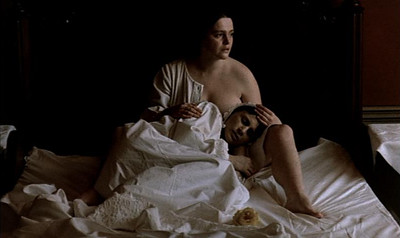
So it's completely appropriate that when Agnes asks for one last act of affection, Bergman quotes the most famous image of maternal love in Western civilization.

You can see in that shot just how painterly Sven Nykvist's cinematography is throughout. The formal, staged, quality of the film's compositions is the only thing that makes the intense on-screen suffering at all watchable; along with the period costumes, it distances the viewers a little from Agnes's pain. A little, not a lot. There's a lengthy shot of Agnes laboring to breathe that is the stuff of nightmares. Speaking of nightmares, Cries and Whispers has a nightmare sequence that, once again, establishes Bergman as the best horror director never to direct a horror film. Sometimes shallow focus can be terrifying.

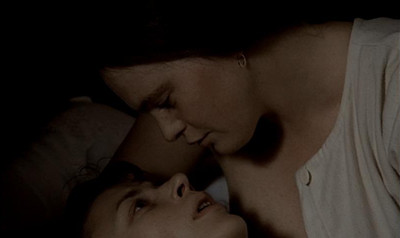
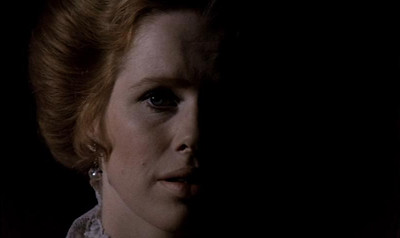
The film's structure is intensely formalized: between scenes of Agnes's death and its aftermath, we get a flashback or dream sequence focused on each of the four main characters. Except for Agnes's flashback, each begins with a closeup of the character's face, strongly lit on one side.

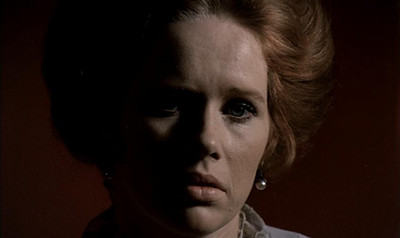
And each ends with a similar closeup, lit from the other side.

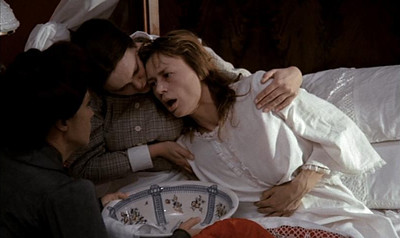
Bergman and Nykvist abstract the actors' faces into something lunar and alien, but by the end of each flashback, we know some of the damage behind their eyes. But only some of it. There's an emblematic scene shortly before Anna's death where, in obvious pain, she tries again and again to throw up into a basin.

No matter how hard she hacks, spits, and heaves, she can't get anything to come up. That's part of what Cries and Whispers is about, something we all know to be true but don't like to think about. The thing that will kill us is the thing we can't get out, the poison in the wound. All we can do is tire ourselves out. And yet that's not everything Cries and Whispers tells us. For all the film's relentless interiority, Bergman ends with a passage from Agnes's diary about a day she was feeling well enough to venture outside with Anna and her sisters.

She writes:

I wanted to hold the moment fast, and thought: "Come what may, this is happiness. I cannot wish for anything better. Now, for a few minutes, I can experience perfection."

Our glory is that we can experience perfection, if only for a few minutes. Our tragedy is that we recognize—even as it's happening—that it's only for a few minutes. The poison is in the wound.

Randoms

  • The film ends with an untranslated intertitle:

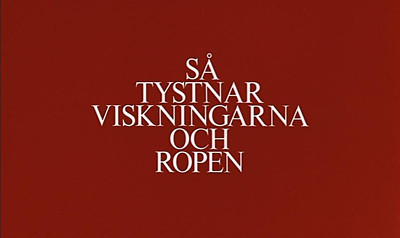
    From what I can tell from googling, it means, "So the cries and whispers become silent." Is that more or less correct, hive mind? Any idea why it wasn't subtitled?

  • The DVD features an interview that Bergman gave along with actor Erland Josephson, which makes him seem like he must have been rather horrible to know in his personal life. Both he and Josephson are remarkably blithe about having mistreated women and been awful fathers, although they're certainly charming in an "incorrigible grandpa" sort of way. I did like one of Bergman's stories: unhappy with the negative reviews a particular critic was giving his work, he apparently cold-cocked him because he knew the critic's newspaper could no longer allow him to review Bergman's work after a public altercation. Diabolical.

Saturday, August 21, 2010

#100: Beastie Boys Video Anthology

Beastie Boys Video Anthology, 1981–2000, videos directed by Evan Bernard, Adam Bernstein, Tamra Davis, Nathanial Hörnblowér, Spike Jonze, Ari Marcopoulos, and David Perez.

The only type of film that gets less critical attention than music videos are commercials, and that's a shame on both counts. For one thing, the consumerist dystopia in The Flowbee Home Haircutting Show is crying out for exegesis. But since Criterion stubbornly refuses to release their long-rumored Popeil Infomercial Anthology, let's talk about music videos.

They were kind of a surprise success. No one would have thought in 1980 that there was about to be an insatiable market for what are essentially short films, but that's what MTV created. In fact, if you wanted to make a short film that had a chance of attracting an audience, they were the only game in town: from "Video Killed the Radio Star" until the creation of YouTube, music videos were the only short films most people saw. (For that matter, since musicals were pretty much an abandoned form during the same period, they were the only place you were likely to see singing and dancing). The low budgets and relatively low stakes meant little interference from the record companies who funded them, so music video directors had freedom to take risks (something that was wholly absent for, say, commercial directors). All that added up to a great training ground for feature directors: three of the directors represented on this DVD went on to work in features, and one of them went on to be a genius. And they all worked with the Beastie Boys.

Full disclosure: I'm a fan. I was squarely in the target audience to appreciate "License To Ill" when it was released, which is to say I was a ten-year-old boy. However puerile their beginnings, by 2000 their sample-heavy music had moved the state of the art forward by leaps and bounds. And with a twenty-year back catalog, Criterion had plenty of music to choose from.

So what did they pick? Let's get the bad news out of the way first. The Beastie Boys Video Anthology does not include Ric Menello & Adam C. Dubin's video for "(You Gotta) Fight For Your Right (To Party!)," the only song that uses as many parenthetical phrases as I do (apparently, they left Def Jam on bad terms). So if you're looking for the most inexplicable pie fight in the history of music videos, you're going to want to head over here. If you can live without the Def Jam stuff, however, every other period of their career is well-represented here (even their punk beginnings).

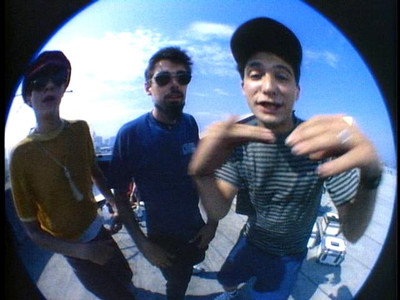
As essential as the Beastie Boys were to the music of the 90's, they're kind of an odd choice for a music video anthology, because the nature of their music makes for strange videos. Any attempt to film them performing vocals means that all three band members be on screen simultaneously, because they all yell certain words in unison. And it should take nothing away from their considerable contributions to music to point out that the Beastie Boys are not the world's greatest dancers, so elaborate choreography is out. The result is that some of the videos on these DVDs seem like entries in a Lars Von Trier experiment: how do you maintain visual interest while filming, basically, the same shot of three people singing into the camera?

Some directors use a fisheye lens, as in "Shake Your Rump:"
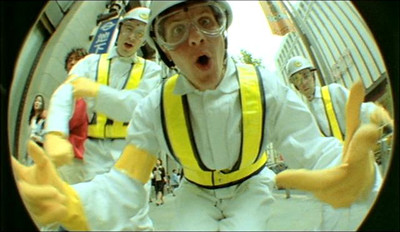
When a fisheye lens isn't enough to keep things interesting on its own, you can add bizarre costumes, as in "Intergalactic":
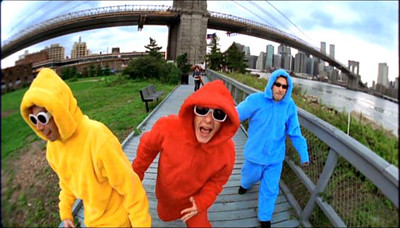
Better yet, use bright colors (and, of course, a fisheye lens), as in this still from "Alive" (2000):
When brightly colored costumes are not available, video effects can be applied to the background, as in "So What'cha Want":
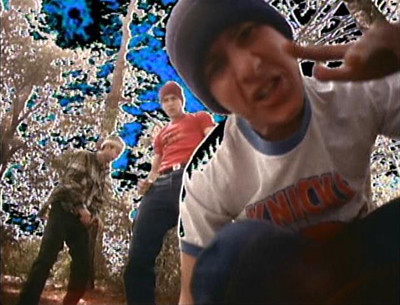
In an emergency, should anything happen to your fisheye lens, you can improvise by filming into a hubcap, as seen in "Pass The Mic":
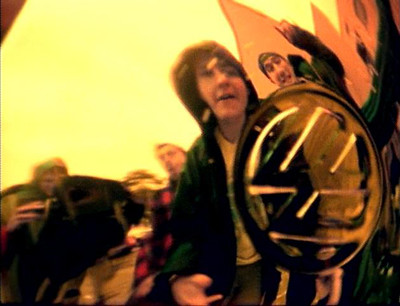
Okay, I'm cheating a little bit: those are all examples from videos directed by "Nathanial Hörnblowér," a mysterious director who looks like David Cross but sounds exactly like Adam Yauch. Hörnblowér loves fisheye lenses. But to be fair, it's not as though Spike Jonze could do much better: this is from "Sure Shot":
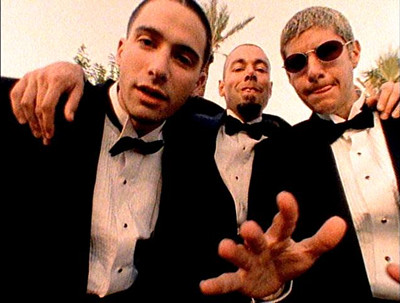
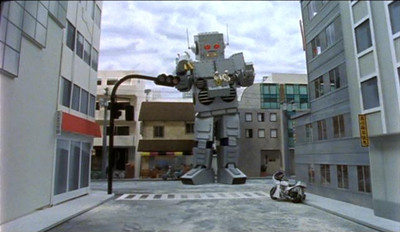
There just aren't that many directions to take this shot, and it's obligatory, at least if you're going to follow the traditional conventions of music videos. Which is why the best examples of music video work in this collection are the ones that don't focus on performance footage. "Intergalactic," despite its fisheye sequences, also features a Japanese-style fight between a giant robot:
And a hapless octopus-creature:
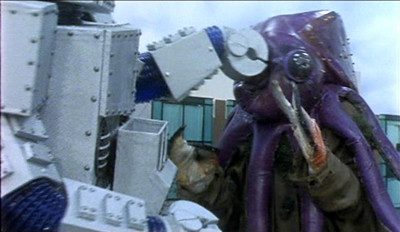
It's not exactly Raging Bull but it beats the fisheye lenses. Better still is "Hey Ladies," an homage to the '70s complete with eight-tracks.
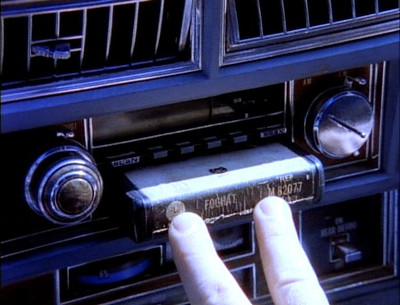
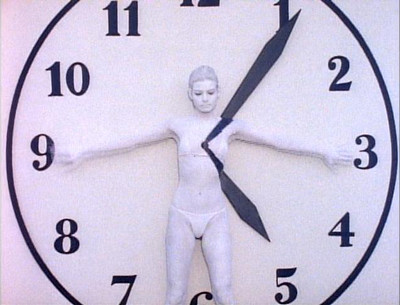
Unless I'm mistaken, "Hey Ladies" also wins the medal for "Most Unexpected Allusion to The Blood of a Poet." Check out the Lee Miller lookalike:
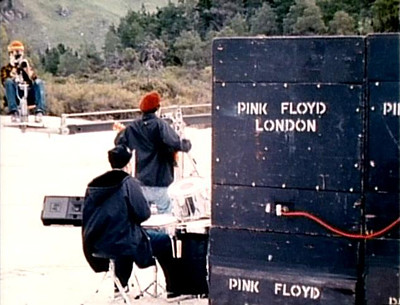
Speaking of homage to the 70's, David Perez's video for "Gratitude" is not just inspired by Pink Floyd: Live At Pompeii, some sequences are a shot-for-shot remake. So if you're wondering why a two-note riff is being treated like the greatest guitar work in human history, remember that the camera shenanigans you're seeing were designed with David Gilmour in mind. To be fair to Perez, he doesn't exactly hide his influence:
Amid all the other music video tropes (the stock military footage video, the skateboarding/surfing/snowboarding footage, the just-wandering-around-Echo-Park-with-a-video-camera video), one video stands head and shoulders above the rest. I bet you know where I'm going with this.
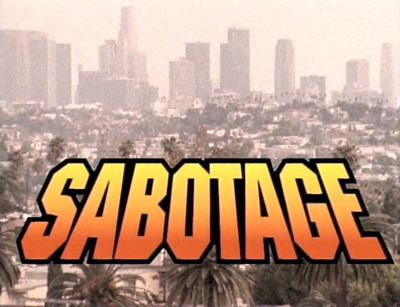
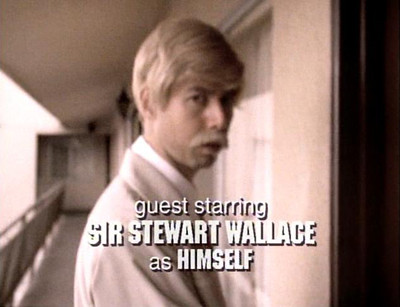
But you're wrong. It's true that Spike Jonze's video for "Sabotage" is hilarious and charming and everything you'd expect from Jonze. Anyone could cut together a faux-1970's cop show, but it takes a bit more to come up with a shot like this one:
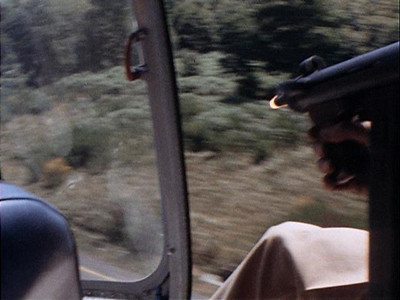
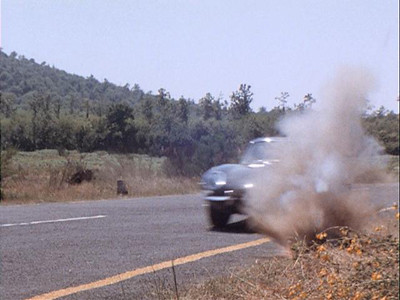
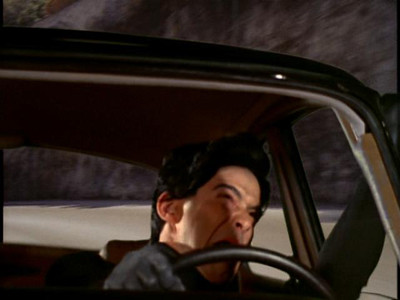
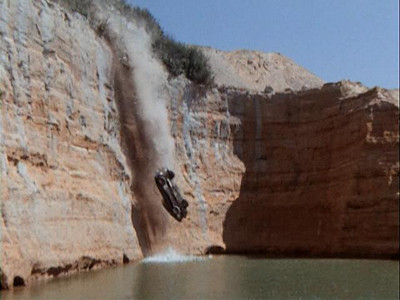
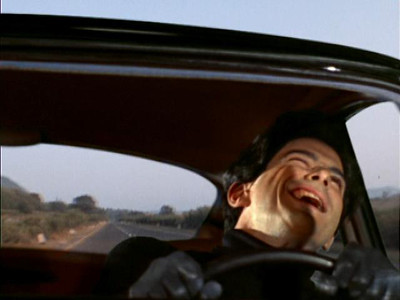
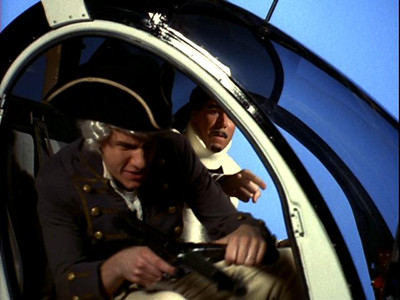
So that's great. But the one masterpiece of the music video form on these DVDs is is "Body Movin'," Nathanial Hörnblowér's magnum opus. There's not a fisheye lens in sight. While watching Mario Bava's 1968 schlock epic Danger: Diabolik, Yauch noticed that its filmmaking conventions presented a unique opportunity. Bava managed the film's stunts by intercutting closeups of the cast with long shots of stuntmen: what Yauch realized, and capitalized on, is that the closeups could be easily and cheaply replaced. Here's how you make it look like Adam Yauch and Mike D are chasing Ad-Rock around in a helicopter:
It doesn't hurt that all the videos action-movie-calisthenics are caused by the heist of a top secret fondue recipe.
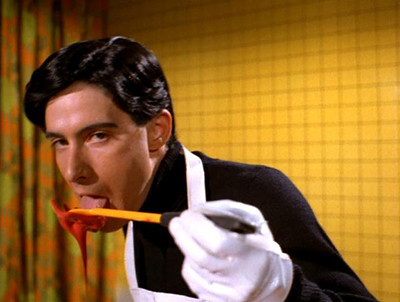
It looks like it was worth it. I don't want to knock the special effects in "Sabotage," because I'm kind of in love with the sequence where they throw a dummy off a Los Angeles bridge.

But you might have noticed Adam Yauch is wearing a neck brace in the helicopter shot above. Here's an earlier shot that explains why:
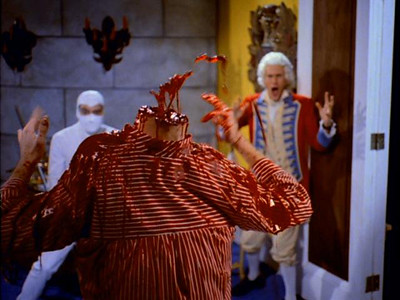
Spike Jonze, I'm sorry, but Nathanial Hörnblowér just took your music videos and sprayed fake blood all over them.

As you can see, even the best videos on the Beastie Boys Video Anthology are not exactly masterworks of Western cinema. Nevertheless, the Beastie Boys Video Anthology is a masterwork of DVD, a format with a great deal of untapped potential. Ask yourself this: when was the last time you used the "angle" button on your remote? Now consider the following menu from "Intergalactic":
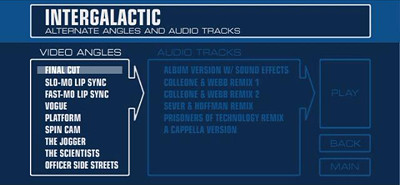
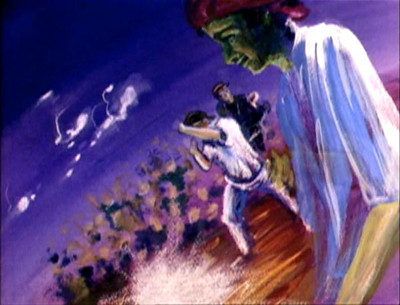
That's nine separate video tracks and six audio tracks. The remixes were done with the constraint that the vocals are still in sync with the original, and although the video tracks must include most of the footage shot during the video's production, the lips are still synched to the sound. So you can cut together your own version of the video on the fly, switching around between different remixes and camera angles with a touch of your remote. That's the theory, anyway. In practice, there's enough of a lag between pressing the "angle" button and picking up the new video track that this isn't as much fun as you might imagine. Still, it's interesting to see how the final cut stitches together the raw footage. Some of the different angles are interesting in their own right: "Shadrach" lets you switch between the original video footage:

And the rotoscoped version that appears in the video:
Most of the videos get similarly extensive treatment. By my calculations there's about nine and a half hours of content on this two-DVD set. Even if you're a Beastie Boys fan, that's an exhausting amount of material, but you've got to admire their thoroughness. But here's the thing: all that content is still on a DVD. You can't (legally) pull the raw video or audio from the disc and make your own version. So this marks the Beastie Boys Video Anthology as a product from a specific historical window, after DVDs were ubiquitous, but before most of the audience had access to video editing software and YouTube. That said, this is the only DVD I know of that uses every conceivable feature the medium makes available, even if it didn't usher in a golden age of DVD authoring. I look forward to a Criterion Blu-Ray that advances the medium further. Come to think of it, now that we are in the YouTube era, there's a whole lot of great filmmaking in desperate need of curation, preservation, and critical assessment. I eagerly await the twenty-angle, 30-audio track Blu-Ray release of "Dramatic Chipmunk."

Randoms

  • The director's commentary tracks on these DVDs feature someone (Spike Jonze? Adam Yauch?) prank calling the other directors, pretending to be an employee of Criterion named Ralph Spaulding, and asking them inane questions. Most of the calls end when Ralph asks the director what they're wearing; in one of them he starts talking about how lonely he is and starts crying. Needless to say, this is one of the greatest commentary tracks of all time.

  • Remember when people thought it was really cool to wear overalls with one strap undone?
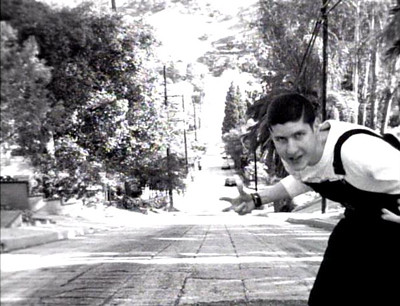
    Mike D does!

  • Unless I'm mistaken, Chloë Sevigny makes a one-frame appearance in the "Sure Shot" video:

    Sassy magazine's most successful intern, at least a year before appearing in Kids.

  • Remember when people thought it was really cool to dress like Captain Marvel?
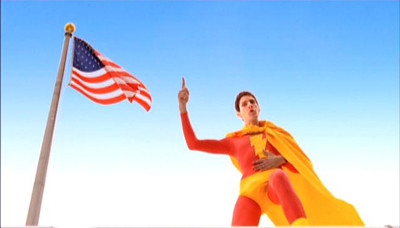
    Mike D does!