Tuesday, August 25, 2009

#93: Black Narcissus

Black Narcissus, 1947, directed by Michael Powell and Emeric Pressburger, screenplay by Michael Powell and Emeric Pressburger, from the novel by Rumer Godden.

Cinema's a multidisciplinary medium. In a perfect movie, all of its various elements would work together toward a unified goal: writing, acting, cinematography, editing, score, and so on. But one can't have everything; even Citizen Kane has its Achilles' heel.1 Black Narcissus is a cinematographer's movie, a director's movie, an editor's movie, a composer's movie, and an actor's movie. It's got eye-poppingly beautiful Technicolor, and at least one unforgettable performance. On the other hand, the film's politics are cringeworthy, and the structure is truly bizarre: for one hour and ninteteen minutes, it's a travelogue/drama, and then it suddenly becomes a German expressionist horror film. It's absolutely essential viewing and an astonishing technical achievement. But a lot of it is pretty hard to watch.

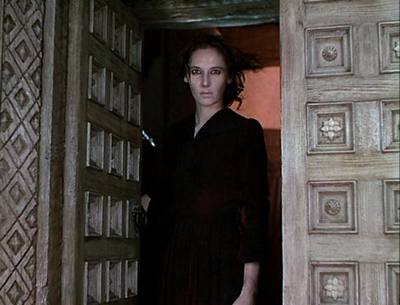
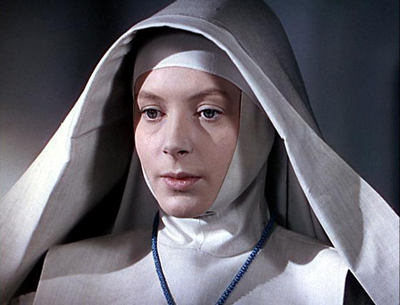
Here's the premise: Deborah Kerr plays Sister Clodagh, one of the whitest, palest nuns in an exceptionally white and pale order. As the movie opens, she is appointed the youngest, whitest, and palest Mother Superior in the history of the order, and charged with establishing a school and hospital in the Himalayas. I'm not exaggerating how monochromatic Clodagh and her order are—the actresses wore flesh-colored lipstick so their lips wouldn't have too much color:
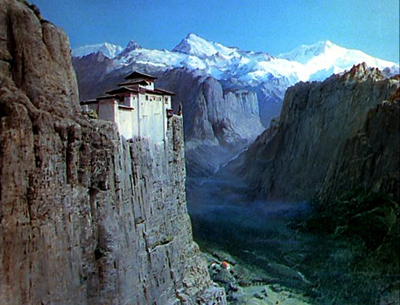
The location for the hospital and school has already been decided: a local general has donated the Palace of Mopu, which looks pretty innocuous when it's just a matte painting:
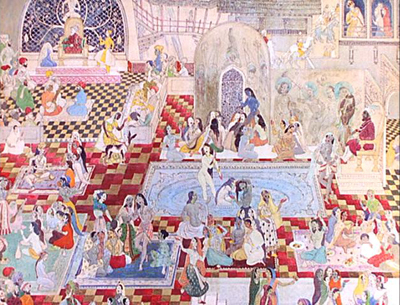
Inside, however, the murals and paintings give a hint of the palace's original function: living quarters for an older general's harem. It looks to have been a stately pleasure dome right out of Coleridge's most vivid opium dreams:

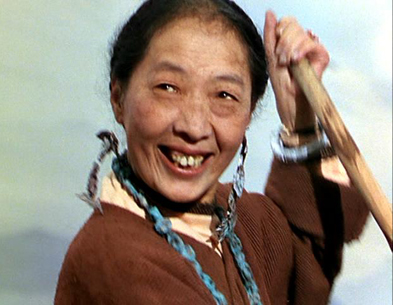
It's not the first time the general's tried to get a religious order to class the joint up; we're told that an order of monks made a go of it but only lasted a few months. The palace comes complete with a supremely unhelpful housekeeper who pines for the old days (May Hallet, looking more Native American than Indian, frankly; maybe there was a mixup in the costume department):

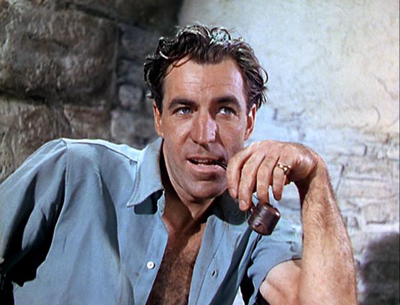
Security, general handiwork, and leering sexual innuendo are to be provided by British Agent Mr. Dean, played by David Farrar.
If you're thinking this might be a bad place for a nunnery, you're absolutely right. If you're also thinking Edward Said would have a field day with this movie, you win the Order of the British Empire. So let's run through it: Said's basic critique of Western depictions of the East was that Westerners infantilized, feminized, and eroticized the East to justify a system of colonial oppression and explotation. Black Narcissus soft-pedals the oppression part of the equation, but it's sure got the rest of it. Infantilization? Well, Powell and Pressburger start out with footage that could be from an Encyclopaedia Britannica 16mm film—happy native peasants, working away:
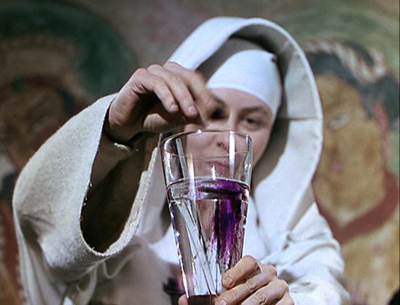
The first time the nuns actually meet the natives, they wow them with a water-to-wine trick that wouldn't play at a five-year-old's birthday party:
And the dialogue makes this explicit; as Mr. Dean puts it:

Well, you must remember, they're primitive people. Like children. Unreasonable children.

That's infantilization. Next on the checklist is feminizing and debasing Eastern masculinity. And no one else in the history of cinema could play a preening man-child like Sabu, who appears here as a self-absorbed general with all the mental acuity of a precocious first-grader. A picture is worth a thousand words:
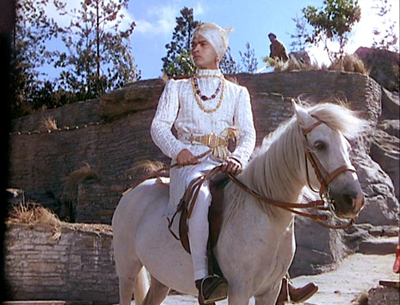
And the film's title refers to a perfume that Sabu's character wears. So there's your feminized masculinity. Last on the list: treating the East as the locus of eroticized, silenced Otherness. Well, how do you feel about Jean Simmons in brownface, eating a papaya?
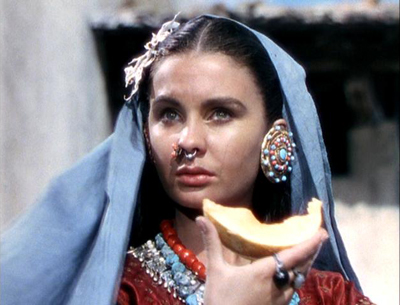
She doesn't have a single line in the entire movie, except when she screams in pain as she's whipped, she's sent to the nunnery because she won't stop trying to seduce Mr. Dean, and you can get a sense of the sexual politics around her character from this shot:
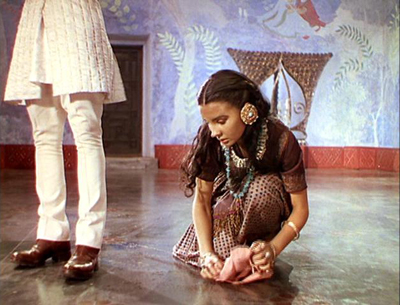
That's Sabu she's crouching in front of; hardly the epitome of masculinity himself. So there were plenty of times in Black Narcissus that I found myself cringing. And yet there are moments when it seems that Powell and Pressburger are in on the sick Colonialist joke. Here's one of the local children helping the nuns give an English lesson:
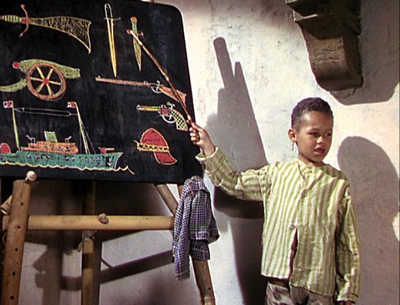
The class repeats after him as he teaches them the words "cannon," "warship," "bayonet," "dagger," and "gun." That's a joke that doesn't seem to be in the novel (at least if Google Books is to be believed). And this is a film that ultimately sees the nun's attempts to civilize the natives as a doomed enterprise. So it's not a classic Colonialist film, like, say, Gunga Din. It's pessimistic about the West's ability to impose order on the East.

Of course, whether you think Western rationalism will defeat Eastern superstition and sensuality or not, as soon as you frame things that way you've given up the game. And Black Narcissus isn't shy about condescending to the East; it's not exactly flattering to decide that the local culture is so hopeless and corrosive that it will destroy any Westerners who try to engage with it.

So why has the movie endured? The cinematography certainly doesn't hurt—this is the most beautifully photographed Technicolor film I've ever seen. But I think most of the film's reputation can be credited to the last act, even though that section represents a dramatic shift in tone.

Over the course of the film, there's a very slow increase in tension between Sister Clodagh and Sister Ruth, mostly caused by sexual jealousy and a mutual attraction to Mr. Dean. With twenty minutes left in the movie, that tension goes completely off the rails, and Powell and Pressburger are suddenly directing a horror film. Despite any problems I might have with the tactic of using India as a blank slate to project the psychosexual conflict between two Western women, the conflict itself is pretty compelling, because of a combination of Kathleen Byron's over-the-top performance and Jack Cardiff's cinematography. To give you some idea, here's Sister Ruth's descent into psychosexual madness in photos:
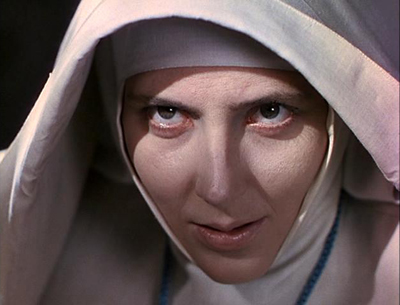
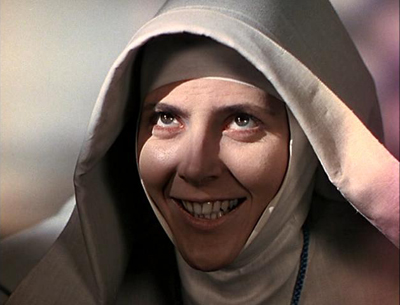
We can stand around and argue all day about whether or not it's a good idea to present female desire as something akin to demonic posession, but it's still unforgettable.2 For those twenty minutes, Black Narcissus is a master class in horror filmmaking.

Unfortunately, Kathleen Byron can't keep stalking around the frame forever, and at the end we're left with a strange mixture: a technically brilliant film that has something more than a little bit rotten at its core. Dave Kehr sees the final shots of the nuns leaving as the rains break as almost a moment of valedictory realism: a farewell to the Raj. I think that analysis misses a rather large point: the nunnery may have been a disaster, but Mr. Dean isn't going anywhere. Just because you can't civilize them doesn't mean they can't pick your tea.

Randoms

  • Black Narcissus opened in the UK in May of 1947; it made its way to New York on Wednesday, the 13th of August. That Thursday and Friday, Pakistan and India became independent nations. So this may have been the last film about the British Empire released before it started collapsing in earnest.


  • For the record, since I've kind of held Gunga Din up as the worst Colonialist film, I should note that whenever Sam Jaffe is off screen, I love it, warts and all. Like Black Narcissus, the good things about it are so good that they almost make up for the terrible parts. By the way, ever wonder why they cast Sam Jaffe in brownface to play the eponymous water-bearer? Sabu wasn't available. No, I'm not kidding—he really was the go-to guy for Indian stereotypes.

  • The DVD includes an excerpt from Painting with Light, a documentary about Jack Cardiff's cinematography. It contains a lot of interesting information about the early days of Technicolor. Here's Cardiff in front of a three-strip Technicolor camera (note the extra wide film magazine: it would hold three reels in parallel).
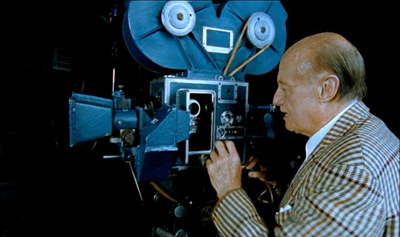
    That's a manageable size for a camera. But here's what the camera looked like when encased in the sound-damping equipment necessary to muffle the noise it made on set:
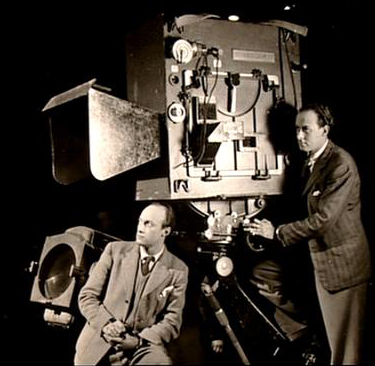
    It's positively cartoonish.

  • For reasons that aren't entirely clear, Painting with Light also includes some color footage of the 110/5 interchange, which was replaced a long time ago with a giant stack interchange.
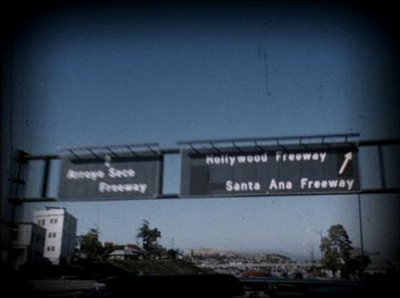
  • The film's backdrops of the Himalayas were created from giant blow-ups of black and white photographs, which the art department colored by hand. The matte paintings are exceptionally good; here's one of the best.

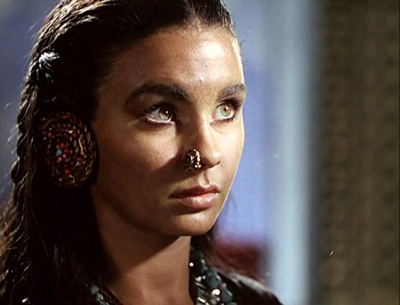
  • I only knew Jean Simmons from Great Expectations and Hamlet. It's unfortunate that the first time I saw her in color, she was in brownface. But I had no idea how lovely her eyes were.
  • Scorsese has nothing but praise for Cardiff's cinematography, for obvious reasons. Here's a shot he singled out for special praise, because of the light on the water. It's from a flashback to Sister Clodagh's civillian life.
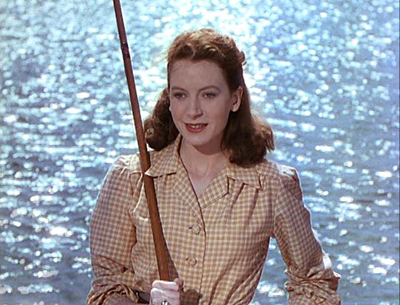
    I certainly agree that the water looks amazing. I also think this shot demonstrates just how perverse it is to cast Deborah Kerr in a Technicolor masterpiece and then hide her hair under a wimple for most of the movie.

  • David Farrar's performance as Mr. Dean is pitch-perfect: he's charming, cynical, overtly sexual, and completely corrupt. I carefully chose the still I used of him in the main essay to highlight the things that are great about his performance. Now, the things that are not so great: his wardrobe and his pony.
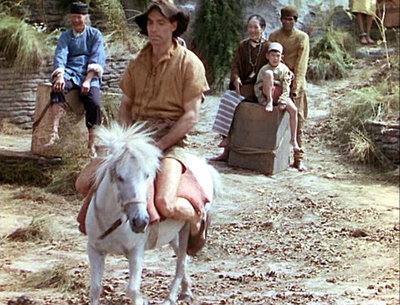
    So let's end with this cautionary photograph from the Journal of Poorly-Explained Haberdashery:

    People of the subcontinent, meet your ruler!

1It's Joseph Cotton's brief turn as "Crazy Ol' Grandpa Leland" in the nursing home scene.

2In our enlightened age, no one would make a movie with a character like Sabu's childlike general. But we keep churning out the Sister Ruths. It's lucrative.

Monday, June 15, 2009

#92: Fiend Without A Face

Fiend Without A Face, 1958, directed by Arthur Crabtree, screenplay by Herbert J. Leder, from the short story "The Thought Monster" by Amelia Reynolds Long.

Some movies are brilliant from the first frame to the last. Some are irredeemable drek all the way through. And some have flashes of greatness. Fiend Without A Face falls into the last category, although it's not so much a flash as a splatter.

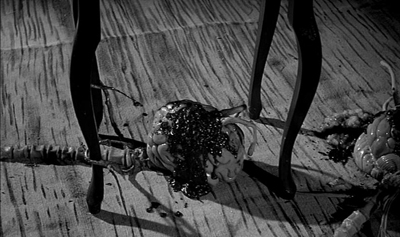
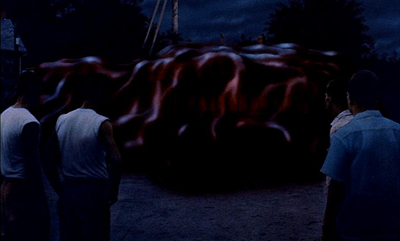
That's one of the eponymous fiends, the physical manifestation of a human thought, in its death throes. Yes, in this movie, human thoughts are represented as giant brains with attached prehensile spinal columns. With eyes on stalks. When shot, vast quantities of raspberry jam squirt out of them with horrible burbling noises. They eat brains. They're powered by atomic radiation. And they can fly. More or less what Pascal wrote about in Pensées, if I remember it correctly.

As awesome as flying, brain-eating brains sound (and they are pretty awesome), the fiends don't actually appear for the first hour of the movie. So the audience has to wade through the obligatory "mysterious string of deaths in a small town" section to get to the good stuff. The first hour has its compensations: a pre-Doktari Marshall Thompson is very, very serious in uniform:

And Kim Parker, as Thompson's love interest, does what she can to help with the marketing campaign:

That shower scene is completely gratuitous and not very risqué, but it was featured in every advertisement and poster for the film. So if you don't get to see women's legs or shoulders in your day-to-day life, Fiend Without A Face has that going for it. But there's only so much narrative interest you can squeeze out of a whodunnit where Kynaston Reeves' character is clearly, obviously, a mad scientist.

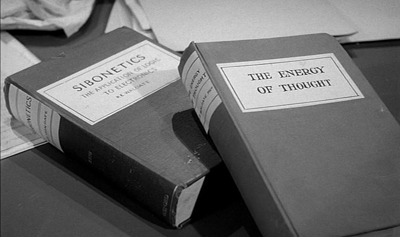
People address him as "Professor Walgate," though he doesn't teach! He does that fist-clenching thing that only mad scientists do! No one in town understands his research! Worst of all, he's written prop books: the ominously titled The Energy of Thought and the ominously spelled Sibonetics: The Application of Logic To Electronics.

The misspelled title, the peeling label on the spine, the fact that the spine of Sibonetics has embossed printing everywhere but the title: all of this screams "crackpot." The local citizenry can't believe one of their own could be behind the mysterious disappearances, especially when there's a more obvious scapegoat: nearby Stock Footage Air Force Base, pictured below:

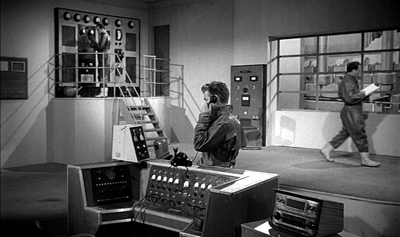
They appear to be about as well-staffed as Professor Walgate's publisher; this is the most personnel in any shot, during a test of an experimental radar system:

It's worth noting that there are more personnel here than there are at the nuclear plant that powers the base:

What's more, apparently radar stations and nuclear plants are controlled with the same equipment, an early example of modular design. Note that although you need four more telephones to control a radar test, the consoles are otherwise identical.

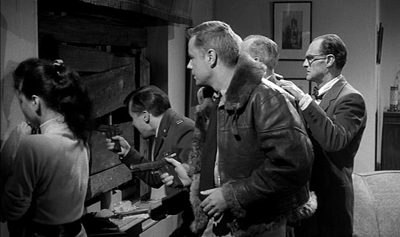
Nobody sees a movie like Fiend Without a Face for the set design or snappy dialogue, though, and within the realm of B-sci-fi/horror, this is a fun little movie. It's certainly better than The Blob, even without Steve McQueen. Crabtree knows how to shoot suspense, especially in the sequences where the fiends are still invisible. They move around with a distinctive thumping, slurping sound that is surprisingly creepy. There are decent "stuck in the house alone with the monster" sequences (especially the mayor's death). And as on-the-nose as much of the dialogue is, it's hard not to love a film that introduces us to the main character by showing him smoking and popping pills at his desk, while his subordinate asks him, "You ever think of trying sleep instead of Benzedrine? You know, you might like it."

So, yeah, there's some goofy charm here. But the movie's not famous for goofy charm, and it would have long faded into B-movie obscurity were it not for the over-the-top gross-out fest that is the final fifteen minutes. Actually, it would probably have been famous even without the special effects, because without the "locked in a house frantically boarding up windows while countless horrors try to get in" sequence, we would not have had The Birds or Night of the Living Dead.

On the other hand, without Fiend Without A Face, we might have all been spared Gore-Met, Zombie Chef From Hell and basically any other schlock horror that ignores the uncanny in favor of the abject. Because:

And furthermore:

The fiends' deaths aren't just grosser than anything that came before, they're grosser than just about anything that came after, at least until Cronenberg. No, the stop-motion animation isn't very convincing, and yes, they're kind of silly looking to begin with, but there's something about the burbling noise they make as the goop squirts out of them that's completely stomach turning. Inducing nausea isn't enough to make a movie great (look at Salò), and this isn't a great movie. But even a cursory glance at the horror and sci-fi that followed it will show that, for better and for worse, Fiend Without A Face has cast a much longer shadow than your typical Z-grade horror. For a movie made for almost nothing by a producer whose greatest goal was to build England's answer to American International Pictures, that counts as an extraordinary success.

Randoms:

  • I wasn't kidding about England's answer to American International. Producer Richard Gordon's brother Alex worked at American International and literally plucked "The Thought Monster" from their pile of rejected submissions.

  • The best dialogue in the film is not the Benzedrine line, believe it or not. It's when Professor Walgate announces, "We're facing a new form of life that nobody understands. I believe it feeds no the radiation from your atomic plant, and that it's evil."

  • The highly-trained professionals at the Air Force base know exactly what to do when they discover that the fiends feed on atomic radiation. Like anyone with a great deal of experience with nuclear energy would, they put as much TNT as they can find in the control room and blow the whole building up. As the scientists in the audience know, destroying the cooling system and control rods for a controlled nuclear reaction causes the whole thing to gracefully shut itself down, with no long term effects on the surrounding area.

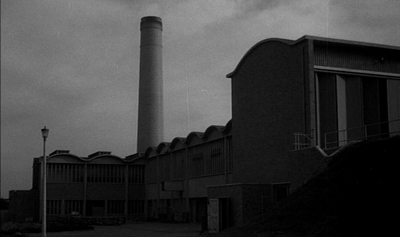
  • You can learn an awful lot about budget filmmaking from studying this movie closely, both from the missteps (like the control console noted above) and the successes. Crabtree stages his nuclear plant explosion by showing a static shot of the "plant":

    He follows this by flickering a few single-frame inserts of all white:

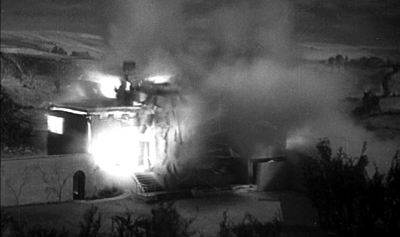
    And then cuts to stock footage of a model exploding that is clearly not the same building, if you look at the first frames of it going up:

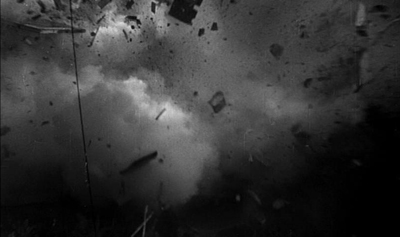
    But since the "building" is obliterated in just a few frames, and the flying debris that follows could be from just about anything:

    The effect viewed at normal speed isn't half-bad. And must have cost approximatelly nothing. Which is a long way of saying I'm planning on using a lot of footage from Roland Emmerich movies in anything I do going forward.

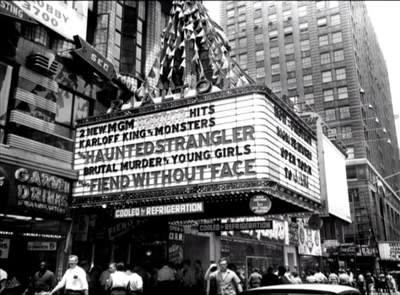
  • MGM distributed Fiend Without A Face domestically, as a double feature with another John Croyden/Richard Gordon production, The Haunted Strangler (also in the Criterion Collection). It had a very nice run at the Rialto on Times Square:

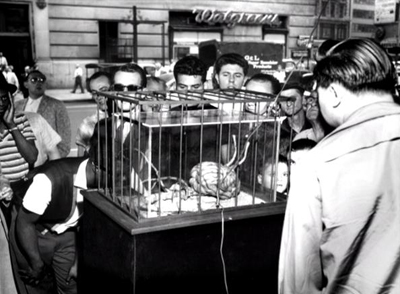
    In 1958, it was the place to show horror films in New York City, complete with Arclight-style lobby exhibits on the sidewalk itself:

    That's the right kind of theater for Fiend Without A Face, but it's not where it premiered. The geniuses at MGM sent it for a tryout, along with The Haunted Strangler, to Detroit's Adams Theater, which was MGM's prestige house in the area. Before Fiend, it was showing Gigi, and the theater manager was less than enthused with Richard Croydon's suggestion that they promote the upcoming films by setting up a coffin with a body in it in the lobby. Things didn't go well for the theater after that; it was finally demolished just this summer, but didn't age gracefully. It did a stint as a porn theater, tried unsucessfully to go back to legitimate movies, but was finally sunk when it was the site of a homocide and a shootout (separate incidents!) in 1988. Here's the auditorium circa 2005. Which just goes to show: no good will come of inadequately promoting a Karloff picture.

  • No good will come of adequately promoting a Karloff picture either; the Rialto was torn down in 1998 to make way for the Reuters building. It did its time as an adult theater too; its last incarnation was for one of those hydraulic seat attractions called Cinema 3-D. So maybe the best thing is not to have anything to do with Karloff pictures at all.

Sunday, May 03, 2009

#91: The Blob

The Blob, 1958, directed by Irwin S. Yeaworth, Jr., screenplay by Kate Phillips and Theodore Simonson, from an idea by Irvine Millgate.

It's an article of faith among film critics that the schlock sci-fi of the fifties can be mapped onto the fears of the era: Godzilla is about fear of the atomic bomb, Invasion of the Body Snatchers is about fear of conformity, and Forbidden Planet is about fear of Leslie Neilsen movies. So it's not too surprising that people look at The Blob and try to find a deeper subtext. Maybe it's about Communism. Or Korea. Or the Republican Party. Bruce Kawin makes the best guess, pinning the blame on post-war consumerism. You can make a case for that, and Kawin does, but I think it's probably apophenic to find too much deep cultural significance in a film that was inspired by the Sherwin Williams logo:

The Blob is, as Kawin notes, pretty unique among fifties movie monsters for being completely devoid of human characteristics. It's just exactly what you'd think it is from the title.

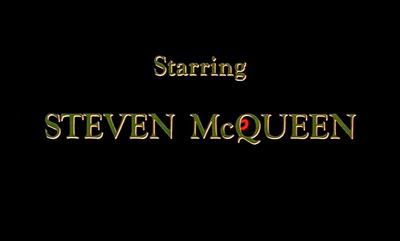
Found inside a crashed meteorite by a crazy hermit, the blob is a transparent goo that grows as it eats. And it eats people. It's a great idea that's kind of indifferently executed, because Yeaworth and company were as interested in making an antidote to teenage delinquency movies as they were interested in a monster movie. So for every scene of the blob creeping up behind an unsuspecting victim, you're guaranteed a scene of good-hearted teenagers trying to convince the town's authority figures that they're being honest about the monster they keep reporting. So why has the film outlived contemporaries like The Crawling Eye or The Giant Claw? I can answer that in three words:

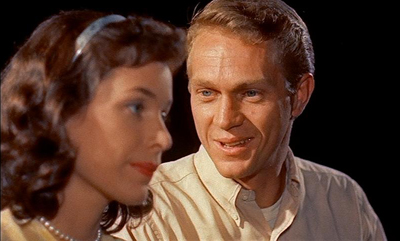
This was McQueen's first starring role in a feature, and not a moment too soon. He was 27 when this was filmed and looked every last day of it.

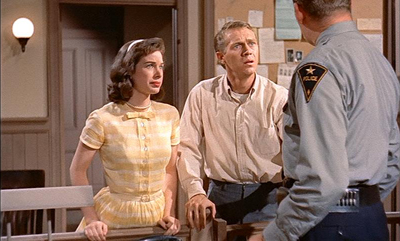
I'm more likely to believe that a semi-sentient man-eating gelatin could crash-land on earth than that McQueen or his co-star Aneta Corsaut are in high school. Maybe that's smart, in terms of distracting the audience from all of the film's other implausibilities, but this was not McQueen's finest hour. He hadn't really developed the persona that made him famous, and Bullit was years away. So The Blob is a rare opportunity to see one of the coolest movie stars in film history play a dork. We're talking shirt-tucked-in-no-belt, people.

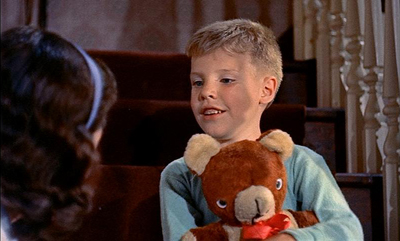
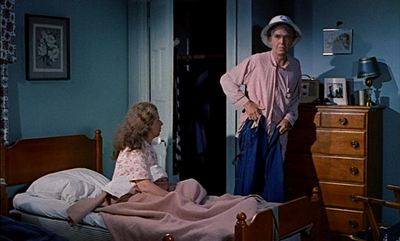
McQueen does an acceptable job of playing a guy who is not very cool by any modern standard, but he gets completely left in the dust by an actor named Kieth Almoney. Cast as Corsaut's younger brother, Almoney made the bold choice to portray him as the tragic victim of a brain parasite.

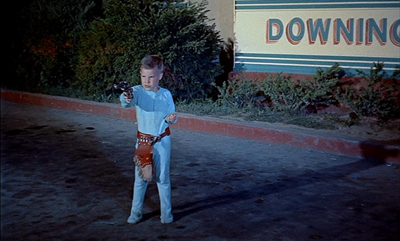
It's hard to choose a single favorite thing about Almoney's magical onscreen presence: when you deliver each line like Homestar Runner, everything you do makes an impression. His one-man toy pistol assault on the Blob is probably the high point.

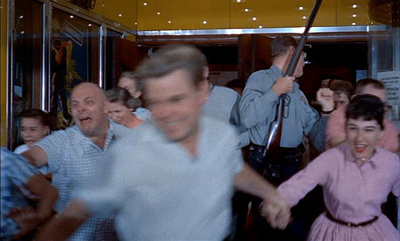
Almoney's performance betrays The Blob's origins; it was independently produced by a band of amateurs, far from Hollywood. Jack H. Harris was an independent distributor fed up with trying to sell poverty row Westerns to audiences who wanted Technicolor. He put the film together for virtually nothing at Valley Forge Studios in Pennsylvania, with a director and crew trained in producing religious shorts. Kate Philips had written for television, and Yeaworth mentions hiring an experienced editor after some false starts (although no one in the editorial department has previous credits on IMDB), but everyone else was brand new to the feature world. In fact, Kieth Almoney, like several other cast members and all of the extras, was recruited from Yeaworth's church. When something's that homegrown, it's easier to forgive things like the happy grins on the faces of the crowd fleeing the Colonial Theater in terror: they're gonna be in the movies.

As far as casting the main roles goes, Harris made the financially smart decision to shell out for experienced actors in minor roles, while giving the leads to cheaper unknowns. Of course, when you luck into hiring Steve McQueen as an unknown (and pay him all of $3,000), the success of your film doesn't really depend on the audience finding Alden Chase's face reassuringly familiar.

Harris's modest goal with The Blob was the same as every scrub at Sundance: get studio distribution. Fortunately, Paramount needed something to fill out the bottom of a double bill with I Married A Monster From Outer Space, so Harris got his wish. Yeaworth and some of the other crew seem to have believed they'd made a work of gothic horror, but the Paramount executives knew what they'd bought: the first thing they did was cut the ominous opening-credits music (over Saul-Bass inspired titles) and replace it with a novelty single called "Beware of the Blob," written by Burt Bacharach and Hal David. The single charted in Los Angeles, Carson made a joke about it on-the-air, Paramount gave The Blob top billing (and re-released it once McQueen was a star), and there's no Criterion edition of I Married a Monster from Outer Space. Maybe there should be.

Randoms:

  • This is probably the only Criterion Collection DVD to use the word "superstud" on the back of the DVD case. The exact usage ("THE BLOB helped launch the careers of superstud Steve McQueen and composer Bert Bacharach") should piss off composers and Burt Bacharach fans everywhere.

  • Superstud or no, McQueen was apparently impossible to deal with on set. Harris talks on the commentary track about having to drive from Philadelphia to the set several times to coax him back on set. Smoke drifts up incongruously over his shoulder in one shot because he wouldn't put out his cigarette while filming a close-up. He apparently borrowed Yeaworth's car (the only new car he ever owned), drove it to New York City, and returned it with unexplained scratches all over the roof. His behavior was abysmal enough that Harris, who'd signed him for a three-picture deal, released him completely.

  • Many of the minor roles were cast from the performers of the Hedgerow Theatre, a repertory group based in nearby Rose Valley. The company's founder, Jasper Deeter, has one of the only funny-on-its-own-terms scenes in the film, as an aged Civil Defense volunteer and volunteer fireman who can't decide which helmet is best suited for Blob-fighting.

  • Among all the inappropriately smiling extras, the gentleman in the checked shirt in this still clearly deserves some recognition for his performance. He's not only the only extra who looks unhappy, he genuinely looks horrified.

  • Robert Fields, who went on to a distinguished film career of his own, contributes a pretty amusing commentary track. He would have been 19 when this was shot, and basically remembers it as "the summer I hung out with Steve McQueen and unsuccessfully tried to score with one of the actresses." Actors usually talk about their jobs at a certain remove, but Fields sounds like anyone else seeing footage of their summer job when they were 19: he remembers virtually all of it in terms of personal relationships, and clearly the experience of being rejected that summer still burns him a little. On the other hand, though he doesn't remember her name (I would bet it's Molly Anne Bourne or Diane Tabben, both of whom are credited as "Teenager" on the IMDB) he does remember that she was engaged, so it's probably for the best. Here she is, sitting next to him in pink:

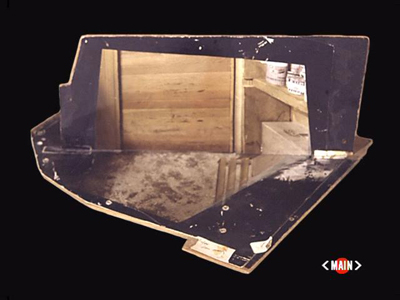
  • Most of the effects shots depend on plywood constructions with forced-perspective scenery, like this:

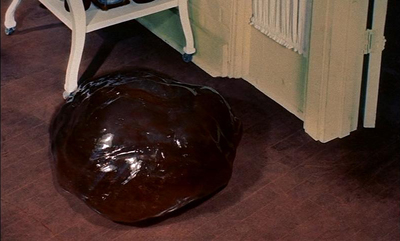
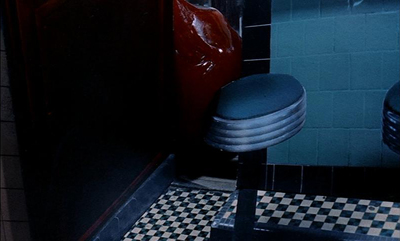
    The Blob (colored silicone, in its pre-implant days) would then roll toward the camera when the set was tilted. When it works, the effect looks fine, but when anything's wrong with the perspective, things go very badly. Take a look at the M. C. Escher inspired angle on the diner stool:

  • For shots that wouldn't work with forced-perspective models, the filmmakers used rotoscoping, and sometimes resorted to straight cell-animation. This is about as convincing as you might imagine:

    That said, there's a single shot of the teenagers looking at the Blob enveloping the Downingtown Diner that goes right around past bad to good and ends up looking like something Miguel Calderón would hire someone else to paint:

    I would absolutely buy the original.

  • The DVD includes images of posters for the film from various releases and rereleases. Most use some variation of the original key art:

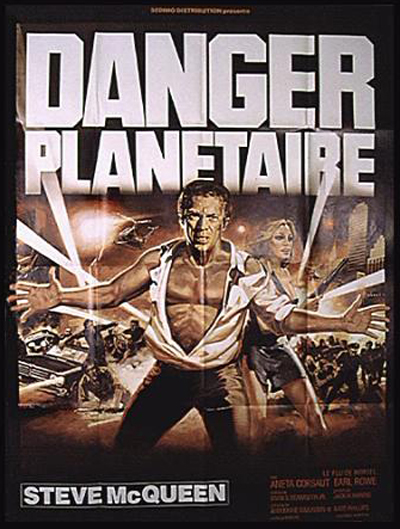
    Say what you will about the art style, you know what you're getting. And then there's the French. One thing to remember about The Blob is that McQueen is never shirtless in the film. What's more, since it was made in 1958, there aren't any cars from the mid-60's in it. Nor are there helicopters. Or skyscrapers. And McQueen's costar is a brunette, not a shotgun-wielding blonde. So the French poster might lead you to draw some incorrect conclusions:

    Ah, La France! If Danger Planetaire existed, I'd watch it more often than The Blob.