Thursday, January 17, 2008

#81: Variety Lights

Variety Lights, 1950, directed by Federico Fellini and Alberto Lattuada, screenplay by Federico Fellini, Alberto Lattuada, and Tullio Pinelli, story by Federico Fellini.

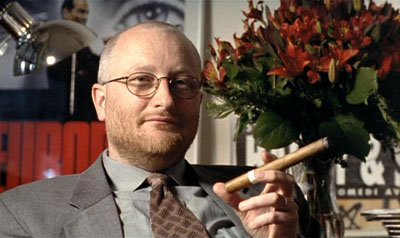
The showbiz movie has two basic archetypes, positive and negative. In the positive version, an innocent gets discovered and rises to the top: the conflict comes when they have to choose between violating some core principle and taking some kind of short-term gain—Singin' In The Rain is probably the best example. The flip side of the mirror are the movies where a ruthless protagonist slimes his or her way to the top; think of All About Eve or The Player. But while the positive and negative archetypes may portray show business at different levels of toxicity, there's never any question of its seductive power. Half the appeal for the viewer (especially in the negative showbiz movies) is the chance to vicariously experience the power and the glory of the entertainment industry. What makes Variety Lights so charming is its version of power and glory. Here's Checco Del Monte as we first see him, embodying all the irresistable glamour of third-rate post-war Italian vaudeville:

He's not exactly Joel Grey in Cabaret. Checco is played by Peppino De Filippo, and that's as dignified as his character gets. He's the capocomico of a troupe whose appeal is becoming more selective. It's hard to imagine why; not only do they have Checco's singing, they have Giulio Cali's fantastic magic act:
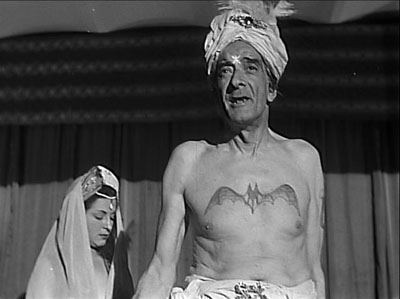
His big trick is eating a lightbulb.

And if that's not enough to seal the deal, there's the act that gets the largest print in the posters... TUTTI A BIKINI!
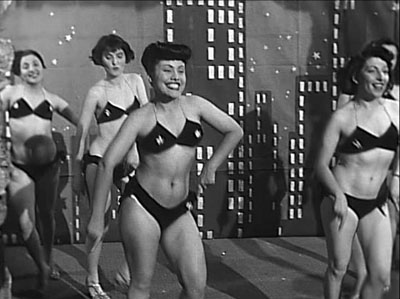
It's as glamorous as the "Dignity... always dignity!" flashback in Singin' In The Rain. But while Don Lockwood and Cosmo Brown both go on to bigger things, for Checco and the rest of his troupe, the performance that opens the film is their finest hour. Fortunately, they reach at least one member of the audience, Carla Del Poggio's Lily Antonelli, who applauds the show's cheesy finale like it's Jesus coming back from the dead.
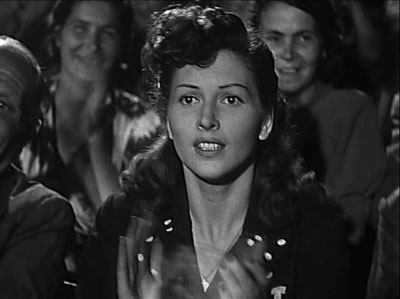
Lily tracks Checco and his company down on the train to their next show and explains that she is eminently qualified to perform with them: she was the winner of a local dance marathon ("I had to stop because the others did, but I wasn't tired at all"), she was elected Beach Queen, and a local paper said she had "legs like Maresca."1 Sterling qualifications, to be sure, and Checco is suitably indifferent, even when she hands him a stack of glamour shots and shows him her legs in person. She finally makes an impression when she rents a cart for the whole (flat broke) company and saves them several miles of walking. This gesture convinces Checco to give her her big break. She takes full advantage, first upstaging the prima donna:
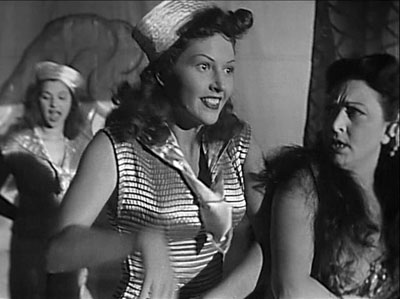
Then winning the hearts and groins of her audience with a convenient (but accidental) wardrobe malfunction:
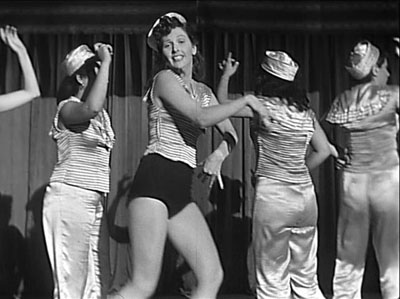
Needless to say, Checco knows talent when he sees it, and Lily quickly becomes the company's star attraction. This doesn't go over well with the rest of the act, but it especially doesn't go over well with Checco's sort-of-fiancée, Melina Amour. She's played by Fellini's wife Giulietta Masina, and if you remember Nights of Cabiria you know that no one plays long-suffering like Giulietta.

Of course, it's apparent that Checco's world—where success means staying on for a repeat performance of "TUTTI A BIKINI!" for an audience of farmhands—won't satisfy Lily for long. You can actually see the moment when she decides he won't be able to get her where she wants. He's taking her around Rome, trying to put a new production together, and booking agents are roundly ignoring him. He plays things cool, but she looks around appraisingly at the other agents:
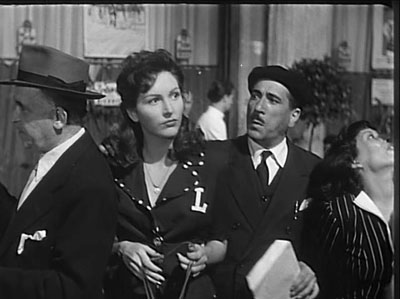
It's a beautiful moment. Although Lily does turn into something of a monster over the course of the film, this is an altogether gentler film than All About Eve, and even at her worst, there's something charming about her. Checco's a rube, but he's still seen a lot more of the world than she has. She knows enough about the best of everything to order lobster and champagne when Checco takes her out:
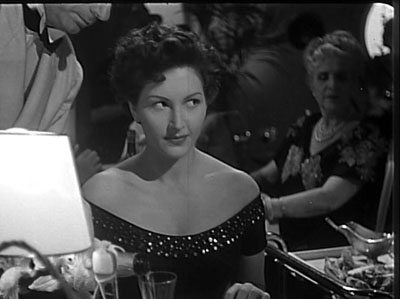
But after one sip, she says, surprised, "It tastes just like soda!" and orders a beer instead. In short, Checco should know better, but Lily clearly doesn't. And so the film doesn't fit the mold of the negative showbiz movie: it isn't about Lily's megalomania, but about Checco making a fool of himself. Let's be clear: this is not a man with a lot of dignity to spare:
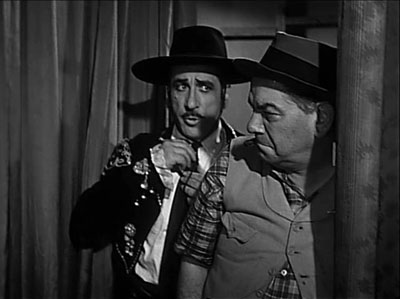
But he does have the one thing you can't afford in the entertainment industry: sentimentality. Although he treats Melina Amour terribly, he unfortunately seems to see Lily as something more than a means to an end.
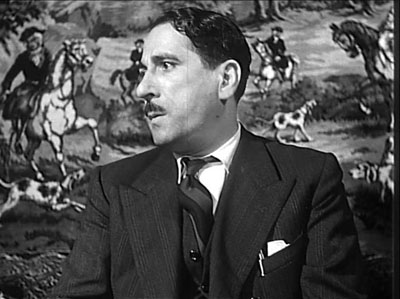
Watching the gap widen between Checco's version of Lily and the genuine article will be a familiar experience for anyone who's had a good friend go off the deep end for the wrong person. And when you're emotionally invested in someone who's using you, you can always fall lower.
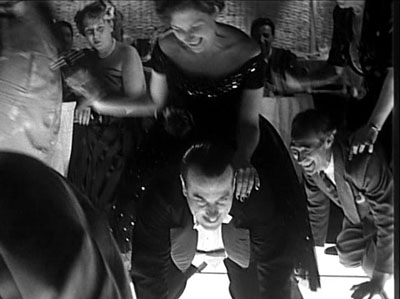
I'm making this sound like an unpleasant film about unpleasant people, and that isn't the case at all; whatever happens, it's clear that the filmmakers have tremendous affection for all the main characters. So they all get a happy ending, at least from their own perspectives, even Lily. She achieves the success she's always wanted; when we last see her, she's dripping with fur:
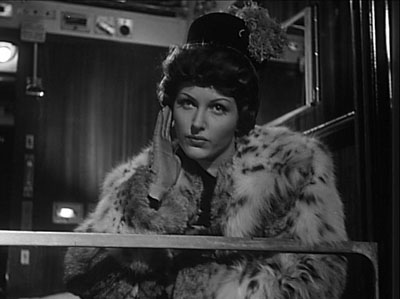
Which is considerably more than she wears onstage.

And Melina may have lost her savings, but she's doesn't seem to be too unhappy about it.
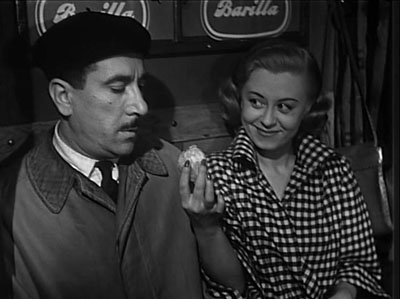
Neither is Checco, for that matter. He's put his old troupe together for a grand tour: they're playing Bisceglie2, Molfetta, and posssibly even Trani. He's also still letting Melina take care of him, but at the film's end, we see him flirting with another would-be actress. This is where the Fellini and Lattuada stumble: like Melina, they forgive Checco too much. He's squandered Melina's libretto postale and dashed her dreams of running a salumeria. While it's credible that Melina would have him back (it's clear she can't deny him anything), and he's clearly incorrigibly foolish, it's asking a lot from your audience to try to wring a lighthearted tone from his disastrous moral failures. It's a testament to the filmmakers that they almost pull off this ending, but ultimately I wasn't quite sentimental enough about Checco. It's probably churlish to play the sentimental card, given that we're talking about Italy circa 1950; it wasn't exactly a mecca for cold-eyed rationalists. You can read Luigi Barzini's The Italians, for a book-length exegisis of what I'm talking about,3 or you could just observe that in Variety Lights, an audience is brought to tears and a standing ovation by Melina Amour's singularly unconvincing impression of Garibaldi:

So the film's treatment of Checco is a product of its time and place. Sometimes the filmmakers seem to be aware of this, and sometimes they aren't. It's not a keenly observed character study, and it's not Nights of Cabiria. But Variety Lights mostly gets by on likeability and low-rent charm. A lot like Checco. Or Italy.

Randoms

  • Fellini and Lattuada do a wonderful job of capturing the feeling of life on the road. One of the film's high points is an impromptu banquet at the estate of a man who enjoyed the show. Pasta, meat, and lots of Parmigiano Reggiano.
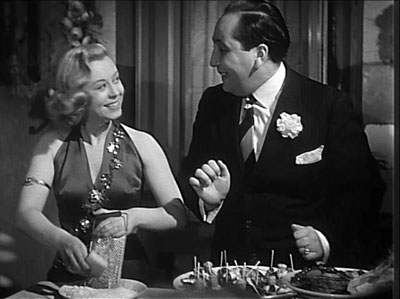
    There's a great shot of the meal that has no conversation, just the sound of lots of people noisily chewing. Of course, the evening ends with Checco throwing a fit and getting everyone thrown out without a decent night's sleep. But that seems a fair trade-off for the food.

  • Variety Lights features Johnny Kitzmiller (aka "the only black man in Italian cinema") playing a prototype of the "magical black man" character so beloved inn American films. He shows up out of nowhere to give Checco hope and inspiration (he's wandering around Rome in the middle of the night playing trumpet, no less). More interesting is Joseph Falletta's portrayal of the"magical Mexican sharpshooter."
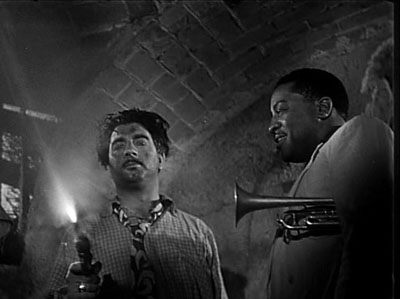
    Coincidentally, a magical Mexican sharpshooter is the one thing that could have saved The Legend of Bagger Vance.

  • A word about Johnny Kitzmiller's appearance. He tells Checco that he was a chemical engineer in the states ("a darn good job!"), but "I like music, so I came to Italy." Kitzmiller grew up in the states; you would think he'd have pointed out to Fellini and Lattuada that a black chemical engineer—who would have had to fight tooth and nail to get that education and that job—probably wouldn't quit on a whim. Not to mention his unlikely decision that the best place for a black man to play jazz trumpet in 1950 (that's the time Miles Davis was recording the singles that ended up on Birth of the Cool, if you keep track of these things) was Italy. Or as I like to call it, the "land of jazz."

1Probably this was a reference to Lidia Martora Maresca, an actress who seems to have been Peppino De Filippo's lover. Anyone know for sure?

2Not "Bisceglia," as the subtitle has it, but this place. Note that all three stops of Checco's tour are on a ten-mile stretch of railroad track.

3Particularly his chapter on family life—he calls Italy a "crypto-matriarchy," which is still apt.

Sunday, December 16, 2007

#80: The Element of Crime

The Element of Crime, 1984, directed by Lars von Trier, written by Niels Vørsel and Lars von Trier.

I rarely like dream sequences. They're usually a solution of last resort when a filmmaker needs to cram in some exposition about a character's mental state and can't find a way to do it elegantly. Even in Ratatouille—which I think is near-perfect—Linguini's nightmare about Ego doesn't add anything we don't see more clearly in other scenes. And when it comes to taking dream sequences seriously, using Freudian dream-logic to articulate things that characters hide from themselves and others, I'm with Nabokov: "Let the credulous and the vulgar continue to believe that all mental woes can be cured by a daily application of old Greek myths to their private parts." So that's dream sequences. But what about a dream movie? For me, one of the salient features of all of my nightmares is my inability to leave, that moment when you would like to wake up but are unable to. You can't capture that in two minutes of film, but you might be able to in a feature. Of course, then the question becomes, "But why would you want to?" Lars von Trier's The Element of Crime proposes an answer, but it's not exactly the one you might expect.

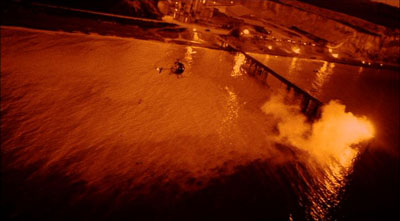
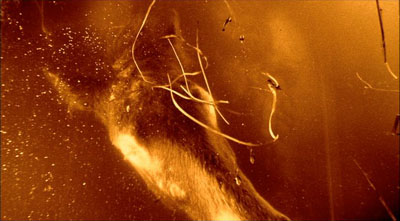
The film is a cinematic nightmare in at least two senses: it captures the logic of dreams in a way most films don't, and it's a singularly unpleasant viewing experience. This has a lot to do with the look that von Trier and cinematographer Tom Elling came up with, which is (I hope) unique in film history. Here's a still from early in the film, of a horse sinking in debris-strewn water:

That's not a brief, strangely colored insert: the entire film is lit with that same sickly yellow. It looks like Piss Christ: The Motion Picture. Von Trier and Elling got the look by using sodium vapor lamps (now illuminating a grocery store parking lot near you), and it's unforgettable. Which is not to say it was necessarily a good idea.

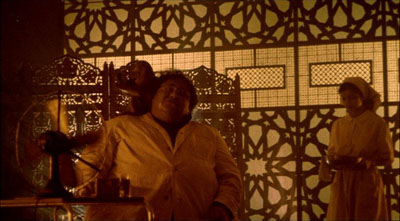
Michael Elphick stars as Fisher, a man undergoing hypnotherapy in an attempt to cure his headaches. After an hour of staring at The Element of Crime's palette, I knew exactly how he felt. As the film opens, Fisher is living in Cairo, where he's apparently seeking medical care on the set of Raiders of the Lost Ark:

N. B.: this doctor's office is in the "real world" that opens Fisher's hypnotized memory of his last trip to Europe. So to say the film is expressionist is an understatement. Fisher's memory is a muddled pastiche of film noir and serial killer films, with a touch of Apocalypse Now thrown in for good measure. It's a bit like what T. S. Eliot might have produced instead of "The Wasteland" if he'd known film noir instead of Dante. Here's how Fisher begins telling his story:

I'm a policeman. I've finally been called back to Europe to solve a murder case.

Note that he's telling it like a dream, not a memory; he might have begun "I'm an X-wing pilot" or "I'm a trombone." The Europe he's been called back to is unrecognizeable, even to him; the first time we see him there, he's adrift in a boat, yelling that someone has "moved the fucking stairs." The murder case he's been called back about is actually cases: a serial killer has resurfaced long after his case was supposedly closed by Fisher's discredited mentor Osborne:

Osborne was a criminologist with an unconventional method that will be familiar to fans of crime movies (and which John Woo took very literally): in order to catch a criminal, you must become him. Osborne refers to his method somewhat cryptically as "the Element of Crime." To anticipate where the serial killer will next surface, Fisher duplicates a preparatory trip the killer took before his first crimes. Fisher drives the same route, stays in the same hotels, wears a hat with the killer's name on it, and even sleeps with the same woman. Does he end up identifying a little too well with the killer? Are the killer and the cop assigned to catch him, in the end, not so different? Well, I don't want to give anything away.

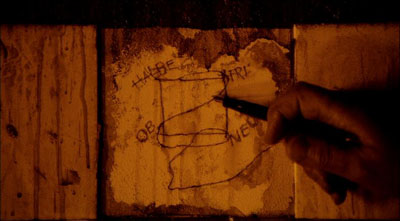
Although the movie predates the long string of serial killer films of the 90s, all the tropes of the genre are there. The killer has a grand design he's enacting with geometric precision:

There's the obligatory autopsy sequence with the inappropriately cheerful coroner:

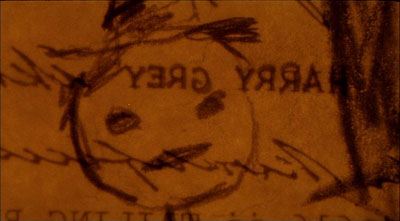
There's the repurposing of things associated with childhood, from the repetitive nursery rhyme nonsense some characters mutter (e.g., "books and bother killed my mother") to the childish drawings that cover key documents like this one:

And there's even the misogyny that lurks just beneath the surface of so many of these films, mixed with more menophobia than Carrie and Superbad combined.

But if you noticed the name "Harry Grey" a few stills back, you've figured out that Von Trier's cinematic touchstones are less De Palma and more Carol Reed—apparently Harry Lime sounded too brightly colored for such a monochromatic film. Von Trier evokes Reed's Vienna throughout the film in small ways and large:

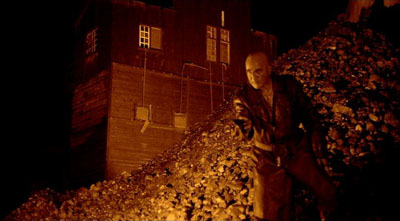
That's appropriate, since like The Third Man, The Element of Crime takes it as a given that Europe is in its last stages of moral and physical collapse. Everyone Fisher meets seems to be on their last legs, and the sets are uniformly decaying. The references to Apocalypse Now are a tougher fit, since that film dealt with such a uniquely American catastrophe. They're there, though: Jerold Wells in the still above is meant to remind you of Brando, and there's a great helicopter shot later in the film that's should have "Ride of the Valkyries" playing over it:

Kramer, the police chief Wells is playing, goes so far as to wander around a chaotic excavation yelling "Who's in charge of this operation?" like Willard. Finally, Von Trier tips his hat once or twice to Tarkovsky, starting with the opening shot: a donkey trying to get to its feet like the wounded horse in Andrei Rublev.

The problem with this hodgepodge of cinematic references is that they don't make the film any less tedious. Von Trier does create a pretty convincing nightmare: there are plot points that almost make sense, vague suggestions of ominous things happening off-camera, and more textbook Freudian puns than Bringing Up Baby. But unless you're really emotionally invested in the decline and fall of European culture—in which case, you're probably blogging about Islamofascism, not watching arthouse movies—The Element of Crime isn't going to connect as anything more than a stylistic exercise. If you want a moving depiction of a nightmare, your time would be better spent with "In Dreams Begin Responsibilities."

So what's Von Trier's mash up of film noir, cultural anxiety, and monochromatic cinematography in service of, exactly? My theory is that it's in service of Lars Von Trier. This was his first feature, and from a game theory perspective, The Element of Crime is kind of a brilliant opening move. The script is just a draft away from being a conventional serial killer film. If a few of the stranger lines were excised, it would have been easy to raise money to get the movie made. The sodium lighting makes the film instantly memorable; you can't mistake a frame of it for anything else. And the fragments of other films Von Trier has shored against his ruins are critic bait if I've ever seen it. If Von Trier had made the serial killer film The Element of Crime is very close to becoming, it would probably have gone straight to video. If he'd announced upfront that his plan was to make an incoherent mess of references to other films, and color the whole thing like urine besides, I doubt he would have found a willing producer. By combining the two, he made a grand entrance, and hasn't slowed down since.

While I find The Element of Crime difficult to watch (it really is nightmarish), I can't deny that it has style. And style, like personality, goes a long way. In Von Trier's case, it took him to Cannes, where he was nominated for the Golden Palm and left with a Technical Grand Prize. I don't like this movie. But I do think Von Trier is a magnificent bastard for making it.

Randoms:

  • The only other Von Trier film I've seen is Dancer in the Dark, which I thought Stephanie Zacharek summed up pretty well for Salon: Von Trier's "movies are meat grinders he feeds his characters through." The Element of Crime doesn't really fit that description, but only because it's impossible to give a damn about any of the film's characters. Both films are as cruel to female characters as Brazil. In The Element of Crime, women are either there to be loathed and then fucked and then loathed again, like Me Me Lai, who plays Fischer's lover:

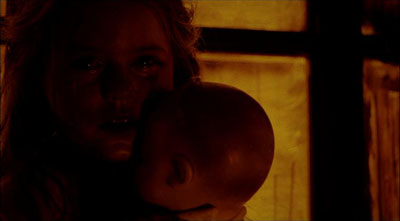
    Or they're anonymous victims, like nearly every other woman we see in the film:

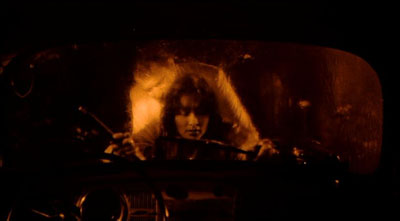
    So Björk sort of got off easy, in the sense that she didn't have to feign sexual ecstasy while leaning over the hood of a Volkswagon.

  • Von Trier has a brief cameo, as the clerk at one of the film's many decaying hotels.

    His character is just as charming as he looks.

  • The DVD also includes Tranceformer, a profile of Von Trier directed by Stig Björkman and Fredrik von Krusenstjerna. It was made while Von Trier was directing Breaking the Waves, and is notable for two reasons. The first is a clip of Von Trier saying, "Shall we skip the niceties and get on with the interview?" on camera, presumably after the interviewer asked him how he was doing or complimented his work. It's a nice passive-aggressive thing for the filmmakers to have included, in that it makes Von Trier look like a jerk. The second is the interview footage with Peter Aalbæk Jensen, who produced Breaking the Waves. Jensen appears to have modeled his on camera persona (Producer with a capital P!) after Orson Welles in The Muppet Movie.

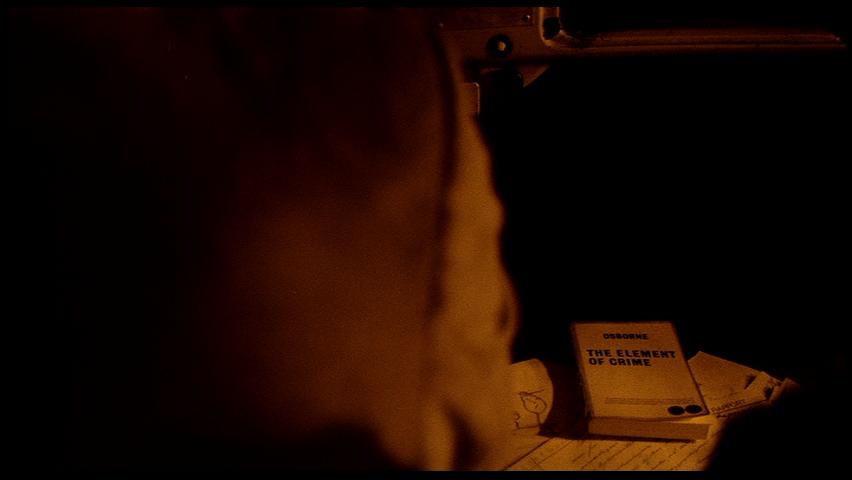
  • The Element of Crime contains a nice example of the art direction colliding with the script. Throughout the film, we see copies of Osborne's monograph, The Element of Crime in various editions, from a leather-bound hardcover to an Arabic translation. The graphic design of each different version is well designed and appropriate; this is the kind of detail I really appreciate when filmmakers take the time to get right). But Osborne doesn't have a first name, which means that the trade paperback floating around the floor of Fischer's car looks a little unbalanced. Click the image for a full-sized version:

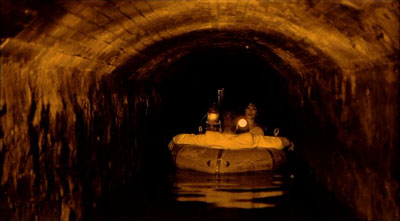
  • Most awkward Freudianism in a film full of awkward Freudianim: Kim tells Fisher "I want to show you something," and the next shot is the two of them on a boat, sailing down a dark, wet passage.

    Fisher's therapist says he's gone "down the drain... into the tunnel of love." Save us, Nabokov!

Friday, November 16, 2007

#79: W. C. Fields - Six Short Films

W. C. Fields - Six Short Films, 1915–1933, various directors and writers.

In The Bank Dick, W. C. Fields says, "In the old Sennett days, I used to direct Fatty Arbuckle, Charlie Chaplin, Buster Keaton and the rest of them... Nights, I used to tend bar." Six Short Films gives viewers a chance to see the product of that kind of schedule. The results are pretty much what you'd expect. Here are the Six Short Films:
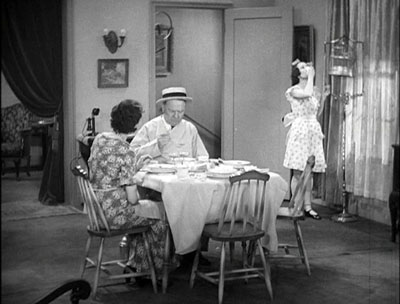
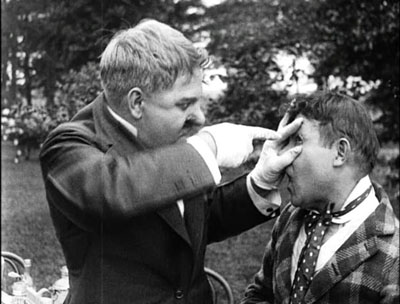
Pool Sharks, 1915, directed by Edwin Middleton, written by W. C. Fields (according to the IMDB; there's no credited writer). Despite what the IMDB may tell you, this was Fields's first film. He basically does his best Charlie Chaplin:

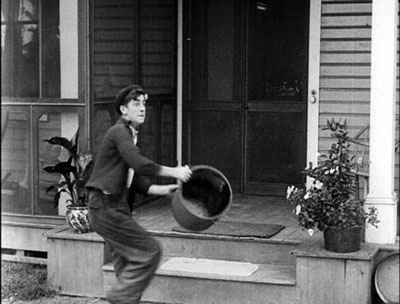
Fields is 35 in this still, still relatively unscathed by drinking. But even at his young age, Fields had grasped the principle of comedy that would inform so much of his career: when in doubt, have somebody start throwing shit.

That's about 30 seconds after the credits. So, film historians, here it is: the first projectile to hit W. C. Fields in the back of the head.

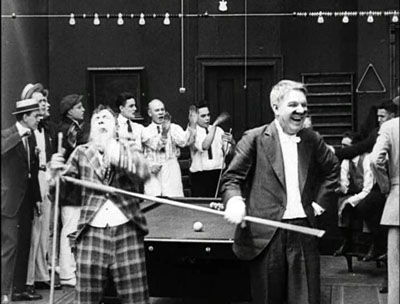
It would not be the last. There's just about no plot to speak of; Fields agrees to play pool with Bud Ross for the hand of the unnamed actress on the hammock. Havoc ensues. The chief distinction between Fields in this film and Fields in the rest of his work is that he's occasionally cheerful:

Of course, he's cheerful about bashing Bud Ross's face in with a pool cue. Some things never change. If you prefer more malice to your physical comedy, rest assured that there's plenty of that as well:

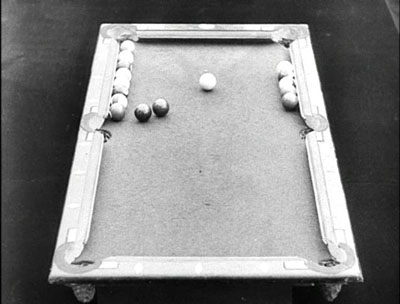
Unfortunately, Pool Sharks gets weighted down in the middle by the actual game of pool. Fields and Middleton put a groundbreaking special effects sequence at the heart of their film, the kind of thing that dazzles any audience. I'm speaking, of course, of jerky stop-motion.

Every time Fields or Ross takes a shot, Middleton cuts to an unconvincing scale model of a pool table, and the balls lurch around in single-file lines. It's a shame, because the rest of the film is remarkably funny for a basically plotless silent. Fields is already remarkably misanthropic, and there's an absurdity to some of the gags that shows up in his later work. For example, is this any place to keep a goldfish bowl?

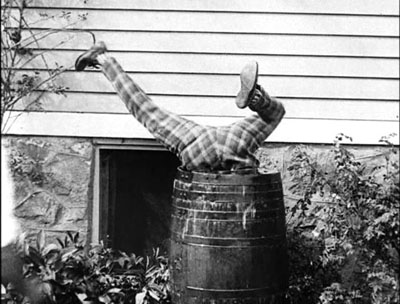
Well, as long as you're going to be standing under it when people start throwing billiard balls, the answer is yes. Clearly, Pool Sharks was included on the disc simply because it was the first movie Fields appeared in, but it's got its moments. Here's one of them:

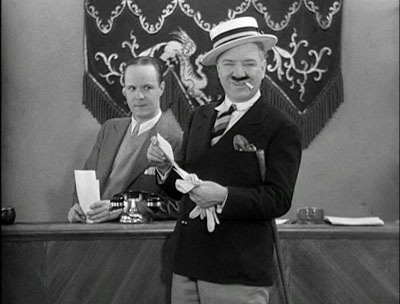
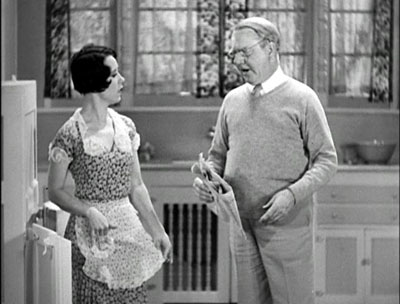
The Golf Specialist, 1930, directed by Monte Brice, written by W. C. Fields. One of the best films on the disc. W. C. Fields plays J. Effingham Bellweather, fifteen years older, drunker, and fatter than he was in Pool Sharks. He's still sporting that ridiculous moustache, though.

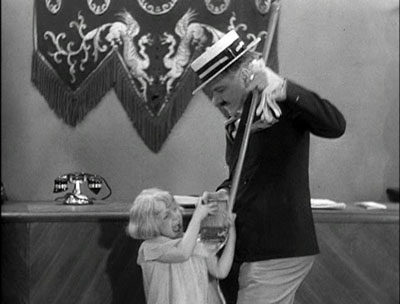
Writing about The Bank Dick, I said I'd have been perfectly happy to watch a film called W. C. Fields Gets Drunk and Beats Up An Eight-Year-Old. I underestimated him. In The Golf Specialist his opponent is only five.

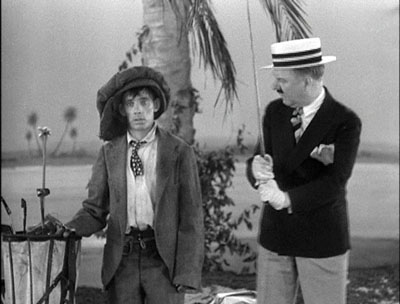
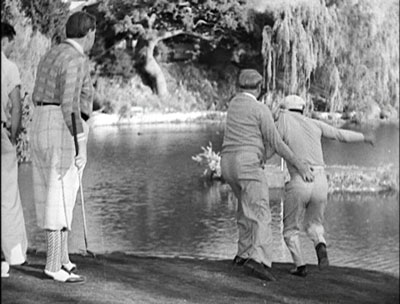
The Golf Specialist presents us with W. C. Fields in his purest form: unjustified rage and unsated desire. After a brief introduction in a hotel lobby, the film settles down to an extended scene where W. C. Fields tries, against all odds, to impress another man's wife by successfully hitting a golf ball. He's accompanied by Al Wood, who plays the saddest sack of a caddy imaginable. His character doesn't have a name, so let's call him Estragon:

Fields's increasingly desperate attempts to accomplish a simple task (and his mantra-like repetition of the line, "Now stand clear, and keep your eye on the ball"), are a perfect example of one of the great principles of comedy: after a certain number of iterations, tragic failure transmutes into hilarious failure. The Golf Specialist is a short film, but in the right hands you can keep that kind of gag going for nearly fifty years.

The Dentist, 1933, directed by Leslie Pearce, written by W. C. Fields. This is the first of the films from "the old Sennett days" that's actually, you know, from the old Sennett Days:

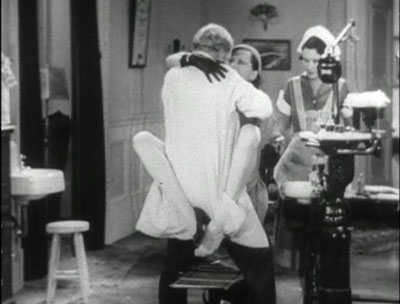
Or rather, the new Sennett days. Mack Sennett, having made his name years earlier with silent comedies (including the Keystone Kops), had just started a distribution deal with Paramount that would bankrupt him a year later. The remaining four films in Six Short Films were all produced by Sennett at Paramount, and released between December of 1932 and July of 1933 (Sennett went bankrupt in November). If that seems like a remarkably fecund period, take a look at the titles of the remaining films; not just The Dentist, but also The Pharmacist and The Barber Shop (only The Fatal Glass of Beer is its own thing). It's a lot like the McKay/Ferrell collaborations: pick a profession, put "W. C. Fields is" in front of it, walk out of the pitch meeting with a greenlight and a suitcase full of cash. That's not enough to make a good movie, whether it's with Will Ferrell or W. C. Fields. In the case of The Dentist, however, it's enough to make an unreleasable movie, because one of the film's patients reacts to being drilled as though she's, well, being drilled:

The Criterion Collection release was the first time the film was presented uncut. The Dentist is otherwise unremarkable; Fields has lost his mustache and submerged himself in a look I like to call "cantankerous Grandpa":

Most of the jokes revolve around how miserable it is to go to the dentist, which is well and good, but not exactly fresh comic territory. The Dentist does compare favorably to The Golf Specialist in one key area, however: treatment of caddies. Fields throws his into a water hazard.

The Fatal Glass of Beer, 1933, directed by Clyde Bruckman, written by W. C. Fields. One of the most bizarre films on the disc. It's often mentioned in the same breath as Monty Python, and with good reason; it's their kind of humor. It's sort of a parody of films about the Yukon, but it's also a parody of parodies of films about the Yukon, like Chaplin's The Gold Rush. But it's also succeeds on its own. W. C. Fields is some sort of Yukon-type; it's not entirely clear what he does besides attempt to milk elk. Shortly after the film begins, the action stops completely while he sings a lengthy song about the evils of drink, accompanying himself on the dulcimer, while wearing mittens:

Yeah, it's that kind of movie. W. C. Fields's wailing tune plays over flashbacks of George Chandler playing "Chester Snavely, the Wastrel Son," as he's corrupted by the titular beverage:

By the song's end, Chester has learned a valuable lesson: "Don't go round breaking people's tambourines," and the film moves on. It's completely, wonderfully absurdist, and not coincidentally, hilarious. Consider this exchange:

                    MRS. SNAVELY
          He wants more money, and if he
          don't get it, he'll take our
          malamute.

                    MR. SNAVELY
          He won't take old Bozo, my lead
          dog.

                    MRS. SNAVELY
          Why not, Pa?

                    MR. SNAVELY
          'Cause I 'et him.

                    MRS. SNAVELY
          You et him?

                    MR. SNAVELY
          He was mighty good with mustard.

As usual, Fields manages to take a good joke and turn it into a great one by taking it just a little further: with mustard.

The Pharmacist, 1933, directed by Arthur Ripley, no credited writer. This is slightly better than The Dentist, if only because the humor depends more on observations about what it's like to work in a service industry (The Dentist, one would hope, tells you very little about what it's like to actually be a dentist). Take a look at the unchecked passive aggression in Fields's smile as his character explains that, although he'll be glad to send a truck several miles to deliver a single box of cough drops, he won't be able to split the box.

The Pharmacist also features more of the sort of alcohol joke Fields got so much mileage out of in The Bank Dick, including the best martini shaker ever:

That's Marjorie Kane as Fields's daughter. She gets a wonderful moment of absurdity a little later in the film: exiled from the dinner table (and from the foreground of the shot) she devours the family pet.

In a some ways, this felt the most modern of the films on the disc, probably because there's an undercurrent of loathing that seems so central to most people's experience at work these days. Fittingly enough, The Office seems to have stolen at least one joke: take a look at the way Fields holds up this little stuffed man and waits for his unamused customer to laugh:

Ricky Gervais held the office stuffed monkey longer, and more uncomfortably, but I'd bet money that's where he got his facial expression.

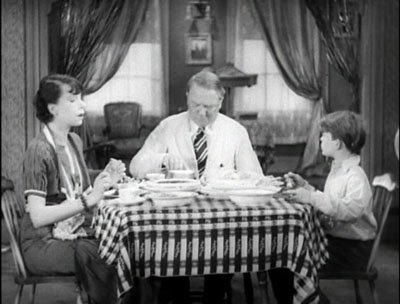
The Barber Shop, 1933, directed by Arthur Ripley, no credited writer. Thoroughly mediocre. Most of the best jokes revolve around how miserable small town life is, but the kind of small town Fields targets (the kind where a proud denizen pronounces that they've got "A public library and the largest insane asylum in the state!") has pretty much died. Fields is in good form here, playing the same kind of antihero he plays in The Bank Dick: the terrible, terrible father. I suppose it was bracing at the time for a comedian to point out that the wisdom dad spouted at the dinner table might be rubbish.

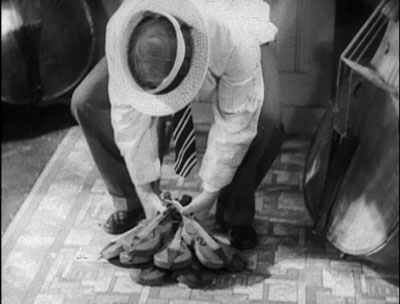
My favorite line: "Mr. Lincoln used to tell riddles, and that, as much as anything else, made him the wonderful president that he was." The stuff in the barber shop itself is very much like The Dentist, but not as funny. It's a pity the disc doesn't end on a particularly high note, but that's the price you pay for chronological order. The Barber Shop hits the kind of absurdity that makes The Fatal Glass of Beer so much fun only once, at the very end. For reasons too convoluted to explain, Fields has left two double basses leaning against one another in the corner of the shop for the length of the film. When he picks one of them up at the end, it gives birth to a pile of violins.

So the disc ends as I suspect W. C. Fields would have wanted it to: on the wrong side of the Hays Code.

Watching this many short films in one sitting glosses over the fact that these were directed by different people over a period of years. And given the incredibly rapid rate at which the Sennett productions were churned out, comparing them to features that spent years in development seems a little unfair. The correct comparison is probably to episodic television, and if he had been born twenty years later, I suspect that's where W. C. Fields would have ended up. He only really played one character, but he played that character extremely well. Whether America would have welcomed a misanthropic, bumbling drunk into their living rooms once a week is another question. But I certainly would have.

Randoms:

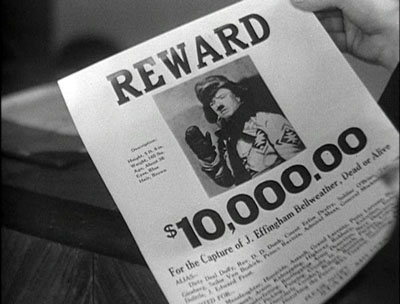
  • The Golf Specialist has a Simpsons-style freeze frame joke. Near the end of the film, we're told that J. Effingham Bellweather is a wanted man, and we briefly see his wanted poster (one of the best photos of W. C. Fields ever).

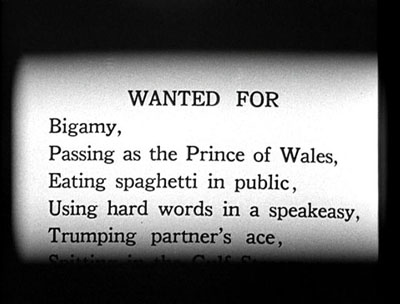
    That poster's interesting in and of itself, because it seems to have all of the rejected ideas for Bellweather's name listed as aliases: Dirty Deal Duffy, Rev. D. D. Dunk, Prince Raviola... But although the poster shows his crimes as things like manslaughter and homicide, the next shot is a ten-second pan down a list of offenses that would be right at home at McSweeneys. Except for its racist conclusion.

    For your reading pleasure, here's everything J. Effingham Bellweather is wanted for:

    • Bigamy,
    • Passing as the Prince of Wales,
    • Eating spaghetti in public,
    • Using hard words in a speakeasy,
    • Trumping partner's ace,
    • Spitting in the Gulf Stream,
    • Jumping board bill in seventeen lunatic asylums,
    • Failure to pay instalments on a strait-jacket,
    • Posessing a skunk,
    • Revealing the facts of life to an indian.


  • Clyde Bruckman, who directed The Fatal Glass of Beer, had his own illustrious history. He wrote most of Buster Keaton's best work, including Sherlock, Jr. and The General, which he directed with Keaton. He also wrote Welcome, Danger! for Harold Lloyd, and directed films starring Lloyd, Laurel and Hardy, and the Three Stooges. But he liked drinking even more than Fields did, was basically too drunk to direct The Man on the Flying Trapeeze, got fired (Fields apparently took over his duties mid-shoot), and nevere directed another film. If that reminds you of the director character in The Bank Dick, well, it should. Bruckman worked as a writer for a while, but became radioactive after Harold Lloyd sued Universal over stolen gags in one of his scripts. After directing an ill-fated live television show starring Buster Keaton in the fifties, Bruckman borrowed a gun from Keaton, went out to eat on Santa Monica Boulevard, bought a meal he could not pay for, and shot himself in the head.


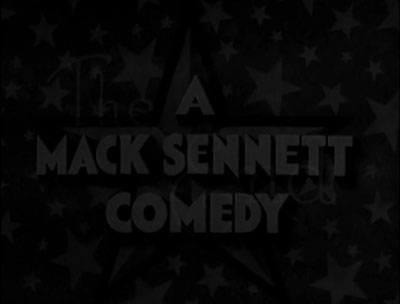
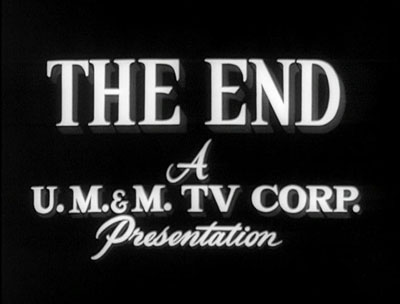
  • Criterion doesn't offer much information about the origins of the prints used for this DVD, but there's a clue in the end credits. We briefly see an end title begin to fade in over the Mack Sennett logo:

    Before it's replaced with the following:

    It turns out that the U. M. & M. TV corporation bought virtually all of Paramount's short film library around 1955, on the condition that they remove the Paramount logo before airing them. Which they did, by cutting the original negatives. So the results are a mixed bag. The opening credits of The Dentist appear to have been restored but are windowboxed (perhaps by mistake?), The Fatal Glass of Beer features a static title screen—misleadingly claiming the picture is copyright 1933 by U. M. & M. TV Corp—while what is obviously the dog from the Mack Sennett logo barks on the soundtrack, The Barber Shop has the same dog barking in the background over a black screen, but then shows a Paramount copyright superimposed over what appears to be the U. M. & M. TV Corp's opening titles. The moral is that both copyright lawyers and film restoration experts have very difficult jobs, and when Paramount tells you to take their name off something, they don't mean destroy the original negative. None of that tomfoolery was quite as jarring as the intertitles on Pool Sharks:

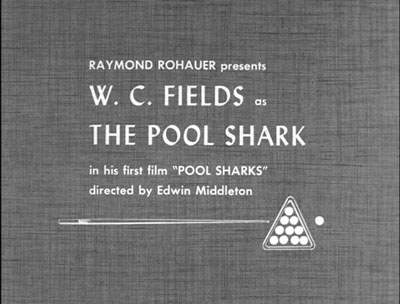
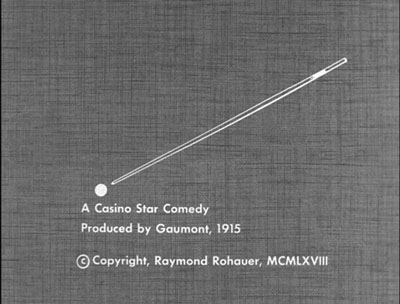
    Yep, it's the Encyclopædia Britannica font, in a film from 1915. There's a reason the film has new intertitles, and it has to do with Raymond Rohauer's somewhat shameful career. The copyright page tells the story:

    Produced by Gaumont in 1915, but copyright 1968 by Raymond Rohauer. Rohauer was in the habit of taking films out of the public domain and copyrighting them himself (usually by making minor changes like the new intertitles seen here). He got his start running the Coronet Theatre in Los Angeles (still extant on La Cienega Boulevard, next to one of my favorite dive bars—it's mostly used for comedy and theater now). He moved from art-house-owner to distributor when James Mason brought him a cache of long-believed-lost Buster Keaton films he found in the garage of a house he'd just bought, and apparently was so notorious for copyright manipulation that he was something of an inside joke for film nerds. As DVD Savant tells it:
    One gag film shown to great approval at Filmex in 1972 was an ersatz Rohauer copy of Fred Ott's Sneeze, an Edison film that lasts about four seconds. The parody surrounded the snippet with at least three minutes of redundant and insulting new scrolling titles, mostly proclaiming Rohauer's copyright and threatening legal action to pirates. It ended with the statement that Rohauer had successfully acquired the copyright on sprocket holes.
    Whatever his sins against the public domain, Rohauer preserved a large number of films that would otherwise have been lost, and gave Kino Video access to his entire collection on his death. Why not Criterion, Raymond?