Wednesday, March 08, 2006

#51: Brazil

Brazil, 1985, directed by Terry Gilliam, written by Terry Gilliam, Charles McKeown, and Tom Stoppard.

In Brazil, Terry Gilliam asks the audience to imagine a world where the government wages a never-ending war with shadowy terrorists, a world where civil liberties are being destroyed in the name of security, a world where torture becomes official state policy in order to conduct more efficient interrogations of suspected terrorists. What's more, in Gilliam's fictional world, the central government is not just secretive but incompetent. Mistakes are made, leading to the imprisonment and torture of innocents. Most offensive of all, Gilliam implies that such a government could exist without its citizens staging an armed revolt. I'm usually willing to suspend disbelief, but this goes too entirely too far.

Despite the description, Brazil is not a documentary. It's not even political, at least not the way most dystopian works are. Instead, it's a critique of bureaucracy in the broadest possible sense. Critics who don't read Brazil as a critique of their least favorite political system tend to say it's about the power of dreams to conquer oppression. But that misses the point, too. In Brazil, fantasy is dangerous. Not because it's dangerous to institutions, or the system, or whatever else you might have been coached to expect in this kind of movie. No, pretty much because it's a hopelessly inadequate weapon against even the most incompetent power structure. Oh, the other thing about Brazil: it's a comedy.
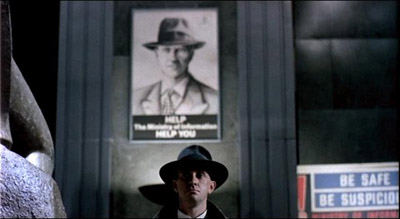
Jonathan Pryce plays Sam Lowry, an anonymous functionary rotting away in a dead-end government job. The poster he's unconsciously mimicking is out of focus by the time he steps into the frame, but it reads, "HELP The Ministry of Information HELP YOU." It's instructive to note what kinds of governments actually have Ministries of Information. Sam works for the bad guys, but in his defense, he doesn't work very hard for them. He's found a way to be part of the system while doing as little damage as possible; the classic go-along-to-get-along guy. He's a clerk with the Department of Records, as far from the bright center of the universe as possible. Brazil opens with a horrifying scene of an official abduction at Christmastime. Stormtroopers in gas masks burst in through the doors, windows, and ceiling of a poor family's home, wrap the man in a burlap sack, read a scripted arrest notification ("Mr. Buttle... has been invited to assist the Ministry of Information with certain enquiries...") and bundle him off.
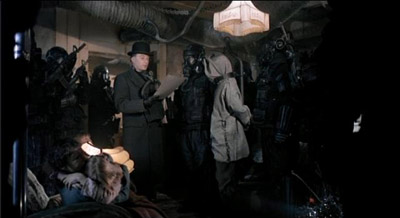
Sam Lowry is aware of the scene above—the terrified wife, the screaming children, the officer in a bowler, the uniformed thugs—but by the time it's brought to his attention, this is what it looks like:
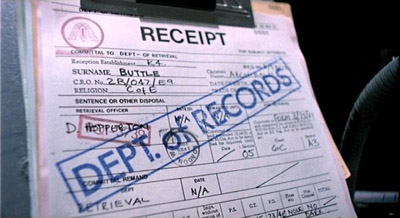
That's the Department of Records's copy of the Ministry of Information's receipt for Mrs. Buttle's receipt for her husband. Unfortunately for nearly everyone in the movie, the Ministry of Information should have picked up Archibald Tuttle, not Archibald Buttle. This error is what pushes Sam out of his cocoon of paperwork and into the horrors that surround him. But the mechanics of the plot aren't what makes Brazil a great movie. It functions best as an essay about the way power systems force people into passive-aggressive relationships with each other. In this sense, Gilliam's movie is closer to Rousseau than Orwell.

There are three standout performances that show different ways of peaceful coexistence with a beast like the Ministry of Information, ranging from the comic to the horrifying. Most passive is Ian Holm's performance as the head of the Department of Records, Mr. Kurtzmann, who is the petty tyrant his name (short-man) implies.
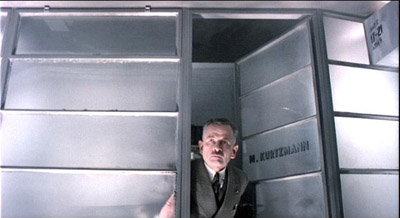
Kurtzmann is an incompetent, effete paranoiac. But he's better equipped for survival than Sam; he knows how to avoid being held accountable. Kurtzmann and Sam's relationship will be immediately familiar to anyone who's had a boss who knew less than they did. But as the film progresses, Kurtzmann looks smarter and smarter; his incompetence is a shield.

Less funny and more threatening are Bob Hoskins and Derrick O'Connor as Spoor and Dowser, two duct repairmen from Central Services whose battle with Sam over the repair of his ducts is a major sideplot.
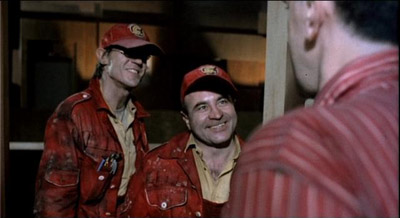
Bob Hoskins, as you'll note from his smile, is in full The Long Good Friday mode; nobody to fuck with. Sam Lowry calls these guys in when the air conditioning at his apartment breaks. Once he pisses them off (by having the system fixed by an off-the-books repairman), they do everything they can to torment him. The beautiful part is that they do it all by the book, filling out all the necessary paperwork as they tear his apartment to bits. By the end of the movie, all Lowry's possessions are dripping icicles as Spoor and Dowser hang out in environmental suits. This is the definitive portrait of aggrieved functionaries, using every bit of their limited power to fuck things up.

The most horrifying character in Brazil, however, is also the best family man in the movie, filled with bonhomie and good intentions. This is Michael Palin, playing Sam's oldest friend, Jack Lint. He has a beautiful wife and adorable triplet daughters. He also works for the Department of Information Retrieval, on the top floors of the Ministry of Information, where he tortures people to death for a living. It doesn't seem to bother him much.
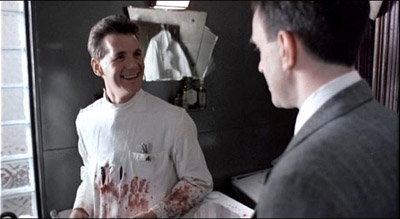
You don't get the impression that Kurtzmann or Spoor or Dowser think too much about what they do for a living. Lint's different; he believes he's fighting the good fight. "Our job is to trace the connections and reveal them," he tells Sam. But Jack can't afford to draw any connections between what he does for a living and the kind of person he imagines himself to be, and his cognitive dissonance is the moral abyss at the center of the movie. A system like the Ministry of Information requires thousands of Jack Lints, each more interested in their daughter's latest exploits than the bloody handprints on their shirts. Casting Michael Palin in this role was a brilliant move on Gilliam's part—not only is Palin naturally affable, but the audience has been coached by Palin's work with Monty Python to expect him to be funny.

Which is not to say Brazil isn't funny, but it's darker than a black comedy. Call it a black hole comedy; no light escapes. Katherine Helmond and Jim Broadbent turn in great performances as Sam's mother and her plastic surgeon; here they are at a post-op celebratory party. Note how plastic Broadbent's face is here.
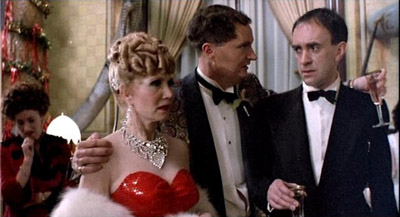
This party scene is actually the one moment in the movie that's almost entirely comic. Kathryn Pogson, playing a young woman Sam's mother is trying to set him up with, does a bit of physical comedy that's absolutely first-rate. And if you can watch Jonathan Pryce's eyes during his conversation with Jack Lint and his wife without cracking up, you're a better man than I. But the party is also where Sam definitively sticks his head above ground, accepting a promotion from the Department of Records into Information Retrieval. From here on out, Sam's part of the moral, spiritual, and even architectural emptiness that's at the heart of this world. Here's the entrance to Information Retrieval.
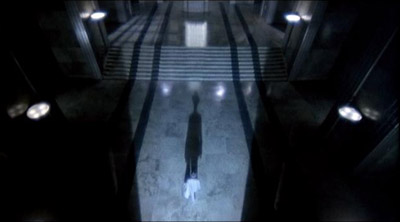
There's a straight line from those doors to the movie's heart of darkness, which makes Room 101 look like Candyland.
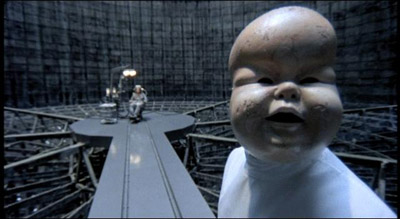
It's worth noting at this point that the highest ranking official who's ever mentioned in the movie is the deputy minister. Nobody's behind the controls. And the most dangerous thing in a system like that is believing you can make a difference. Which brings us to Sam's daydreams.

Sam thinks of himself as a movie star hero, an angel with metal wings and facepaint:
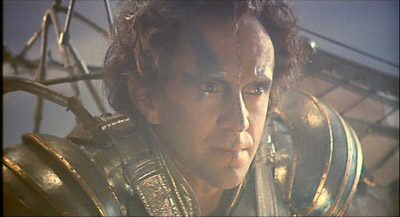
Obviously, this bit of costume design hasn't aged as well as the rest of the film, but it's clear that Lowry's ideas of heroism come from the movies. His apartment, unlike anyone else's, is decorated with film posters, and at one point, looking for a conversation ender, he steals a line (inappropriately) from Casablanca. That's a significant movie to choose, because Rick Blaine is the definitive Hollywood portrayal of what Jim Shepard calls "the hero in disguise." Here's Shepard's description of Blaine:

No one in Casablanca...is at all surprised when Bogart's Rick throws self-interest out the window in favor of the underdog and duty. Sure: Rick may talk like an isolationist for three-quarters of the movie. But when the chips are down...

Part of the fun of Casablanca is waiting for Rick to inevitably become a hero. But waiting for Sam Lowry to try to make the same move is more like watching a babysitter in a slasher film set out to explore the dark basement. At the beginning of the movie, daydreams provide Sam with some respite from the awfulness around him, and that's all they do. It's once he convinces himself that he really is the kind of hero he dreams about, and tries to assume that mantle, that things go terribly wrong for him. At the film's end, he's still relying on fantasy as a shield from the horribleness of his existence, but his existence is orders of magnitude more horrible and he's gotten everyone he cares about killed. So to me, to the extent the movie was about fantasy at all, it was about the danger of confusing fantasy with the real world. From my perspective, Sam's dreams are no more important than Kurtzmann's incompetence, or Spoor and Dowser's petty triumphs; just another way to bear the unbearable. And maybe a riskier coping mechanism than anyone else's, at least in the Ministry of Information. Dreams don't leave a paper trail.

Randoms:

  • As you can tell from the stills above, James Acheson's costume design is a film noir lover's wet dream. Note especially the jump from the late 30's to the mid-50's for the formalwear at Sam's mother's party. As if the rich can afford to live fifteen years or so in the future. Which they more or less can.

  • As great as the costume design is, it has nothing on Norman Garwood's production design. Just a few examples; virtually every frame of the movie is packed with brilliant work. First, here's the Ministry of Information's logo, featured on every one of the billions of pieces of paperwork that litter the movie:

    Note how busy and overdesigned the logo is, and yet how immediately recognizable. Much simpler in terms of graphic design are the propaganda posters that cover the walls. You can see one in the first still above, but there are more than twenty. My personal favorite is the one that reads "DON'T SUSPECT A FRIEND...REPORT HIM!" But for sheer design genius, it's hard to beat this:
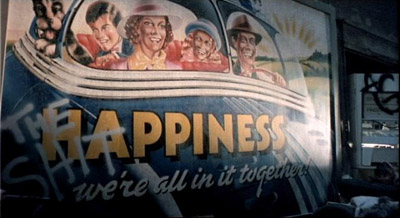
    Which is a modified version of a piece of billboard art that Margaret Bourke-White captured on film in the 30s:
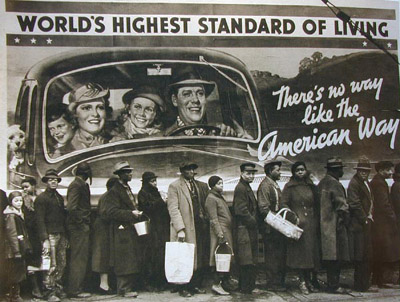
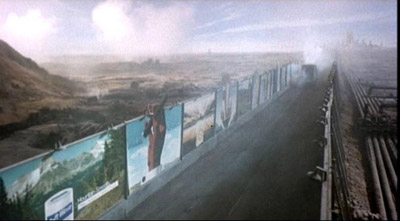
    Notice how much meaner the kids look in Brazil's version. Last, here's the film's version of the open road, offered as a bracing tonic to the overcrowded squalor of the cities:
  • One thing Brazil has in common with 1984 is the overall shoddiness of their worlds. Remember Victory Gin? Well, the food in Brazil doesn't seem so great either, but it's the industrial design that's really appalling. Here's a telephone:
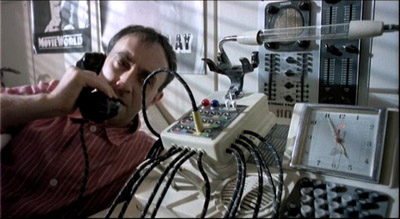
    To talk, you simply put the right cables in the right plugholes. It's as easy as making calls with CINCO. And here's a computer:
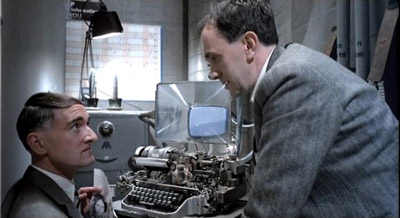
    Both devices are as user-unfriendly as it's possible to imagine. Nothing in Brazil works right, and even the East Germans designed better looking technology. You can see the Ministry of Information logo on the filing cabinet in the background, looking more than a little like a Masonic compass and square. (Blake would have loved this movie, I'm convinced). By the way, that's co-screenwriter Charles McKeown on the left, playing a character named Harvey Lime. Is the name a clue that he's in charge of the whole show? Almost certainly not.

  • Two more cameos: the technician at the film's opening is Ray Cooper, who worked on the score with Michael Kamen and my roommate tells me is Elton John's percussionist. And it's not really a cameo but I would be a jerk not to mention Robert De Niro's role as renegade duct repairman Harry Tuttle. De Niro apparently spent a great deal of time researching his part, much to the annoyance of the rest of the cast and crew.

  • A word about the score Cooper helped with: it's brilliant. It's based on Ary Barroso's "Aquarela do Brasil," a masterpiece of cheesy lounge music. Gilliam's original idea for the movie came to him from a single mental image: a man sitting on a beach dyed black with coal dust, surrounded by industrial wreckage, listening on a staticky radio to an old song that promised exotic escape. "Aquarela do Brasil," (or to be precise, the worst English versions he could find) was what he settled on. Kamen hated the song, and tried to get Gilliam into Luiz Bonfá and Antonio Carlos Jobim, but to no avail. Gilliam wanted "Brazil," and Kamen rose to the challenge. Virtually every cue takes something from the song; all of them are good and some are transcendent. My personal favorites are the music under the tracking shot through the Department of Records (a particularly manic arrangement designed to mimic typewriters) and the cue during Harry Tuttle's burial by paperwork (Harry Tuttle's theme comes back in a minor key and is gradually overshadowed by the bass line from "Brazil," newly ominous). Also, I defy anyone who has noticed that Harry Tuttle's theme can be sung "Haaaaaaaaaaarry Tuttle!" to not think of that whenever his horns come in. Finally, it should be noted that the samba-with-children's choir version of "Brazil" that closes the movie is a direct allusion to the end of Black Orpheus, but kind of a sick joke, given the difference in tone between the two endings. Bonfá and Jobim redefined movie music, so Kamen returns the favor by redefining Bonfá and Jobim.

  • The film isn't kind to women. Besides Sam's nightmare of a mother, the only other major female character is Jill Layton, who we know just about nothing about that isn't filtered through Sam's fantasies.

    Reportedly, Jill had a larger role in the script, but was scaled way back because Gilliam wasn't happy with Kim Griest's performance. I suspect she would have been cut back anyway; the film is already overcrowded.

  • Not as overcrowded as the Criterion Collection DVD edition, however. At three disks, this is the largest set so far (and the reason for the gap between the last movie and this one). Watching And The Ship Sails On, I wished for more special features. Well, like the man says, everyone gets everything he wants. Brazil was the subject of an epic battle between Universal's Sid Sheinberg and Terry Gilliam; Sheinberg wanted cuts made to the movie and Gilliam wouldn't make them. Usually, these arguments are very private; Gilliam made this one personal and public, appearing on the Today Show with a glossy photo of Sheinberg and taking out a full page ad in Variety ("Dear Sid, When are you going to release my movie, Brazil?") Eventually, Sheinberg brought in a team of ringers to recut the movie; the third disk of this set is the U.S. television version, believed to have been made from Sheinberg's cut. It's excruciatingly bad, but worth watching to see how the same raw footage can be used to produce a work that's entirely different in tone and effect. Anyway, this movie chronicles parts of the production process that most DVDs ignore completely. Which is great—but don't think you're going to get through it in a weekend. If two commentary tracks, the two cuts of the film, and an entire disc devoted to production details isn't enough to keep you busy, you can always buy Jack Mathew's book.

  • Confidential to any Central Services employees: here's form 27B-6. Keep a few copies with you; you'll need them.

    Wired magazine runs a blog on "Privacy, Security, and Crime online" that's an invaluable resource if you're interested in those things. Although the blog's name is now officially Threat Level, fans of Brazil will enjoy its original name, still part of its URL.

  • The highlight of the second disc, to me, was the section on various drafts of the screenplay. As a screenwriter, it's incredibly reassuring to see the missteps that even writers like Tom Stoppard make between the initial concept for a film and a polished shooting script. To put a complicated process in a few words, it's about simplifying and streamlining, getting as few characters as possible to do as much as you can. In this case, early drafts featured no link between Buttle and Tuttle (that was Stoppard's great structural contribution). Having Jack Lint be the man who'd interrogated Buttle was a third or fourth draft simplification, one that it's difficult to imagine the movie working well without. Before then, he was Lowry's friend, but played no real role in the plot. Oh, one more thing to learn from the screenplay section: DON'T PISS OFF TOM STOPPARD. Here's how Terry Gilliam describes the differences of opinion that led them to stop working together:
    There would be areas where I just didn't agree with what he was doing, I didn't get it, it was too intellectual or too, I guess, clever, as opposed to emotional.
    Now here's how Stoppard describes the same problems:
    What I recall in a general way is that, because as I remarked before, Terry wasn't principally interested in verbal humor, or indeed in words—I really don't believe he's that interested in dialogue as a craft—sometimes he wouldn't understand a joke, perhaps, and it's incredibly difficult to explain a joke to somebody who simply doesn't understand it. There's a line somewhere in the film where Michael... Jonathan Pryce meets Michael Palin somewhere and he says, "Hello! How are the twins?" and Palin says, "Triplets," and Sam [Michael] says, "Oh, how time flies!" Terry was completely bewildered by this, and also I was completely incapable at explaining why it was a joke at all. It is in the movie, I believe. And there's a scene where the mother, who's fairly hideous—no, that's perhaps unfair—but the mother is having plastic surgery of some kind. And halfway through the process one sees her looking, you know, quite repellent. And the doctor's saying, "There you are! Already she's twice as beautiful as before!" And the son looks at her and says, "My God, it works!" Terry didn't... Terry had difficulty understanding, and in fact I think he cut that out, and then later he got it, and tried to put it back and perhaps succeeded in putting it back.
    I would rather not have Stoppard running around saying on the record that I was a dolt who couldn't get a joke, much less a writer who was not interested in words. By the way, Gilliam cut that "My God, it works!" line out of the Criterion edition.

  • There are four different cuts of this movie: a European theatrical cut, the U.S. theatrical version, the television syndication cut, and the Criterion edition's director's cut. I know that I've seen the U.S. theatrical version (which I think is the only one that has the "My God, it works!" line—although the TV version does have Sam say, "My gosh, it works") but I don't know where I might have seen it. Maybe on a 16mm print in college; it's also possible that the VHS version was this cut. It's not available on DVD, though; the Universal DVD is the same cut and transfer as the Criterion edition, but without any of the extras. So we'll all have to wait for the twenty-five disc definitive Criterion reissue to see that version again.

  • Finding political parallels between this movie and the present day is a first-paragraph-only kind of exercise. But it's also a last-bullet-point exercise. I feel like the world has moved further from 1984 and Brave New World. And certainly Alphaville seems quaint. Brazil? Not so much. An exchange from the screenplay that didn't end up in the movie:

                    JILL
          Don't you know the sort of thing
          that Information Retrieval does?

                    SAM
          What do you mean? Would you rather
          have terrorists?

                    JILL
          We've got both.

    Ladies and gentlemen, welcome to Brazil.

Tuesday, February 07, 2006

#50: And the Ship Sails On

And the Ship Sails On, 1984, directed by Federico Fellini, written by Federico Fellini and Tonino Guerra.

The tenth literary rule Mark Twain accused James Fenimore Cooper of breaking in "James Fenimore Cooper's Literary Offenses" goes like this:

...the author shall make the reader feel a deep interest in the personages of his tale and in their fate; and... he shall make the reader love the good people in the tale and hate the bad ones. But the reader of the "Deerslayer" tale dislikes the good people in it, is indifferent to the others, and wishes they would all get drowned together.

Well, one thing you can say about And the Ship Sails On: Fellini may have broken Rule 10, but at least he gave me what I was wishing for. I tried to like this movie. I saw it several times. I read everything I could find about it. But it seems to be the work of a different director than Nights of Cabiria, and not a better one.

And the Ship Sails On is the story of a doomed ocean liner travelling through the Mediterranean during July of 1914. Austrian archduke Franz Ferdinand was assassinated on June 28 of that year; the first armed clashes of World War I took place in early August. So the action of the movie takes place in the lull as Europe geared up to tear itself to shreds. Until the last third of the movie, however, history barely impinges on the quotidian concerns of the aristocratic passengers. The purpose of their voyage is to scatter the ashes of a recently deceased operatic diva near the island where she was born. Most of the passengers are connected in some way or another to the world of music, with two exceptions. The first is a journalist named Orlando, played by Freddie Jones (who you probably recognize from many of David Lynch's movies):

Orlando serves as the audience's guide to the dozens of characters on board the ship; he's there because he's making some sort of documentary about the voyage. Sometimes he is accompanied by a cameraman, sometimes he just addresses Fellini's camera. When Orlando addresses the camera (as he does quite often), you're rarely sure whether Orlando is breaking the fourth wall or just talking to his cameraman. The idea of a talking-head-style journalist in the silent era is one of the better jokes in the movie, but I found Orlando's asides more distracting than effective, not least because of the constant blurring of the real asides with narration that happens within the world of the movie. Fellini actually opens with this kind of blurring: the initial footage is scratchy and silent, complete with intertitles, and people react to the camera like the novelty it is:

But before Fellini switches from silent footage, we see the cameraman and his camera; we're looking through an invisible camera as in most movies. It's playful but he keeps switching back and forth throughout the film, and you're never certain whether a character is going to react to the camera or not.

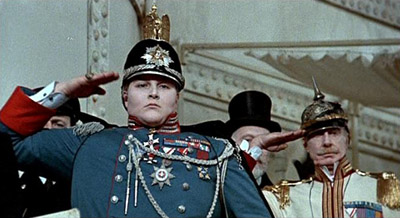
The other passenger who doesn't really belong to the world of opera is an Austrian Archduke. He's more fortunate than Franz Ferdinand, in that July of 1914 finds him still among the living, but less fortunate in that he seems about as likely to grow a mustache like Franz's as he is to grow wings. He looks like a castrato, and the few times you hear him speak about foreign policy don't inspire much confidence.

You could read the Archduke's feminine appearance as a critique of the aristocrats who were marching Europe into disaster during the time of the movie, but he doesn't look much worse than anyone else in this film. To put it bluntly, the passengers look like the walking dead throughout the movie. Here, for instance, is Shakespearean actor Barbara Jefford in a relatively recent photo:

So here's what Fellini made her look like in And the Ship Sails On.

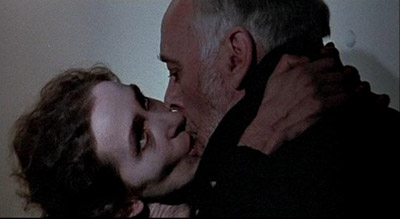
Not a good look for her. And she's held up as the heir to the operatic throne the dead diva has recently vacated. Jefford, by the way, was stunning in the fifties and sixties, but that didn't seem a fair comparison. But in a movie where nobody looks good, nobody looks quite as bad as German dancer Pina Bausch, playing the Archduke's blind sister. Here she is, in the single least attractive kiss since The Shining:

The movie isn't easy to look at; I don't know if the quality of the transfer is responsible, but as you can see, the colors are pretty washed out. As muddy and unappealing as I found the look of the film, however, it was nowhere near as distracting as the sound. Freddie Jones speaks his lines in English, as do several other actors; they've all been dubbed in Italian with near complete indifference to the movement of his lips. Once I realized some of the actors were speaking English, I found the movie difficult to watch, because I couldn't stop lip-reading. Italian films almost never use direct sound, but if you compare five minutes of Nights of Cabiria with five minutes of And the Ship Sails On, you can immediately see the difference between good and bad postsynchronization work. This isn't strictly a function of Fellini letting his English-speaking actors act in their native tongue, either; the Italians do an excellent job of dubbing American movies so that they appear to feature direct sound.

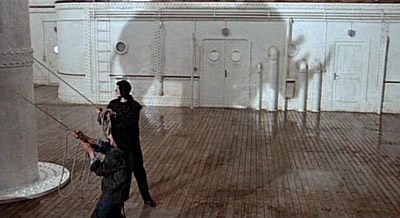
And even if the synchronization were perfect, the sound mix would be hard to listen to. All the voices are mixed at the same level and it sounds as though at most four actors were employed. There's no variation in tone, and some of the voices (the general who accompanies the Austrians, for example) sound like nothing human. Even when the actors are clearly saying their lines in Italian, the same lines as on the audio track, the sound doesn't even come close to corresponding to the image. You can make a case that this is a Brechtian device for distancing the audience from the seductive spectacle of cinema. In fact, the rest of the movie supports this idea: Fellini deliberately uses very artificial special effects and, at the end, has the camera pull back to show the ship's deck in its stage at Cinecittà. But I'm skeptical of film analyses that make subtle virtues out of apparent shortcomings, and whether these are deliberate technique or just indifference, it made the experience of watching the movie excruciating. To me, cinema's seductive qualities are kind of the point.

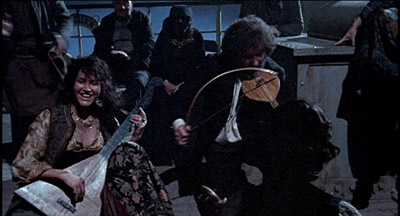
But perhaps this is an unfair criticism, akin to looking for plot holes in Armageddon. As Vincent Canby (who loved the movie) pointed out, And the Ship Sails On "doesn't depend for 10 seconds on anything as conventional as identifiable characters or a narrative." And as we've seen, it also doesn't depend on technical virtuosity. What's left is something you have to watch sort of like you would a sketch comedy show; there are individual scenes and images that work, but looking for anything else will only lead to disappointment. The movie gets better toward the end, when the aristocrats' voyage is disrupted by the world outside, first in the form of Serbian refugees. The refugees look more alive than anyone on screen to that point, and they have the obligitary scene where they play music and dance with greater charm and skill than the upper classes:

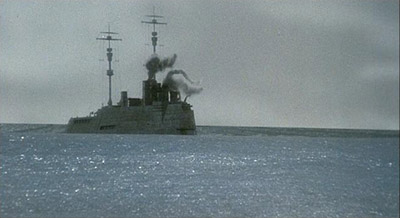
That scene's a cliché, but I liked it anyway. And even the shoddy model work occasionally pays off; I liked the looks of the Austrian warship that appears to capture the Serbian refugees. It looks like an Orion-class battleship as designed by Terry Gilliam:

Note the obvious cellophane sea in that shot; actual water is a rarity in this film. And Fellini does continue to have the same talent for surrealism that characterizes his great films from the sixties. The most notable sequence of this type in And the Ship Sails On is a semi-successful attempt at bathing a rhinoceros, the ship's most unhappy passenger.

The movie's at its absolute best when Fellini is playing with the paradoxes of a media-driven life. The diva whose ashes are at the center of the story keeps getting resurrected, first by an impersonator, then by Victrola, and finally by film, coming most fully to life as the ship sinks:

But Fellini doesn't linger on this (or any of his most effective images) long enough to provoke more than a momentary pleasure in the viewer. Nights of Cabiria was a focused character study with humanity shining through in every shot; 8½ is made with a clear affection for its main character. And the Ship Sails On feels like the work of someone who has fundamentally lost interest in other people; no one but the dead diva seems human. Now I'm not opposed to detached, academic filmmaking per se, but I think for a movie in which we don't care about the characters to work, it has to be well structured and technically competent. And the Ship Sails On, I am sorry to report, struck me as neither.

Randoms:

  • In all fairness, I should note that I am unqualified to judge the operatic music that's a big part of the film. As Canby points out, Fellini uses chopped bits of opera scores, with different lyrics, throughout the movie. Unfortunately, the music is not well mixed, and the new lyrics are not subtitled. The DVD features no commentary tracks, and there doesn't seem to be much criticism of the film available online. So without a better knowledge of Italian (or better hearing) than I've got, you're pretty much on your own as far as teasing out what Fellini is up to with this. I'm prepared to believe that I missed the key that would have made the movie seem brilliant to me. But I could have used more help from the DVD.

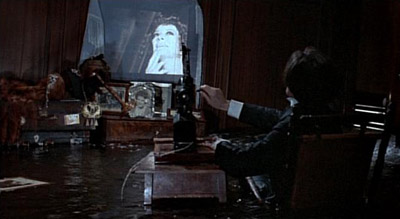
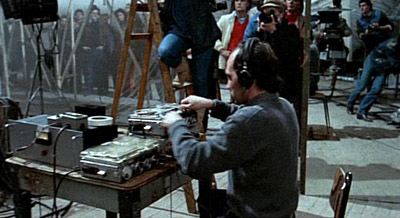
  • The strangest thing about the shot where the camera pulls back to reveal the set at Cinecittà is this guy:

    Clearly recording sound during the shoot (there's a boom mike visible, as well). What did they do with these tapes? They don't seem to have been used—even as a reference—when the postsynchronization work was done.

  • Like I said above, Fellini does a good job of playing around with mediated experience in this movie. Here's the thing, though: And the Ship Sails On premiered at the Venice Film Festival in September of 1983. That means it arrived seven months too late, because the February before, David Cronenberg's Videodrome was released. The two films have some of the same concerns (both even feature characters who only exist in mediated form: the diva in And the Ship Sails On and Professor O'Blivion in Videodrome). But to me Videodrome seems fresh and alive, while Fellini's film seems as antiquated as its sets.

Friday, January 27, 2006

#49: Nights of Cabiria

Nights of Cabiria, 1957, directed by Federico Fellini, screenplay by Ennio Flaiano and Tullio Pinelli, with additional dialogue by Pier Paolo Pasolini.

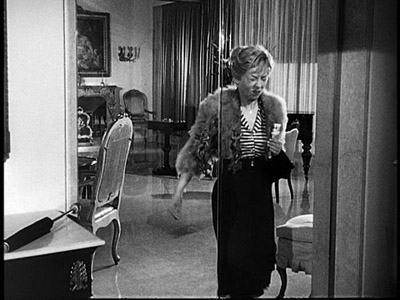
If I made a list titled "Good Settings For Physical Comedy," I think "An Aging, Low-End Prostitute's Descent Into Penury" would be toward the bottom. Which means I would never have made Nights of Cabiria, a film that owes as much to City Lights as it does to The Bicycle Thief. Mixtures of pathos and comedy fit somewhere on a continuum from Waiting for Godot to The 40-Year-Old Virgin. As you would expect from its subject matter, Nights of Cabiria is more Beckett than Apatow, but Fellini isn't afraid to have his star walk into a glass door when the mood needs lightening.

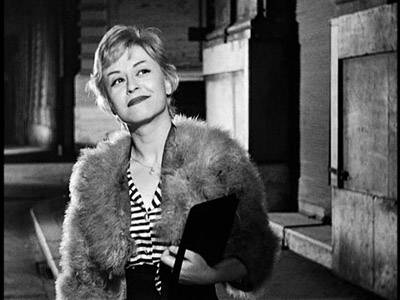
Nights of Cabiria shifts so effortlessly between the heartbreaking and the comic that it's easy to forget how badly the movie could have gone. It's about that most sentimental of stock characters: the hooker with the heart of gold. It's easy to imagine a lighthearted version in which Cabiria is lifted from her sordid surroundings (and that version is called Pretty Woman). Or the movie could have gone the other way and been a turgid "gritty" drama about life on the Roman streets. In its bare outlines, the story is an encyclopedia of cruelty: bad people do bad things to our good heroine. But Cabiria is so fully realized and human that she defies stereotypes. Credit for this goes entirely to Gulietta Masina, who captures Cabiria's loneliness and pride in every frame. She's got a face for the ages:

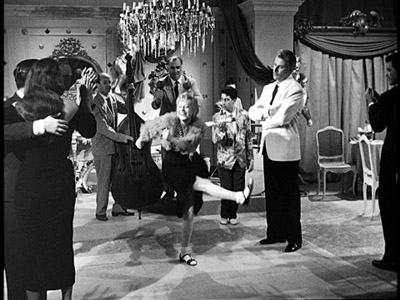
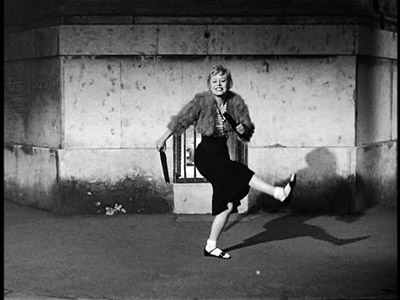
Most of the movies in the collection so far have showcased the work of directors or writers, but Nights of Cabiria is an actor's movie. Masina has a preternatural talent for both broad gestures and more nuanced ones. The most celebrated example is the sequence where she is picked up by a film star named Alberto Lazzari and taken dancing at a nightclub. She's the shortest person in the room, out of her league culturally and financially and pretty clearly intimidated. But once Lazzari takes her on the dance floor, she does this crazy outsized mambo and owns the room (not necessarily for the right reasons):

If this were Pretty Woman, the scene would be all about Cabiria's infectious enthusiasm winning over a crowd of stuffed shirts. It's not, though; as the movie makes clear again and again, none of Cabiria's adventures end happily. This one ends with her sleeping on the bathroom floor while Lazzari enthusiastically reunites with his girlfriend.

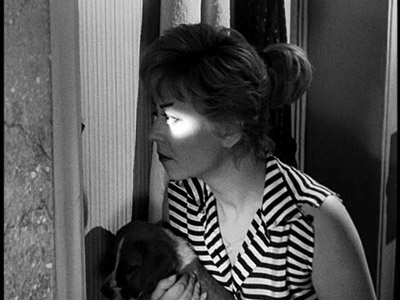
Smaller details are just as keenly observed. My favorite is at the very beginning: Cabiria has just narrowly survived being thrown into the Tiber by a lover who wants to steal her purse. Understandably, she's a little upset.

You can't show it in a still, but when you see the film, pay attention to the way she taps her cigarette, starts to light it, then loses her train of thought and forgets about the cigarette. On paper, it sounds like a showy bit of actor's business, but it's not; I didn't notice that she'd forgotten to light it until the second time I saw the scene.

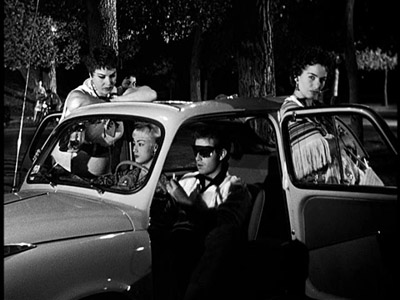
Nights of Cabiria lives or dies on Giulietta Masina's performance. I think it would be hard to make a bad film with her playing Cabiria. That said, Fellini's direction and Piero Gherardi's production design don't hurt. You could say of Cabiria, as Martin Amis said of Austen, "Money is a vital substance in her world; the moment you enter it you feel the frank horror of moneylessness." I was impressed with the ways Fellini and Gherardi imbue that class awareness into the locations and props. The most ostentatiously wealthy person she knows is a pimp with bad sunglasses and a Fiat 600:

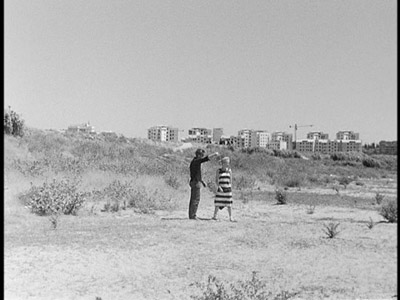
Attention to little details like the car makes all the difference in making you aware of how much money matters in this world. The locations are also carefully chosen. Cabiria doesn't work the Via Veneto, but the Terme di Caracalla, a hangout for prostitutes to this day. Best of all is Cabiria's house, a cinderblock cube in the middle of a wasteland between Rome and Ostia. In 1956, Rome was undergoing its postwar expansion, and Cabiria's neighborhood is on the edge of that sprawl. You can see the city transforming itself into something bigger and uglier in the background of almost every shot, even the first:

I'd be willing to bet that there's a terrible block of terrible apartments now where they're standing.

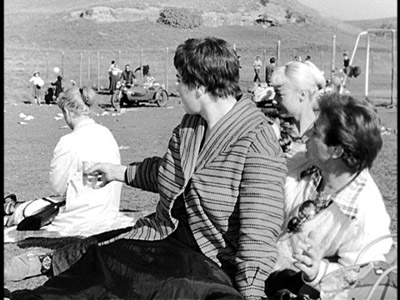
There's nothing about any individual production design choice that's really showstopping. Instead, Gherardi and Fellini make Cabiria's world credible through a slow accumulation of small details. This is what sells Masina's performance when it switches from charming to heartbreaking, when you realize how badly she wants to change. Most people seem to think this happens when Cabiria and her friends make a disastrous pilgrimage to the Sanctuary of Divine Love. But to me, the moment the tone really shifts is a summer afternoon she spends out in the country sometime later.

Masini's performance borders on melodramatic here, but I think the scene captures the way idleness can be unspeakably depressing when you're afraid your life is going the wrong direction. But then I'm the kind of person who takes it for granted that religion won't offer much solace, so the pilgrimage sequence offered no suprises for me. In the later scene, getting drunk fails to cheer Cabiria up. Now that's horrifying.

To the extent the movie has a formal structure, it's a retelling of the same story in successively louder tones: Cabiria finds something she believes will make her happy, but it ends in disaster and humiliation. So the last act is hard to watch: she meets a man who wants to marry her, open a shop in the country, and grow old together. Cabiria doesn't know what kind of movie she's in, but the audience does, and it's not a romantic comedy. The beautiful locations toward the end are to the Roman scenes as Lazarri's villa is to Cabiria's house, and if you've been paying attention, you know that Cabiria won't be allowed to enjoy them for long. It's a rare movie that can fill a shot like the one below with menace.

It's worth noting what makes the last sequence as nerve wracking as it is. Fellini sets up a number of points where you expect Cabiria's new lover to betray her. But instead of the humiliating disaster you've been conditioned to expect, Fellini uses each scene to give you more information about how much Cabiria has bet on this last chance at happiness, financially and emotionally. It's excruciating, but it serves a purpose: the higher Fellini ratchets the tension, the more strange and wonderful ending is.

More than almost any other film character I can think of, Masina's Cabiria seems fully realized to me. It's not that she's particularly realistic in the sense that anyone I've ever met is like her. But I think it's precisely that uniqueness that makes her so alive; she's a true original, as vibrant and sad and suprising as anyone you will ever know.

Randoms:

  • Alberto Lazzari, Movie Star, is played by Amedo Nazzari, Movie Star. It probably wasn't too much of a stretch for him.

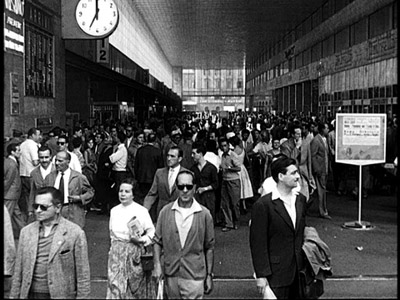
  • Of all the great Roman locations, the shot that really got me was this one:

    That's Termini, looking just as I remember it from 1995. Apparently it's different now; the station was renovated in 1998 and nothing in current photos is recognizable to me.

  • And speaking of renovations in 1998, Nights of Cabiria was cleaned up for a theatrical rerelease that summer (while we were all watching Armageddon). It may be the best example of film restoration ever. Here's what it looked like on video in the states until that summer:

    And here's roughly the same frame from the Criterion edition (made from the 1998 restoration):

    Look at the detail on the dog's face and Masina's hair—it's like a different movie.

  • The subtitles were also rewritten for this release. Unfortunately, the scene they chose to show in the DVD extras as an example of this rewriting has the one line that jumped out at me as a bad translation when I saw the movie. Cabiria is burning everything an ex-boyfriend left at her house (it's the ex who "broke up" with her by "stealing her purse and pushing her into a river to drown"). So she's in a hell of a mood and is yelling as she throws his stuff in the fire. The original subtitle for one of her lines read "Who'll feed him now, my fine good-for-nothing?" Which doesn't make much sense. The new one reads "And who's gonna feed you now? St. Peter?" That's an improvement. But the line (in a bad phonetic transcription of dialect) is actually "Do vai a mangia? A San Pietro?" In modern Italian, that would be "Dove vai a mangiare? A San Pietro?" Which is literally "Where are you going to eat? To Saint Peter's?" It's a name, but it's also a place.

  • This version of the film restores a sequence that was cut out before the film's release, reportedly at the request of the Catholic Church. At least, that's the story everywhere I can find it, except in an interview with Dino Di Laurentiis on the DVD. He claims that he and Fellini fought long and hard over that sequence because he believed it brought the action of the movie to a screeching halt; his version of the story ends with him stealing the negative so Fellini couldn't use it. Reports also vary as to whether that scene was ever shown; Fellini writes that it was shown at Cannes, but this doesn't square with De Laurentiis's version of the story or the more common story of church interference. In any event, the sequence was restored from a print found in France, so it may have screened at least once.

  • The company logo on this is Paramount's, and the title reads "La Paramount Presenta." Did Paramount have a European distribution branch in the fifties?

  • The screenwriters relied on Pier Paolo Pasolini for help with Roman slang. Yes, it's the same Pier Paolo Pasolini who directed Salò. No, nobody eats shit in Nights of Cabiria. Stop worrying.

Monday, January 16, 2006

#48: Black Orpheus

Black Orpheus, 1959, directed by Marcel Camus, screenplay by Jacques Viot, from the play Orfeu da Conçeicão by Vinicius de Moraes.

Critics often write about movies as though they exist in a vacuum. Although they'll trace one filmmaker's influence on another, the ways a film can bleed into the rest of the culture isn't usually part of the conversation (the notable exception is right-wing pundits blaming Hollywood for America's moral decline). I'm not really that interested in talking about movies destroying our moral values (and that conversation is only tangentially about movies). Movies that change the landscape for other kinds of art, though? Yeah, that interests me. One example: I left the United States for Italy in September of 1994, about two weeks before Pulp Fiction was released. Although I saw it while abroad, I didn't think it was going to be more influential than, say, Forrest Gump (its rival at the Academy Awards that year). The next July, on my second day back in the states, I saw a commercial for Crest toothpaste with a surf rock soundtrack. Tarantino had changed what that kind of music meant, and in just ten months it had trickled down to toothpaste ads. For the next five years or so, every time a band at a party launched into a half-assed cover of "Misirlou," I had Tarantino to blame.

Black Orpheus is also one of those movies that bled from one kind of art into another. Marcel Camus didn't inspire the kind of devotion among filmmakers that Tarantino did. But Black Orpheus changed the music world, introducing the west to Latin American music. So when that cover band stops playing Dick Dale and goes into "The Girl from Ipanema," you've got Camus to thank (or curse). Black Orpheus is filled with music from the first frame to the last. The songs were written by Luiz Bonfá and Antonio Carlos Jobim, and they still show up in movie soundtracks, most recently in Casa de los Babys. As far as their bossa nova credentials go, try this: Jobim's the guy who actually wrote "The Girl From Ipanema." So the movie's worth seeing for the music alone, which is good, because I wasn't blown away by the rest of it.

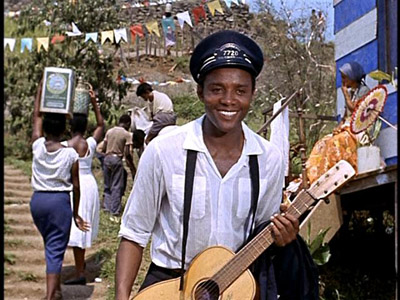
Black Orpheus is a retelling of the myth of Orpheus and Eurydice, set in the favelas of Rio de Janeiro. In the myth, Orpheus is a gifted musician; as played by Bruno Mello, he's also a streetcar conductor.

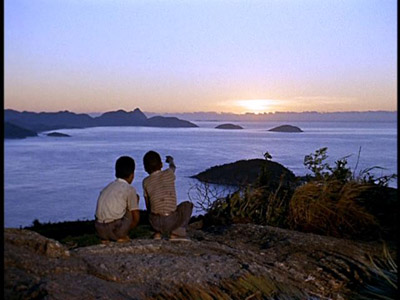
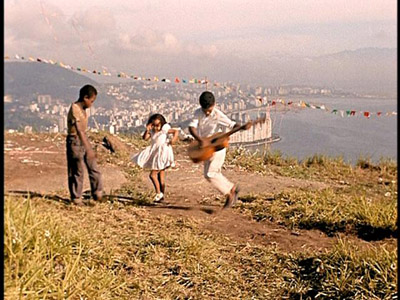
His low-paying job makes him seemingly the most employed man in his whole neighborhood, a slum of epic squalor overlooking the city. Rio is the one city where traditional housing patterns are reversed: the rich live at sea level, while the poor get views like this:

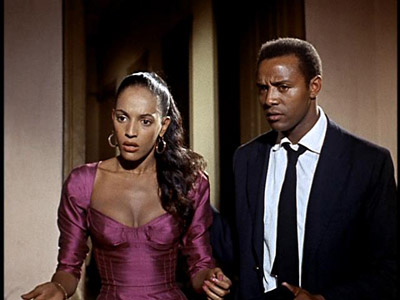
Those kids are watching the sunrise because they believe Orpheus's music literally makes the sun come up. He's something of a local hero among the adults of the neighborhood as well, which is why his fiancé is so hellbent to get married. The first half of the movie or so is a pretty conventional love triangle between his fiancé, Mira, and Eurydice, his true love. Mira is played with aplomb by Lourdes de Oliveira. It's not a particularly difficult role, since Mira is basically enraged at someone from frame one to the end. Usually, it's Orpheus, although in the still below, she's mad at a clerk:

Eurydice, played by the jaw-dropping Marpessa Dawn, has to look dreamily in love for most of the movie. And she's very good at it:

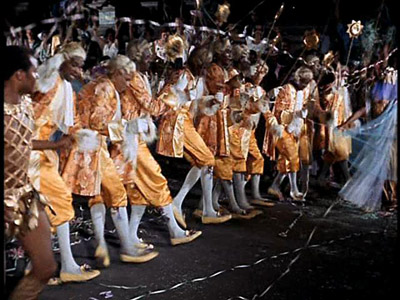
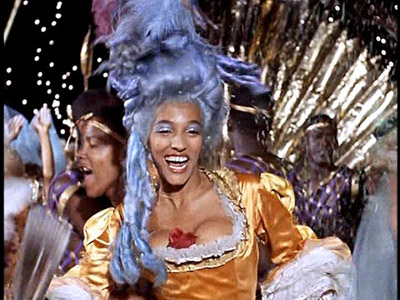
If you know your mythology, you know Eurydice isn't long for this world. Which is good, because although Camus's version spends most of its time with Eurydice still alive, the love story feels prefunctory. Not to say the early sections of the film are boring: Camus has a tourist's enthusiasm for Rio, and the settings are gorgeous. The movie takes place during Carnival, when the favela's samba school is preparing for the parade. Here's part of the parade:

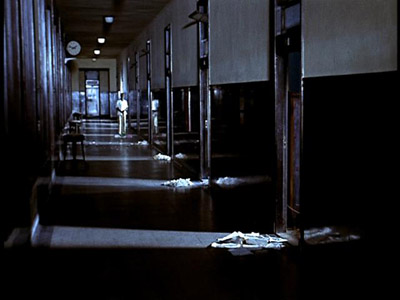
As you can see, Jean Bourgoin's cinematography is a really vibrant technicolor throughout. The colors are at least as bright as The Red Shoes. But Black Orpheus doesn't really get interesting visually until Eurydice is dead. After running through the depressing wreck that Carnival becomes when it's over (police rounding people up, drunks passed out on the streets, &c.), he arrives at the bureau of Missing Persons, possibly the most depressing building in South America.

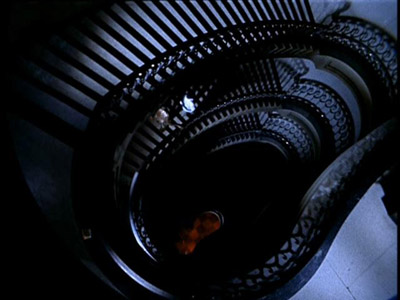
I didn't get a still of the exterior (nor do I know what building Camus actually used) but it's as inhuman as anything in Brasília. My favorite shot in the movie is of Orpheus being led downstairs from the Bureau of Missing Persons: the red light on the ground floor tiles makes it look like he's descending into a pool of glowing lava.

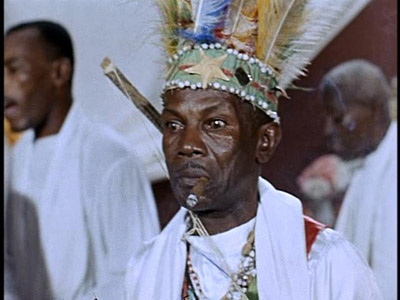
I'm skeptical that those stairs are in the same building as the exteriors, but I love them. (Incidentally, Insomnia also has an oval variation on the stairway-as-maze shot, so we're two in a row now). Less cool than the above: the lowest depths of the underworld, represented by a Macumba ceremony, although I did like the priest:

Now that's a religious leader I could get behind: stone crazy. Camus shows maybe five minutes of this ceremony, and to me, this was the worst scene in the movie. The whole film walks a fine line between focusing on its characters and being a combination travelogue and introduction to bossa nova. The Macumba ceremony goes far enough towards travelogue to feel anthropological. It should be the emotional high point of the film; it's Orpheus's last contact with Eurydice (and the core of the original myth). Maybe it's just my ADD, but staging it during this ceremony seemed distracting to me.

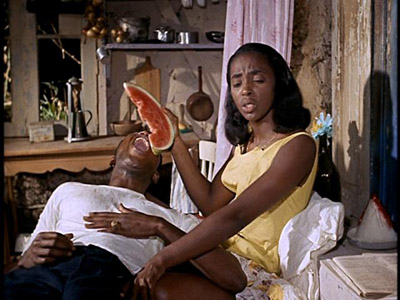
And I guess that was my real problem with this film: it is clearly a celebration of Rio, but it seems at times to focus on being enthusiastic about the city and its music at the expense of its characters. I really didn't find Orpheus, Mira, or Eurydice remotely believable. Not that I know much about it myself, but I suspect that life in the favelas involves more than singing, dancing, and spectacular sunrises. And I'm not a hard-liner about racial stereotypes, but surely I'm not the only person who squirms when a film features a lazy black man chasing after a slice of watermelon.

This is one of those cases where it matters who made the film. I first saw it when a friend who'd lived in Brazil the previous year recommended it to me; I was kind of baffled as to what she saw in it. Talking to her about it later, it became clear that she'd believed the movie was made by a Brazilian, not a white Frenchman. If it were the work of an insider, Camus's condescending view of poverty and flirtation with racial stereotypes would be more forgiveable. But there aren't any insider filmmakers in the favelas of Rio. Fernando Meirelles and Kátia Lund are the closest thing I can think of, and they both grew up in the suburbs of São Paulo. Discussions of authenticity are always a little uncomfortable, and I'm one of the least authentic, most waspy wasps you'll ever meet. So I'm uniquely unqualified to talk about stereotyping or snipe at Camus for being out of line. Still, I have a (probably misguided) sense of who's allowed to say what. Jessy Terrero gets to make Soul Plane and even Stepin Fetchit is undergoing cultural rehabilitation and I don't have a problem with either thing. But the watermelon scene in Black Orpheus made me genuinely queasy.

Anyway, scratch too deeply at anyone's feelings about race and authenticity and you're staring into the abyss (or worse still, watching Crash). That's a discussion for a different place. With Black Orpheus, you'd do better to just enjoy the scenery and music. Camus is smart enough to bring those two elements back together at the end of the film, when one of the neighborhood kids takes on Orpheus's duty of making the sun rise. But unlike Orpheus, who tended toward mournful ballads, the kid's song is fast and infectuous. Whatever you think about the rest of the film, it's impossible to watch the ecstatic ending without being sucked in. It's a pity the rest of the film isn't as fluid and seductive.

Randoms:

  • Bosley Crowther's original review of the movie for the New York Times is available online. It's quite a read: the review is shot through with phrases like "she conveys more forthright emotion than does the non-terpsichorean man." He also uses the royal we. On the whole, it reads a bit nineteenth century (or at least early twentieth). Crowther was in his fifties when he wrote it. How then, to explain the last paragraph?
    The language spoken, incidentally, is Brazilian Portuguese, which is translated in English subtitles that completely lack the samba beat. A cat with a cool vocabulary should have been turned loose on them.
    Maybe I'm missing something here, but that seems a little out of place.

  • Lourdes de Oliveira earns a place in my personal hall of fame for her unbelievably spectacular... sleeves. You can see them pretty clearly in the still below; that's her Carnival costume. But a still photograph doesn't do justice to the force-of-nature impact of watching them move as she dances. Because, um, they're ruffled. Her sleeves are ruffled.

  • Seu Jorge, who's in City of God and The Life Aquatic With Steve Zissou, actually did grow up in the favelas. So if he ever starts making his own movies, there'll be an undeniably authentic movie about that world. I haven't seen Life Aquatic recently, but it seems to me that Jorge is doing his best Bruno Mello-as-Orpheus impression.