Wednesday, September 14, 2005

#40: Armageddon

Armageddon, 1998, directed by Michael Bay, screenplay by Jonathan Hensleigh and J. J. Abrams, adaptation by Tony Gilroy and Shane Salerno, story by Robert Roy Pool and Jonathan Hensleigh (I have no idea what work those writing credits actually correspond to).

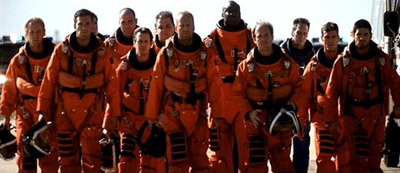
Armageddon seems like an odd choice for a Criterion edition, but if the collection is intended to provide a representative sample of film throughout history, neglecting the late-90's studio system would be silly. If you're one of the three people who didn't see it, it was pitched as "Red Adair in space," and later as "The Dirty Dozen in space." The basic story (and it is the most basic of stories) is that a gigantic asteroid is on a collision course with earth, and NASA sends a group of twelve oil-drillers into space to plant a nuclear bomb that will destroy the asteroid and save the planet. Here they are in full The Right Stuff-hero-mode (which is the only mode they've got):
Armageddon exemplifies a certain type of movie; the big, dumb, loud, critic-proof summer blockbuster. This sort of disaster movie is still around, but it's evolved a lot in the last seven years. The closest thing to Armageddon this summer was War of the Worlds, which is a much more thoughtful movie. Here's why:
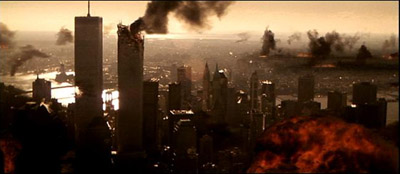
New York, post meteor shower.

The destruction of American cities is no longer a guilt-free pleasure. There's a reason that The Onion namechecked producer Jerry Bruckheimer when they wrote this, and Armageddon is his masterpiece. Watching it now, you see so many scenes that simply could not be made today, or even conceived of, and for me that made rewatching it oddly poignant. The men and women who worked on the film were certain that they were living at the end of history. Too bad it didn't work out that way.

Critics who thought Armageddon was a sort of terminal end point for filmmaking (which is to say, all of them except David Edelstein, as far as I can tell) missed the point. Janet Maslin, for example, wrote, "Armageddon tries to tell a coherent story of guts, young love and space travel." But I don't think it does try; it's not really interested. You wouldn't criticize Star Tours or Batman: The Ride for shoddy characterization or wooden acting, and it doesn't seem fair to me to treat movies like Armageddon as though their writers and directors had the same goals as, say, Tarkovsky. David Foster Wallace put it best (in "David Lynch Keeps His Head"):

Art film is essentially teleological; it tries in various ways to "wake the audience up" or render us more "conscious." (This kind of agenda can easily degenerate into pretentiousness and self-righteousness and condescending horsetwaddle, but the agenda itself is large-hearted and fine.) Commercial film doesn't seem like it cares much about the audience's instruction or enlightenment. Commercial film's goal is to "entertain," which usually means enabling various fantasies that allow the moviegoer to pretend he's somebody else and that life is somehow bigger and more coherent and more compelling and attractive and in general just way more entertaining than a moviegoer's life really is. You could say that a commercial movie doesn't try to wake people up but rather to make their sleep so comfortable and their dreams so pleasant that they will fork over money to experience it – the fantasy-for-money transaction is a commercial movie's basic point. An art film's point is usually more intellectual or aesthetic, and you usually have to do some interpretative work to get it, so that when you pay to see an art film you're actually paying to work (whereas the only work you have to do w/r/t most commercial film is whatever work you did to afford the price of the ticket).

Some movies blur those distinctions (all of the studio products so far in the Criterion Collection, for example), but Armageddon may be the most commercial film ever made. And I mean that in every sense of the word commercial; Roger Ebert called it "the first 150-minute trailer." Michael Bay and his cinematographer John Schwartzman made the jump from advertising to features, and they brought that sensibility with them. What you get is perfect framing, beautiful photography, but what's actually on-screen is pure wish-fulfillment in a way that's completely divorced from narrative. Like this:
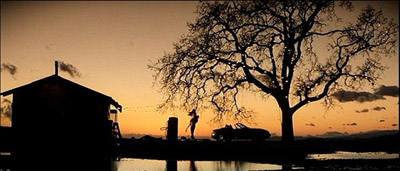
That's the end shot of a love scene between Ben Affleck and Liv Tyler. It's lovely, but it doesn't have any basis whatsoever in reality. Where is the house they've driven to? Does it belong to either character? Why have they strung Christmas lights in the tree? When did they do this? Are we really meant to believe that A.J., a roughneck who works on oil rigs, drives a cute little BMW Z3 when he's on dry land? You can take nearly any frame in this movie and pick it apart in this way, but that presupposes that the goal of this film is to tell a story, and I don't think that's true. The story is a vehicle for the wish-fulfilment you're paying for; when it's in the way, it's jettisoned. This shot does exactly what it sets out to in terms of the mood it evokes in the viewer. It's not a subtle emotion, it's not a subtle shot, and it's not a "justified" shot in any way, shape, or form. But as fantasy, it's great; it's the world advertising has always promised us. (And, of course, it is advertising: BMW paid a good deal of money to have A.J. drive such an unlikely car).

The point is, that shot succeeds brilliantly at "enabling various fantasies that allow the moviegoer to pretend he's somebody else and that life is somehow bigger and more coherent and more compelling and attractive and in general just way more entertaining." So does the rest of the movie. Seen from those terms, all the laughably absurd plot points and continuity errors in the world don't really matter. So the movie takes place in a world without time zones, in which it's simultaneously daylight in India, New York, and Paris; so what? You think Bruce Willis has time to keep track of time zones when humanity's future is at stake? Here's a single tear for narrative coherence:
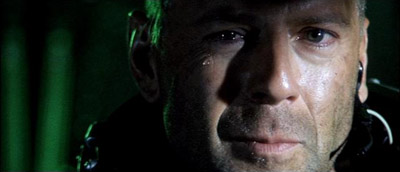
Now if you'll excuse me, I've got a planet to save.

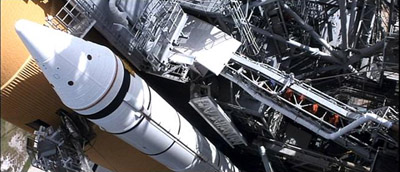
There's another reason Armageddon specifically belongs in a collection like this one: thanks to Top Gun, Jerry Bruckheimer was able to get the crew unbelievable access to NASA facilities during the filming of this movie. So there are shots and sequences that are completely unprecedented, and sheer techno-pornography for someone who, like me, grew up in love with the space program. (Let me put it this way: at age 6, I had a record of radio highlights from the first Columbia launch). Except for mission control, most of the NASA facilities you see in the movie are the real thing, from the vacuum chambers to the shuttle assembly building to the neutral buoyancy pool. Ben Affleck and Bruce Willis became (and remain) the only two civillians to ever wear real space suits for the underwater sequences. This shot isn't faked or altered in any way; that's the cast of the movie on the real gantries with the real shuttle, a few days before a real launch:
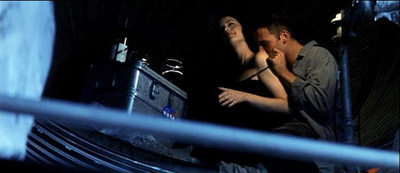
And could there be anything hotter than making out in one of the rocket exhaust cones of the Saturn V booster?
Of course, my own weird space-nerd childhood doesn't really have a bearing on the movie for most people. But it is valuable to see an example of the sort of filmmaking excesses that can result when a filmmaker is allowed to have anything he wants. For example, there's a scene where William Fichtner briefs the crew. In the real world, this would probably happen in a briefing room. Michael Bay decided he wanted it to happen in the shuttle assembly building with a B-2 and 2 SR-71 Blackbirds. So the Air Force flew in the planes, asked him where to park them, and this is the result:
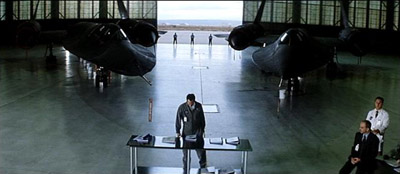
You can't see the B-2 in this shot because it's parked over to the left. It had to be there, because both the engine exhaust and the trailing edge of the wing were classified at the time and could not be photographed. When you see the movie notice that the tail end of the plane is always out of frame. In fact, the crew wasn't allowed to see the back end of the plane at all. Which is to say that Jerry Bruckheimer is able to get the Air Force to risk national security to indulge his director's whims. That sort of excess is unparalleled in film history. And it actually doesn't make me too happy with the Air Force, because, after all, I paid for part of the production of Armageddon, as did most of you. Without any back-end participation at all.

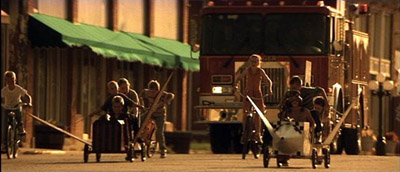
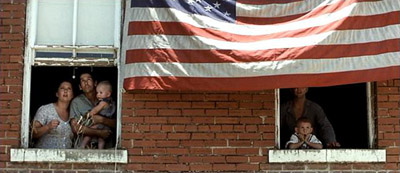
The level of personal wish fulfilment in Armageddon is pretty easy to pick out; it's worth noting that Michael Bay also sells a kind of national wish fulfilment. Armageddon has a serious hard-on for the early days of the space program, specifically for the sense of national purpose it gave the country. In fact, the movie suggests that that America, that national conception of ourselves, is still pretty much what we are, as you can see below. Show these four frames to someone who doesn't know what they're from and ask them what year each one depicts:
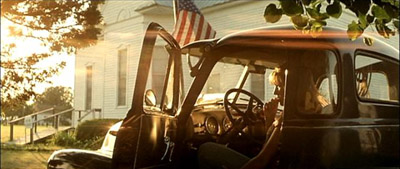
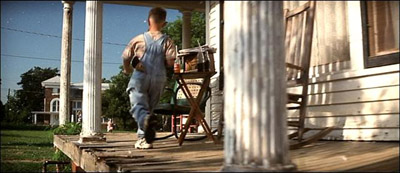
My guess is nobody says 1998 for any of them. Note the NASA hero-worship in the third frame; here's a close-up of one of the soapbox derby cars:
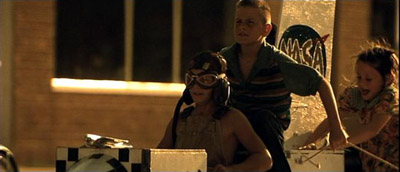
When's the last time you saw a kid with a helmet like that, much less a soapbox derby car? The more observant among you will have also noticed that the last still quotes this photograph from Robert Frank's The Americans:
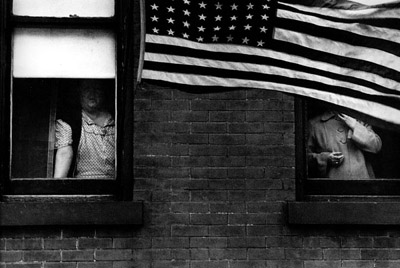
That photo was taken in the early fifties, before Sputnik, and definitely falls under "American mythmaking" (put it this way, Jack Kerouac wrote the introduction to the collection). None of the above is subtle, but here's maybe the most blantantly manipulative shot in the film:

In case you miss it, this shot is immediately followed by one of the astronauts saying "Kennedy, we see you. And you never looked so good!" Of course, he's talking about the Kennedy Space Center...or is he? The point is, these sections are shamelessly manipulative and there's nothing delicate about them. Nevertheless, they have an elegiac tone that's more moving than anything else in the movie. And they seem motivated by a genuine longing for a national purpose, and national heroes, for a more innocent version of America. Of course, that America never really existed, and Armageddon offers Bruce Willis as just the sort of national hero we're looking for, but hey, you take your pleasures where you find them. If you're willing to let go of outdated values like "coherence" and "narrative," you'll find plenty to love in Armageddon.

Randoms:

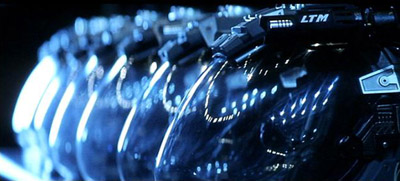
  • If you want to piss off a DP, make him shoot space helmets that expose the whole face. There's nowhere to hide a light (notice how much of the face is covered in the helmets in movies like Alien), which means you have to light them from outside the helmet, which means reflections. John Schwartzman eventually came up with the solution of sticking a light on top of every helmet, so that when you saw reflections of lights in every shot, you would at least think they were coming from another astronaut's headlight and not from a film crew. Here are the helmets:
  • Disney's marketing campaign for Armageddon is a story in and of itself. A few highlights:

    • 50 minutes of the film was shown at Cannes to laughs and catcalls. After the screening, Bruce Willis gave the most hostile press conference of his career, berating the assembled foreign journalists for their reaction to the movie.

    • This was the second asteroid movie that summer; the first was Deep Impact. Disney thought its only real competition was Godzilla, however, and that's why there's an early scene of a toy dog mauling a Godzilla doll (N.B.: those scenes feature a dog that had been specifically trained to attack Godzilla dolls!).

    • Commercials for the movie, including the Superbowl spot, are included on the disc. I thought it was incredible how primitive they seemed compared to ads for movies right now. But I suppose they seemed primitive at the time, too.

    Anyway, with a movie like Armageddon, the marketing is half the story; it's exhaustively documented in Peter Bart's The Gross.

  • This is a more religious movie than any other action film I can think of. Characters are continually invoking God and praying. Like the shots of a non-existant small-town America, this is described on the commentary track as an entirely cynical ploy to attract people from flyover country. Given the amount of contempt most studios have for the intelligence of moviegoers in red states, it's strange to me that this particular cynical ploy isn't used more often. If you have any doubt about Hollywood studio executives' feelings about the middle of the country, let me put it this way: a few months ago I saw a memo from a well-respected producer to a well-respected studio executive in which he argued that a director who both men thought was out-of-touch and past his prime would be perfect for a particular project, because only someone out-of-touch could make a movie simple enough for moviegoers in the middle of the country to relate to. This is not, by a long shot, the worst example of this sort of thing, and if I ran a studio it'd be the first thing I'd ban; if executives made movies they actually wanted to see, I think the world would be a better place. Note also that when I say "studio executives," that's who I mean, not filmmakers and not some nebulous idea of "liberal Hollywood."

  • Watch for a nice cameo by Udo Kier, star of Blood for Dracula and Flesh for Frankenstein. He plays the psychologist who has to analyze the astronauts to be. For reasons only he can explain, Michael Bay chose to set these scenes in a parody of a soundproof room with spiked walls:
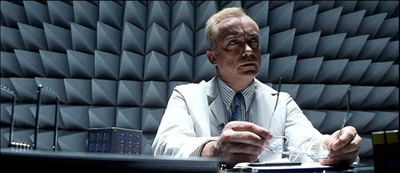
    It's-a me! Dracula!

  • Armageddon does cheat on at least one NASA location; Mission Control. Here's the film's version:
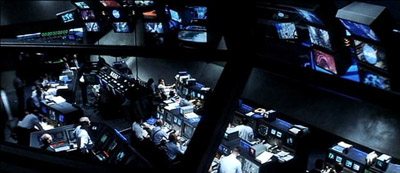
    And here's the real thing, also in the film:
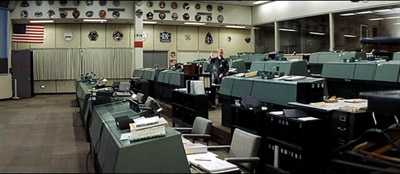
    You can't make him out, but that's Owen "Butterscotch Stallion" Wilson goofing around in the old mission control. Despite looking like a community college classroom, that's where they ran the moon landings.

  • There are some excellent features about the special effects. The most surprising is this shot of the destruction of Paris:
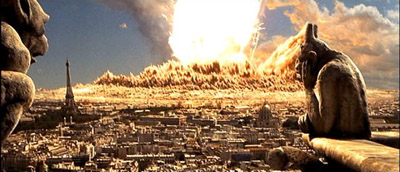
    I always assume shots like this are completely CGI (and today they probably would be), but in fact only the overlay of the Paris streets below is CGI. The gargoyles are a real shot, and the blast circle approaching camera was made by photographing a real explosion of nearly 50 concentric circles of explosive buried several feet under dirt.

  • Although Robert Towne supposedly did some polish work on this script, Steve Buscemi contracts "space dementia" at a certain point in this movie, for no apparent reason, and with no real consequences. I just thought that should be clear at the outset if you're planning on watching it for the quality of the writing.

  • There's an entire commentary track with the "science advisors," a NASA employee and a former astronaut, who tried to make the movie as scientifically accurate as possible. Listening to these guys talk about their constant battles to get Michael Bay and company to make the film at all relate to the world of science (for example, when Mir explodes, it explodes, like it's in an atmosphere) is a case study in cognitive dissonance.

  • The Armadillo, the drill car they drive around on the asteroid, has a chin mounted chain gun. You might wonder when NASA started putting weapons on their vehicles, or what they were expecting to shoot at on an asteroid, or even how they expected bullets to fire in a vacuum. But in fact, this wasn't NASA's decision so much as Mattel's; there was a toy version of this car, and toys with guns sell better. I'm not kidding; plot points were decided on by the toy company.

  • Manny Perry, the guy who was the MPAA's copyright spokesman for a few glorious months, did some of the stunts in this. I can't begin to tell you how delighted I was to see his name in the credits.

  • Like I said, the NASA sets were mostly real. Ben Affleck's teeth? Not so much. And I wouldn't put money on Tom Cruise's. Here's Michael Bay talking about working with Affleck on the commentary track:
    I had him work out. We paid for a set of twenty thousand dollars of pearly white teeth—Ben's gonna hate that story—uh, I always like low shots that kinda come right under your chin, just make you a little bit heroic, and he kinda had these baby teeth. So, uh, I told Jerry Bruckheimer, I said, "God, he's got these baby teeth, Jerry, I don't know what to do." Jerry used a very famous star in a... plane movie that he replaced teeth with so, uh, he says, "We did it to him, why not do it to Ben?" So my dentist had Ben sitting in a dentist's chair for a week, eight hours a day.
  • If you develop over 1,000,000 feet of Kodak film on a single production, Kodak sends you a gift basket with six bottles of Korbel. Michael Bay complains on the commentary that they could have sent two bottles of Dom Perignon for the same money. So, Kodak, if you haven't sent out those gift baskets for The Island yet, take note.

Armageddon was a nice break from my self-planned crash course in foreign and art house film. Now it's back to movies with a little more on their mind. At least until I get to The Rock.

Sunday, September 04, 2005

#39: Tokyo Drifter

Tokyo Drifter, 1966, directed by Seijun Suzuki, written by Yasunori Kawauchi.

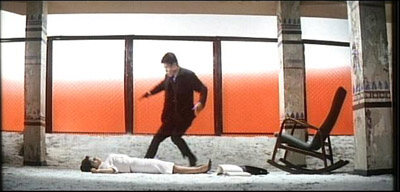
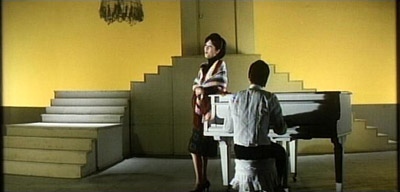
This is another one of Seijun Suzuki's movies for Nikkatsu, and, like Branded To Kill, it has a pretty banal script but is worth seeing for its lurid style. Suzuki got to shoot this one in color (he never made this decision himself, as he explains in an interview on the disc) and, well, never let it be said that he didn't use enough color. The exterior shots in this movie feature realistic looking streets, but the interiors are abstracted to the point of absurdity and feature eye-popping colors. This is easier to see than to describe:

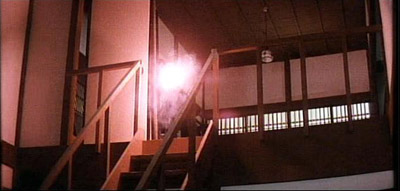
So, yeah, give Suzuki a color palette and he's going to make full use of it. Stranger still, the colors have thematic significance, which I'd seen in the theater but never on film (at least not so blatantly). Take the bottom still: the man in the red coat is Otsuka, the villain of the film. Pretty much any shot he's in, they'll be some other object arbitrarily colored red, which in this movie is also the color of violence. When the woman in the middle still is shot, the windows behind her are halfway colored red; later, Suzuki cuts back to that shot but the windows are now fully red, as though they've filled up with blood. His fidelity to this color scheme extends to the special effects: at a crucial moment, the hero's gun has a red muzzle flash, as below:

Thematic use of color isn't some great, startling invention, but I have never seen a movie that stayed so faithful to its initial rules. As with Branded To Kill, however, the question to ask is not whether Suzuki is stylistically inventive (he is), but what his style is in service of. And although Tokyo Drifter is a much more accessible movie than Branded To Kill and has a much more traditional style, it seems to me to have more going on beneath its surface than Branded To Kill did. It has a standard Yakuza plot, but scratch it and you'll find a critique of Japanese adoption of Western culture, customs, and economics after World War II. I don't mean to suggest that this movie is the work of a genius; in a lot of ways (the acting, for instance) it struck me as mediocre. But it's more interesting than it looks at first glance.

I'm not sure how much of the subtext of Tokyo Drifter is Suzuki's and how much was in Kawauchi's screenplay. I do know that Suzuki routinely made dramatic changes to the scripts he was assigned; in the interview on the disc, he says, "I believe if the script is perfect, there's no reason to make a movie of it." But some of the things in the dialogue are also played out in the set design, so Suzuki clearly had something to do with it. Here's the basic setup. Tetsuya Watari plays Tetsu, the right-hand man of a criminal boss named Kurata. Kurata is trying to go straight, and Tetsu is commited to helping him do it (the movie opens with Tetsu allowing a rival gang to beat him up rather than fight back and provoke them). Kurata is in the process of buying an office building from a man named Yoshii, and another criminal boss, Otsuka (the man in the red jacket above), wants to buy it from under him. The movie chronicles Tetsu's betrayal by his boss; he begins the movie fiercely loyal, and ends completely adrift.

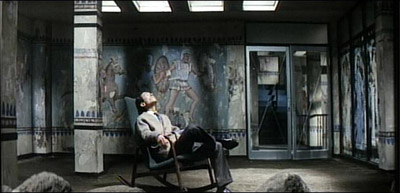
Throughout Tokyo Drifter, Suzuki contrasts Tetsu's value system, based on loyalty, with Otsuka's, based on profit. This is the same thing you see in The Godfather, with the exception that Suzuki explicitly links Otsuka's values to western culture. You can pretty much tell how evil a particular character in this will be from how western they are. Yoshii, for example, is a capitalist; he owns the building that Kurata wants to buy, and he's making his living from interest. However, he's still basically a nice guy; he cuts Kurata a break early on, and he seems to represent the best that western civilization has to offer: an ethical business man. So you would expect that his surroundings would reflect that. And here's his office:

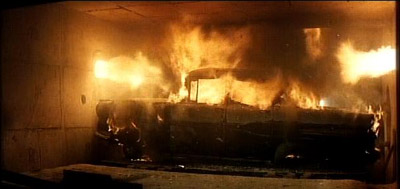
Yes, those are Greek frescoes on his walls: western, but not modern. Yoshii, by the way, gets killed about twenty minutes into the movie by Otsuka, who is more of a modern westerner. Otsuka's office is in the upstairs lounge of a club that's filled with teenage Japanese kids dancing to rock and roll, and one of his trusted hitmen drives what appears to be a 1957 Chevy. Tetsu's attitude towards this aesthetic, at least at the beginning, is exemplified by what he does to the Chevy: he steals it, drives it to a junkyard, and parks it here:

So that's a pretty simple dichotomy. What complicates it is that over the course of the movie, Tetsu changes from someone with a classic Japanese concept of loyalty into someone closer to the hero of an American Western. The movie ends, in fact, with an archetypical American Western scene: Tetsu rejects the love of a woman he used to pursue, and walks off into the night alone. If you have any doubt that Suzuki has American Westerns on the brain, halfway through the movie is a gigantic brawl at a "Saloon Western," complete with swinging doors, people getting hit over the head with chairs, and people being thrown out through a glass window right next to the bar. Western heroes don't form attachments to women; they act for themselves until they are forced to act. When the time comes, however, they use violence with great precision as a tool to defend the powerless. That's more or less where Tetsu is at the end of the movie, but he's definitely a Japanese version of this character; rather than killing his former boss, he gives him a broken glass and lets him commit suicide. I think the idea of honor is what replaces the idea of loyalty in a Western hero, and Tetsu's conception of this is a Japanese one. How long will that ideal stand against the western morality of money and power? Well, Tetsu does kill the bad guys and escape. But right before the last shot of him walking away, Suzuki sneaks in a montage of some neon signs around Tokyo that suggest that he's a bit more pessimistic than his script would suggest. The signs read, in English:

Copacabana.

NEW Latin Quarter!

SHOPPING ARCADE.

Randoms:

  • I didn't have any random thoughts or facts about Branded To Kill, mostly because I had to work pretty hard just to make sense of it. Sorry.

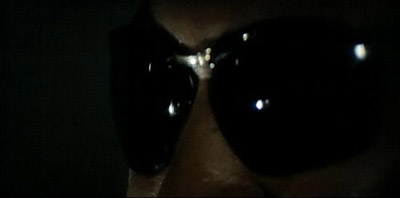
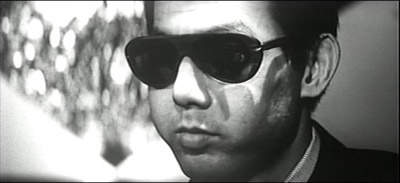
  • Tokyo Drifter marks the third Criterion Collection movie set in modern Japan, and the third Criterion Collection movie set in modern Japan that has a villiain wearing sunglasses. Do the Japanese hate sunglasses? Tokyo Drifter's version of this is especially jarring, as it features lots of closeups of Otsuka's glasses, like this one:

  • In 1985, Seijun Suzuki was named the Best Dressed Man in Japan by the Japanese Fashion Society.

  • The interview on the disc with Suzuki has what might be the secret to why the acting in this movie isn't so spectacular. Here's what he says:
    Tetsuya Watari, who is the main character in Tokyo Drifter, is now one of the biggest stars in Japan. So, now I wouldn't want to say anything that would hurt his reputation, but I think... Tokyo Drifter was his first feature film, I am pretty sure of that. And I had orders from the company to make Watari a star. But, on the set, he couldn't say the lines when we called action. He froze and was speechless. In order to make him say the line, let's say he was sitting somewhere in the scene, the AD would hide behind the chair and hit him with a broom or something, then, I don't know why Watari could say his lines, but he did. That's the most memorable thing about Watari.
    Not a big vote of confidence from your director, Watari.

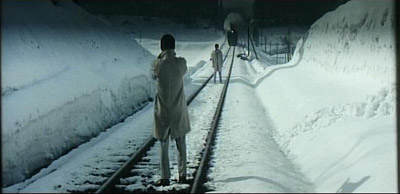
  • After the great action sequences in Branded To Kill, I was expecting some excellent fight scenes. But the fights in this movie seemed too abstract to be much fun. The final gun battle takes place in a nearly empty room, bathed in light; it has nothing of the messiness that makes the action in Branded To Kill exciting. There is one very tense showdown in Tokyo Drifter, however (and, not surprisingly, it's set outside, where the surroundings are more realistic). I'll just put up a still and you can sort out what makes it tense for yourselves.

  • In an interview I read about Kill Bill, Tarantino talked about how Japanese movies used blood in a theatrical way, and that that's what he was going for in the fight scenes of his movie. Seijun Suzuki is definitely from that school. The scene where Kurata cuts his wrists? Like an oil well in his sleeve.

#38: Branded To Kill

Branded To Kill, 1967, directed by Seijun Suzuki, written by Hachiro Guryu, Takeo Kimura, Chusei Sone, and Atsushi Yamatoya.

Any country with a developed film industry makes two types of movies: export films designed with world markets in mind, and native films that are not intended to leave the country (and usually don't). My introduction to the latter category was S.P.Q.R. 2000 ½ Anni Fa, a completely unwatchable Italian comedy starring a badly dubbed Leslie Nielsen, which I saw over Christmas of 1994. I don't think anyone wept bitter tears when S.P.Q.R. didn't get a U.S. theatrical release (in fact, I'm sure Nielsen was thrilled); it was pretty clearly designed to stay in Italy.

In a case like S.P.Q.R., the sheer awfulness of the movie explains its lack of foreign distribution, but a movie doesn't have to be bad to be stuck in its native country. As I write this, Wedding Crashers is still seeking distributors in most of Asia, despite its spectacular domestic box office. The point is, any country has a film industry that non-natives rarely get to see, and Japan is no exception. John Zorn writes that Branded to Kill was his introduction to Japanese pop cinema, the kind that never made it to the States. I guess that makes it mine, too, although I wasn't surprised by the existence of this kind of movie the way he seemed to be. Once you see S.P.Q.R., you're not really surprised by the existence of any kind of movie at all.

Branded To Kill is a product of the Japanese studio system, which seems to have been a lot like the U.S. one; directors and actors were under contract to studios and they churned out movies at an astonishing rate. It was Seijun Suzuki's last studio film, following a ten year period in which he averaged 3.5 movies a year (he directed 7 (!) movies in 1963). After this movie, he was fired by Nikkatsu studios for making incomprehensible, unprofitable movies. I don't know if Branded To Kill was profitable or not, but it certainly takes more than one viewing to comprehend. And I'm not talking about comprehending a deeper meaning, I'm talking about comprehending the basic events of the plot. It's a yakuza film, starring Jo Shishido as a hit man named Hanada. I think of him as "the Chipmunk Killer," though, because Shishido had some rather dramatic plastic surgery on his cheekbones early in his career, with the following results:

From some angles he looks normal, but from others he seems to be chewing on Kleenex. Hanada is the Number Three killer in the Yakuza (they're ranked, presumably by U.S. News and World Report). Early in the movie he kills numbers Four and Two. But after a botched hit, the Yakuza sends Number One to hunt him down. If that sounds like a pretty generic crime movie plot, it is. What makes the movie interesting are the bizarre details to the story.

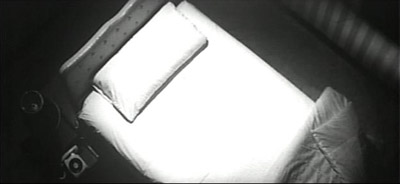
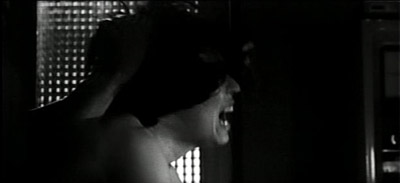
For one thing, Branded To Kill is a fetishist's wet dream. The movie is crawling with people who replace their desire for one thing with something else. Hanada has an obsession with the smell of freshly boiled rice, and is constantly demanding that people prepare rice for him so he can smell it. Suzuki says in an interview on the disc that he thought this would be a good way to show that the killer was Japanese: he doesn't like the smell of steak or hamburgers but of rice. But he takes it for granted that the character would be obsessed with the smell of some type of food. I don't know if that's typically Japanese or not, but it's certainly weird. Hanada is also a fan of non-traditional sex; early in the movie is a five minute sequence of him sleeping with his wife in which variations of this shot:

are intercut with variations of this shot:

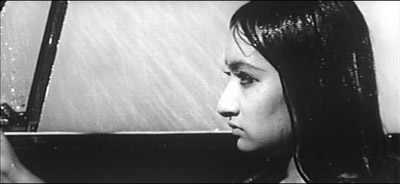
This movie has more sexual positions in that sequence than anything else I've seen except Wild At Heart. With a wife like that, you'd think he wouldn't stray, but he seems to find his wife a little too crazy. So it's no surprise that when he meets a nice, normal girl named Misako, he falls hard for her. They meet cute: he's on the way home after killing six or seven people and his car breaks down. She's driving a convertible with the top down in the rain, and offers him a ride. Here she is, looking as happy as she ever will:

To me, the expression on her face is a warning sign. More worrying is her dashboard ornament:

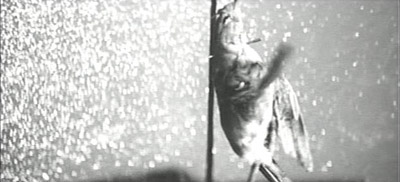
Yes, that's a dead bird with a spike driven through its neck, hanging from her rear-view mirror. Not only does Hanada not get out of the car when he notices this, he can't get her off his mind, and when she shows up offering him a job, he takes it. That's the job he blows, in a pretty literal illustration of the butterfly effect (a butterfly lands on the barrel of his rifle just as he pulls the trigger, causing him to miss). And things go downhill from there. Here's the most tender moment in his relationship with Misako:

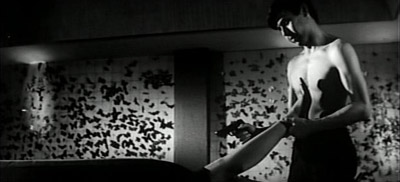
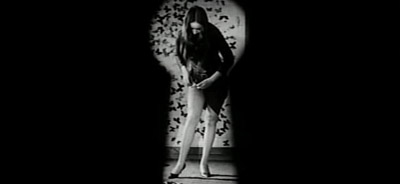
That's Misako's apartment, where the walls are decorated with pinned butterflies. Hanada keeps the gun trained on her while he takes off her shoes, then her stockings. Unfortunately, she gets her hands on the gun then and tries to shoot him. She misses. You would think the (at that point) second-highest ranked Yakuza killer would try to avoid a woman who'd just shot at him, but not Hanada; instead, he watches her put her stockings back on through a keyhole:

So yeah, this film has a kink or two. It's no secret that Japanese sexuality is pretty distinct from the American variety, but I haven't seen many movies that reflect that.

It's a mistake to focus much at all on the relationship between Hanada and Misako, though; this isn't a love story, and it's not what you'd call character-driven. It's also not what you'd call plot-driven; the story is pretty ridiculous. The movie's worth watching almost purely for its style. The stills above give some sense of the sort of late-sixties cool the movie exudes, but they can't convey the experience of Suzuki's truly unique and bizarre cinematic grammar. By grammar I mean the set of conventions he uses to convey information beyond what you see on screen. Everyone's familiar with the Western conventions, even if they don't know it: a slow push into someone's face usually means "this character is making an important decision," a dissolve indicates the passage of time, and so on. Most of these things are understood more or less subliminally, but when you run into a filmmaker who observes none of them, the results can be pretty jarring. I'm not sure if this is unique to him or if it is part of a national style, but I suspect it's just him, since this movie got him fired.

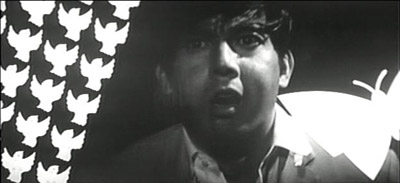
He does have his own set of rules, however, and although it takes multiple viewings to figure them out, it's kind of a fun project. He likes to rotate the camera around a subject in 90 degree increments when they're anguished, for example. He uses non-diagetic sound and shots that are unrelated to the action of a scene to convey subjective impressions. You can see this in the sex scene between Hanada and his wife; although the sudden cuts to shots of Misako make it look like she is watching, the sound of rain from earlier in the movie and the way Hanada covers his wife's face makes it clear that he is imagining he is sleeping with Misako instead of his wife. But for every technique that works, or makes a loopy kind of sense, there's one that doesn't, like mixing cell animation with film for one 20-second sequence, like so:

I'd be inclined to forgive this technique (it's certainly visually striking in a graphic-design kind of way) if it weren't for the fact that he only uses it once in the whole film, and it doesn't really tell us anything that hasn't been established over and over again by that point. I could be mistaken, but it also seemed to me that the last third or so of the movie (after Number One appears) was much less visually interesting, and had a lot of shots that I actively disliked: unmotivated camera moves, shots with peoples' heads cut out of frame, and at least one plot point (Number One seeming to burn his own face with acid in the bathroom for no reason) that I have been trying unsuccessfully to sort out since I saw the movie. I don't think the style is in service of anything throughout the film, and I think the style sort of falls apart towards the end. Without that, there's not much left to enjoy.

But when it is good, it is very very good, and some of Suzuki's techniques look better now than they would have in 1967. Take this, for example; Hanada is slowly crawling under a car that he's pulling forward as he moves toward some gunmen:

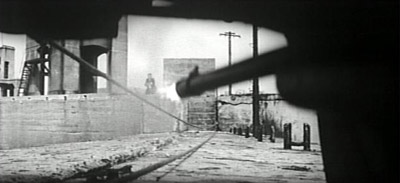
In the shot above, which is quite long and moves forward with the car, Seijun Suzuki has just invented the first-person shooter. I also loved the sequence where Hanada kills four diamond smugglers: the diamonds are being smuggled inside of glass eyes. Glass eyes that are being worn at the time. Anyway. This movie is a bit of work to decipher, but it's interesting. I'm curious to find out the extent to which Suzuki's techniques were picked up by other Japanese directors. And if you want an introduction to a kind of movie you've never seen before, you could do worse than to rent this. Until there's a Criterion edition of S.P.Q.R., of course.

Sunday, August 21, 2005

#37: Time Bandits

Time Bandits, 1981, directed by Terry Gilliam, written by Michael Palin and Terry Gilliam.

In 1980, Terry Gilliam was depressed because he couldn't get Brazil out of development. To get his mind off things one weekend, he sketched out an outline for what became Time Bandits. The movie feels kind of slapdash and ramshackle; it's a minor film, but it doesn't take itself too seriously, and it's a lot of fun. Childhood is a pretty weird time, and children need pretty weird stories to help them navigate it. The whole thing feels like the kind of story you made up at nine or ten; old enough to have a lot of strange things floating around in your psyche but still prepubescent.

Craig Warnock plays Kevin, a boy of about ten who spends his time reading books about ancient wars and is largely misunderstood and ignored by his parents. Fortunately for Kevin, his room is the location of a hole in space-time. So he has a way out of the boredom of suburbia that wasn't available to most of us: running away with a gang of dwarves who are travelling through time stealing anything of value they can get their hands on. I had to settle for legos, but Kevin gets the larcenous dwarves. That's my life. Oh, they're also being chased by both the Supreme Being and the Evil Genius, neither of whom are people you want mad at you.

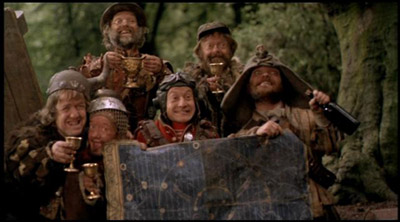
The two smartest moves Gilliam makes in this movie are making his main characters dwarves, and making his main characters jerks. They're incredibly greedy, they don't care for anyone but themselves, they're going down the relatively dumb road of defying gods at both ends of the spectrum, and they keep kidnapping a ten-year-old. But they're dwarves, so their hostility and avarice are kind of endearing. Here's the whole bunch:


Notice the costumes, made from whatever they could scavenge from various time periods. Yes, one of them has a colander for a helmet.

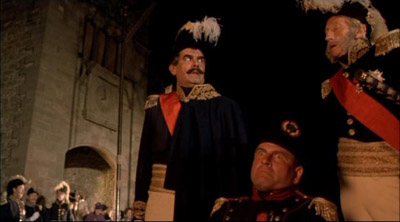
The map they're holding in the picture shows all of the holes in space time that they're using to get from place to place. Once Kevin runs off with these guys, the first half of the movie is a tour of various historical time periods, like a better, stranger version of Bill and Ted's Excellent Adventure. The best sequence is also the first: they visit Napoleon during the battle of Castiglione. Rather than leading his troops, Napoleon (played brilliantly by Ian Holm) is captivated by a Punch & Judy show; when the puppeteer is shot, Napoleon demands more entertainment. The theater owner brings out act after act, but nothing satisfies. Napoleon wants "more of the funny show, the little puppets hitting each other. That's what I like! Little things! Hitting each other!"

Napoleon, looking unhappy. The generals in this shot are standing on boxes to make Ian Holm look even shorter.

Of course you have to imagine Ian Holm's terribly inauthentic French accent to really make the scene complete. Better still is the lengthy, drunken speech he gives about the heights of various world leaders:

Alexander the Great? Five feet exactly. Isn't that incredible? Alexander the Great, whose empire streched from India to Hungary...one inch shorter than me. Oliver Cromwell...the only man with any guts in British History...not a big man at all.

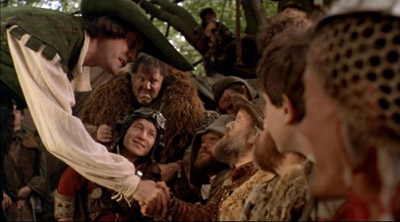
Also notable is John Cleese's Robin Hood, a performance loosely inspired by the appearances of minor British royalty at soccer matches. He doesn't do anything except appear, shake everyone's hand, and make inane small talk. He's only on screen for two minutes or so, but he's great.

The best thing about children's movies, I think, is that you're under no obligation to make the bad guys bad for a reason. They don't have to have anything to gain from their actions, they don't have to have had a bad childhood or any backstory; they're just bad. I'm not really sure what inspired David Warner, who plays the Evil Genius (really, that's his character's name!) but he's great fun to watch. He's very campy, and he's not just a fallen angel, he's also a technocrat. Here's his critique of God:

God isn't interested in technology. He cares nothing for the microchip or the silicon revolution. Look how he spends his time... forty-three species of parrots! Nipples for men!
...
If I were creating the world I wouldn't mess about with butterflies and daffodils. I would have started with lasers. Eight o'clock, Day One!

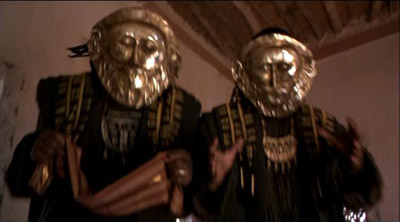
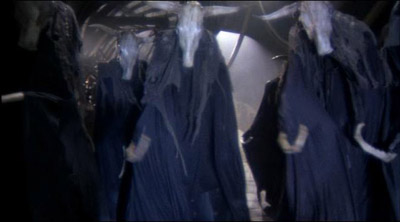
Better to reign in hell than serve in heaven, as long as hell has digital watches. As you can see, some of the anti-technology elements that show up in Brazil are already present in Time Bandits. As are the creepy masks; two examples:

Despite their appearance, these are good guys.

These guys, on the other hand? Not so good.

Those horrific cow-head things are the Evil Genius's minions. They shoot fireballs from their heads and are roughly eight feet tall. While David Warner may be campy, these guys are genuinely disturbing and threatening.

Structurally Time Bandits is very episodic and loose, as you would expect in a movie that jumps from historical period to historical period. As a result, the strong points are individual scenes, not the movie as a whole. I hadn't seen it since I was a kid. I could have told you the basic story, and I remembered Ian Holm's Napoleon, but completely forgot Sean Connery was in the movie. Which should tell you whose performance is more memorable, but also how loose the movie is; cutting away an entire section doesn't make the story fall apart. Anyway: if you're a fan of Terry Gilliam, you'll find a lot in this film you'll like, but don't expect brilliance. Time Bandits is just a low-key, enjoyable movie. You know, for kids.

Randoms:

  • It's hard to see it in the stills above because, except for the Robin Hood one, there isn't much reference, but Gilliam puts the camera at about four feet off the ground for virtually every shot, so that things are shot from a kid's eye view. The effect is subtle but noticeable; adults look more grotesque and kids and dwarves less so.

  • The shot of the Titanic sinking is from A Night To Remember, although it has been colorized. This makes Time Bandits the first movie in the Criterion Collection to include stock footage from another movie in the collection.

  • Two of the six actors who played the dwarves are now dead. Jack Purvis was crushed by a car, and David Rappaport shot himself. As you can imagine, this makes for a cheery section of the commentary track.
  • Although the Criterion Collection's website says that Time Bandits is presented in its original aspect ratio of 1.85:1, you can see from the stills above that it's not; it's actually about 1.80:1. I cropped few pixels on the left and right sides of the frame for those stills as well (I believe they were left black to protect against overscan on CRT monitors). I'm not sure if this was masked incorrectly or what, but what I do know is that on a 16:9 TV you end up losing a little of the image at the top and bottom when you zoom in correctly. (The math on that doesn't work, quite; it would have to be less than 1.78:1 for the image to be cropped. I'm trying to figure out why. It's possible the scaler on my TV is wrong). Anyway, the point is, anyway you look at it, this wasn't transferred at 1.85:1.

  • This may be the only children's movie ever made that alludes to Petronius's Satyricon. This, and The Brave Little Toaster.

Sunday, August 07, 2005

#36: Wages of Fear

Wages of Fear, 1953, directed by Henri-Georges Clouzot, screenplay by Henri-Georges Clouzot and Jérôme Géronimi, from the novel by Georges Arnaud.

After trying to avoid ruining Diabolique for anyone, it's nice to write about something without a twist ending. You could make a case that Wages of Fear is an insightful critique of globalization, particularly relevant during our occupation of Iraq. And you'd be right, but you'd be boring. Mostly, it's a thriller, with as simple a setup as Speed: get two trucks loaded with nitroglycerin from point A to point B without blowing it up. It's a bit like those Grand Theft Auto levels where you're transporting explosives, except non-interactive.

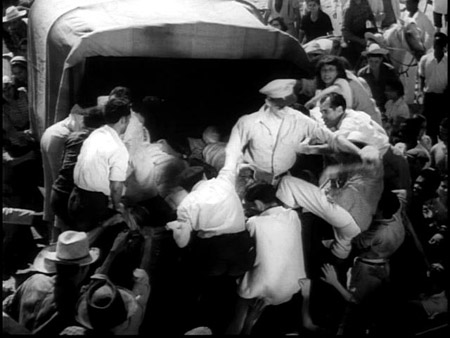
All right, it's a little more complicated than that. The movie's set in a dead-end town in South America. Like in Casablanca, the town is filled with Europeans in exile; they all want to leave, but no one has enough money. It's an oil town, and as one character remarks, where there's oil, there's Americans. In this case they're workers for the Southern Oil Company (no relation to the Standard Oil Company expressed or implied, I'm sure). In classic American style, the oil company employees have integrated themselves with the local community, established a trust-based relationship with the natives, and are pumping money into the economy. No, I kid, I kid. They actually ride around the town on motorcycles, talk to no one, protect themselves and their oil pipeline with armed guards, and live in a secure area (let's call it a "Green Zone"). They do hire natives, for the lowest paying and most risky jobs. Shortly after the movie begins, four locals are killed and nine injured in an oil rig fire; in a public relations masterstroke, the Americans don't tell anyone who's been hurt (they don't seem to know any of their names), and so the truck carrying the sick and the dead is stormed by locals desperate to know if their family members have been killed.

Americans get to know the locals. Note the friendly uniform and sunglasses of the Southern Oil Company, and the unfortunate mummy in the back of the truck (he doesn't make it).

All that stuff is background, though, and it makes the movie sound much more political than it is. The point is to get the oil well burning and establish that the Southern Oil Company doesn't much care if its workers live or die (that goes for Americans, too: one American gets killed in the oil fire; he is given "the boss's regards" over the phone and the company hangs up on his mother to keep their phone lines free). So with those facts as givens, here it is as a story problem:

  • As long as the oil well is on fire, it's costing Southern Oil money.

  • To put out an oil well fire in 1953, you need explosives (at least, according to this movie; you put charges all around and they suck the oxygen out of the surrounding air).

  • Southern Oil has 200 gallons of nitroglycerin available.

  • Those 200 gallons are 300 miles away from the fire.

  • Nitroglycerin explodes if shaken, spilled, or heated.

  • Southern Oil doesn't have any trucks with shock absorbers or safety equipment.

  • Southern Oil has plenty of trucks without shock absorbers.

  • A lot of people in town are desperate for work.
You can probably guess the solution Southern Oil comes up with. They offer $2000 (about $14,000 today) to any driver who can get a truck filled with nitroglycerin to the fire. They end up hiring four drivers: two Frenchmen, an Italian, and a German. The people who don't get a chance to drive a truck filled with explosives through the mountains aren't happy about it; that's how desperate these people are to get out of town. One of the rejected drivers kills himself; another, it is strongly suggested, kills the German in order to take his place. They're suited up in brand new Southern Oil Company uniforms, paired up, and sent on their way in the dead of night.
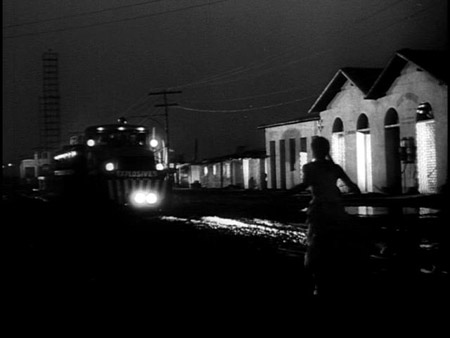
One of the two trucks making its way through town, siren blaring, at three in the morning. Note the subtle and reassuring warning label on the front.

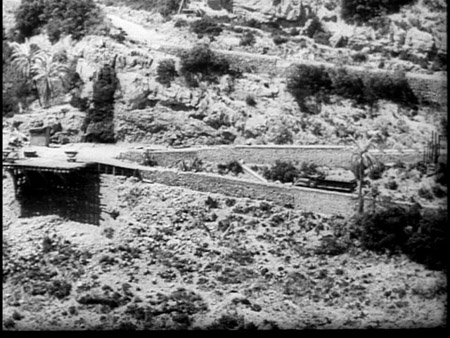
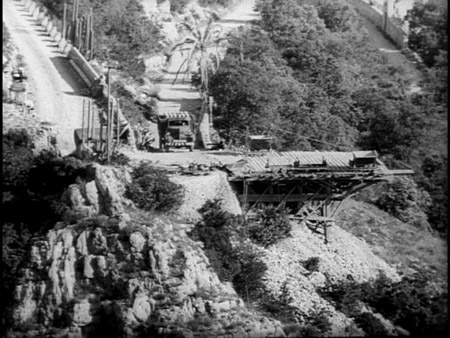
What follows is sort of like the most horrible driver's-ed class imaginable. If either truck hits so much as a pothole, the nitroglycerin will explode. Clouzot sets up a series of increasingly sadistic obstacles for the four men, and the resulting scenes are incredibly tense and exciting. A few examples:

  • There's a 20-mile section of road that's had cement poured on it, and thus is covered with potholes and unstable. It's safe to drive it at less than 6 mph or more than 40 mph, but in between those speeds, the truck will rattle too much and the nitroglycerin will explode. So you've got to choose to go slow or fast and stick with that decision. The first truck starts out fast, has the engine blow out, and miraculously coasts to a stop without exploding. They make repairs and set off slowly, assuming the truck behind them is also going slow. The truck behind them, however, decides to go fast. The road is only wide enough for one truck.

  • A boulder blocks the road completely. It's to heavy to be lifted or moved out of the way, and there's no way around it. Of course, the trucks are filled with explosives, so it should be no problem to just blow it up. But this presents the following problems:

    1. If you spill a drop of nitroglycerin it explodes.

    2. The smallest containers on the trucks are way too big.

    3. If the explosion is large enough to destry the boulder, it's probably large enough to send more boulders down from the surrounding cliffs. If a pebble lands in the truckbeds, they'll explode. This part of it doesn't occur to anyone until after they've sucessfully gotten the right amount of nitroglycerin into the rock and lit a fuse.


  • For sheer tension, however, nothing beats this:

    Note the S turn, too tight for a truck to make.

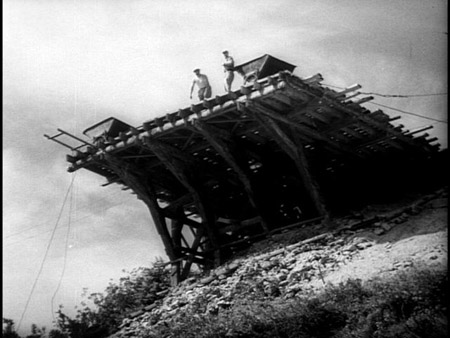
    But fortunately, there's a wooden ramp to use to turn around.

    Which, as you can see, is sturdily built.

    So the truck has to pull forward, then back onto the ramp to make the turn. But the truck is heavy and the wood is rotten, and backing up a truck isn't easy to begin with. What follows is one of the most harrowing scenes ever filmed. I'll give away a secret; they make it. They knock a big hole in the platform with a tire, end up covering the whole thing with slick mud, and nearly go over the edge while backing up, but they make it. Of course, that's the first truck. The second one has a worse time of it. Doing this sequence essentially twice in a row is a ballsy move, but Clouzot pulls it off; it's more exciting the second time around.

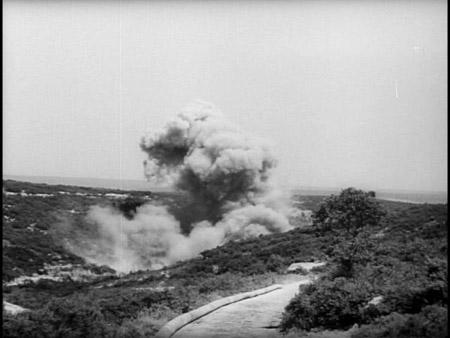
These are set pieces that wouldn't be out of place in a modern action movie (and for the most part, they're handled better here than in modern action movies—the best parts are exciting like Raiders of the Lost Ark is exciting, and I don't make that comparison lightly). On top of that, Clouzot layers a pretty vivid picture of globalization at its worst, and on top of that, there's a sort of pop existentialist portrait of the unknowability of other people (let's just say that "teamwork" is pretty loosely defined by these drivers). It's not Andrei Rublev, but it's more than just entertaining (and it's very entertaining). If you're not yet convinced to see this, I offer one final, irrefutable argument: KABOOM!

Not everyone makes it.

Randoms:

  • The structure of this movie would be weird in a modern film; the trucks don't leave town until an hour in. The first hour of the film is mostly local color and character development; you couldn't do it that way today.

  • This was ripped off in 1958 by a Warner Brothers movie called Violent Road, which was different enough to not require rights to Arnaud's novel. In 1977, William Friedkin remade it (Wages of Fear, not Violent Road) as a Roy Scheider movie called Sorcerer. I'm not at all sure why they called it Sorcerer.

  • Peckinpah stole the opening shot in The Wild Bunch from this movie; he uses a group of children tormenting scorpions. In Wages of Fear, it's just one kid who's tied string around the legs of a bunch of cockroaches and is jerking them around likc puppets. In both films, it quickly establishes the setting as "no place you want to be" and the cruel tone of what's to follow. Incidentally, this movie could just as easily be written about as a character-based study of betrayal, instead of a thriller.

  • Three editors are credited: Madeleine Gug, Etiennette Muse, and Henri Rust. I'm not sure what the division of labor was, but whoever was responsible for the editing of the very last sequence of the movie deserves recognition for it. I won't say too much about it except that it's the other famous scene set to the Blue Danube waltz, it's cut in time with the music (four measures per shot, then faster), it has a listening-to-the-same-song-at-the-same-time synchronicity that Cameron Crowe would love, and the very last part looks to have been done with either two or three cameras, is the kind of thing you only get one shot at, and is cut together so smoothly it feels like a single shot. It's also very cruel.

  • This is out of print right now, but a new version is supposed to be released in the fall, with a new transfer and a lot of extra features (the old Criterion version I rented just has the movie; no extras at all, unless you count chapters, subtitles, and color bars as extras). Criterion's site says that the new transfer is high-definition, but I'm not sure how that's possible, given that the source material is 1.33:1. Unless this will be released in HD-DVD or BluRay. In any event, the cover art on the old version is much better than on the new. But I'll probably buy the new one; I liked this movie enough that I'd love to learn more about it.

  • I have personal reasons for being terrified by a movie about having to drive very very carefully, as anyone who has ridden in my car can attest. I'm the most careless driver I know. And my last experience with a truck ended with me getting stuck in my driveway in such a way (tight turn, steep incline, drive wheels without much traction, manual shift) that I completely baffled three tow-truck guys who had no idea how to get the truck out of there. (In the end, we got five or six people to push it up the hill, all of us waiting to have our legs crushed if the truck lurched forward into the wall again). So do I find the idea of backing a truck up over a cliff particularly horrific? Yes. Yes, I do.

Saturday, August 06, 2005

#35: Diabolique

Diabolique, 1954, directed by Henri-Georges Clouzot, screenplay by Henri-Georges Clouzot, Jérôme Géronimi, Frédéric Grendel and René Masson, from the novel Celle qui n'était plus, by Pierre Boileau and Thomas Narcejac.

It's extremely rare for a marketing department or critic to hail a film as the best ever made, or the funniest, or the saddest, or anything else, with one exception: movies are routinely marketed as the most frightening. What's more, there seems to be some consensus about what the most frightening movies were at any particular time; Nosferatu had the title for a long time, as did Psycho. These days, I've heard again and again that Audition is the most frightening film ever (I haven't seen it yet). I think people are able to make this distinction for horror films in a way they can't for comedies or dramas because a good horror film can keep you creeped out for days, in an involuntary and not necessarily pleasant way. This provides a relatively objective measure of how frightening the film was. Anyway, from 1954 to 1960, Diabolique was the undisputed champ.

For a modern viewer it's more of a thriller than a horror film; there's nothing particularly terrifying outside of the last ten minutes or so. But by modern standards of thrillers, it's exceptional. The plot is the star, more than the individual performances or direction or cinematography, so the plot is what I'd like to talk about most. However, the movie has a surprise or two in it, and Clouzot ended it with the following admonishment: "Don't be DEVILS! Don't ruin the interest your friends could take in this film. Don't tell them what you saw." So I'm not going to go into great detail about the second half of the film, which means this will be an incomplete review.

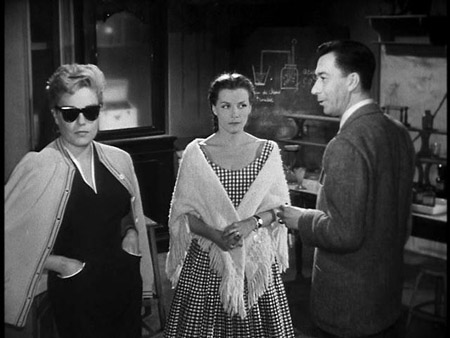
Paul Meurisse plays Michel Delasalle, the principal of a French boarding school with a relatively great life. He's got an attractive wife and an attractive mistress, he makes a comfortable living off his wife's fortune, and he keeps himself amused by bullying people around him. And because he works at a school, he's got plenty of targets. However, his wife and mistress are both less than amused and less than trustworthy. Here's the whole happy family:


L to R: Simone Signoret plays Nicole Horner, the mistress. She's wearing sunglasses because Michele gave her a black eye. Vera Clouzot (the director's wife) plays Christina Delasalle. And Michele is on the right, amusing himself at the women's expense.

As you might have anticipated from the still above, Nicole and Christina team up to exact a hilarious revenge on Michel. It's kind of like First Wives Club. Below is Michel after falling victim to one of their little pranks. See if you can spot the difference between the two stills:

That's right: in the second picture, his suit needs ironing. Also, he's been drowned in a bathtub. Not a pleasant end, but then Clouzot goes to extraordinary lengths to show the audience what a bastard this guy is. He beats his wife (who he affectionately calls "my little ruin"). He beats his mistress. He mistreats his employees. He buys rotten fish for schoolchildren (no, really!). If anybody ever had it coming, it's Michele.

So you're sympathetic to his wife and mistress; you want them to get away with this murder. They have a pretty good plan, too: they drug Michele, drown him in a bathtub while he's passed out, sneak him back into the school grounds and dump him in an unused swimming pool, where he disappears beneath the algae-covered surface. By the time he surfaces, everyone will assume he got drunk and drowned himself.

Except he doesn't surface. Days go by and the body doesn't turn up. Finally, they drain the pool, but the body is gone. As the murderesses begin to turn on each other, someone seems to be having a joke at their expense: Michele's suit is returned from the dry cleaners; someone has rented a room in his name. And that's before the supernatural stuff starts happening. I won't go into the plot in more detail here, but suffice it to say you'll find it more accessible and absorbing than most movies made today. I love Psycho, but I'm not sure it should have taken Diabolique's place in the pantheon of horror movies. Psycho will make you afraid of showers. Diabolique will make you afraid of water.

Randoms:

  • The structure is different than it would be today. Michele is killed roughly an hour into the two hour movie, and the bulk of the time before that is spent establishing how truly awful he is. Today you wouldn't have to motivate the murder so well, and you'd want to get to the part of the story that everyone will remember (the missing body) in the first fifteen minutes if possible. I haven't seen the 1996 remake (with Sharon Stone in the Simone Signoret part), but I'd be willing to bet the murder happens much sooner.

  • The last ten minutes of this movie have clearly influenced every horror movie that followed. Or at least every good horror movie that followed. When you're watching it, pay particular attention to the exceptional sound design.

  • Hitchcock tried to buy the rights to this novel, but Clouzot beat him by a few hours. Boileau and Narcejac wrote their next novel specifically for Hitchcock; he filmed it as Vertigo.

  • Robert McKee (author of Story and character in Adaptation) uses Diabolique as his prime example of image systems. An image system, for McKee, is a recurring set of related symbols that increase the viewer's emotional response to the film. In Diabolique, the recurring image is water (as you might imagine in a movie about drowning). The titles are over an extreme closeup of rain falling in a mud puddle, it's constantly raining, and we keep hearing rain, faucets, drains, liquid being poured; it's in every scene.

    N.B.: I don't think image systems are particularly helpful at the screenplay stage of making a movie; they're more of a director thing. And they're something that script readers watch for now, so if you write a script that opens with a shot of a bird and doesn't have birds in lots of later scenes, you'll be accused of "establishing a false image system." Thanks, McKee!

    That said, McKee is right about Diabolique. It's an extraordinarily wet movie. And it successfully associates water with decay and death, which is a reversal of its normal symbolic value. You can see the same value switch being tried in The Ring, down to the wet footprints from the end of this movie.

  • The wife and mistress seem to have an exceptionally close relationship. One of them has short hair and wears a lot of business suits. The other has long hair, often braided in pigtails, and favors dresses of the "Dorothy in Oz" variety. I have no further comment on this. Pervert.

Wednesday, July 27, 2005

#34: Andrei Rublev

Andrei Rublev, 1966, directed by Andrei Tarkovsky, written by Andrei Tarkovsky and Andrei Konchalovsky.

Here's a minor incident in Andrei Rublev that illustrates the film's moral landscape. A Russian prince is building a new house; he hires stoneworkers to do part of the construction. They finish the work on time and under budget, but the prince isn't happy; he wants the whole place redone because the colors aren't bright enough. The contractors won't do it; they have been hired for another job. As it happens, they're supposed to go work on a house for the prince's brother, where (they unwisely inform the prince), no expense is being spared, and the quality of the stone will be better. The prince shrugs his shoulders, resigns himself to being outshined by his brother, and sends them on their way.

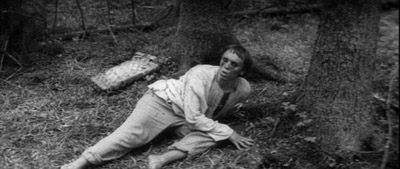
Then he has his soldiers meet them on the road and gouge their eyes out.

A forest filled with eyeless men screaming in pain and crawling in circles: that's the backdrop of cruelty against which Andrei Rublev operates.

The film is a fictional version of the life of Russia's greatest iconographic painter, and in many ways it's as strange as iconography itself. It's a movie about a great painter in which you never see anyone painting; the title character is usually peripheral to the action (if not entirely absent); it has not three but seven clearly delineated acts (plus a prologue and epilogue), and the first clear footage you see of one of Rublev's paintings occurs roughly three hours and twenty minutes after the film begins. That's right, three hours and twenty minutes (total running time: 205 minutes). So have some coffee ready. The movie deserves both the time and attention it demands, however. Tarkovsky raises questions about power, suffering, theology, and art in a richer fashion than any other filmmaker. I expect to have Andrei Rublev floating around in the back of my mind for a long time.

If you're not familiar with Rublev's work (I wasn't), he lived from around 1360 to 1430. Here's the one surviving painting that's entirely his own, the Old Testament Trinity (the image depicts Abraham's three guests in Genesis 18):


(Click for a high-res version from Wikipedia)

For me, the invention of linear perspective is a bright line between painting I really appreciate and painting that seems more mysterious than approachable. Of course, Eastern iconography isn't meant to be approachable in any sense of the word; part of the point of its strangeness is to remind the viewer that what it depicts is not the world we know, but spiritual truth. In fact, the Eastern Orthodox church had (has?) a set of very strict rules for iconography, established in 1551. The model from which these rules were drawn was the work of one Andrei Rublev. So Rublev's influence was not limited to artists independently imitating and learning from him (as is true of every other artist); his style of painting was church law.

That's all background to the movie, and honestly you don't have to know any of it to appreciate the film. Rublev's personal artistic development is at best a secondary concern; the main concern as I see it is dealing with a world in which the exercise of power, whether by God or man, is unjust and arbitrary. Again and again, Tarkovsky presents the viewer with scenes of people being punished. Sometimes we know why: a jester is arrested for singing an obscene song about a boyar (and dropping his pants). Sometimes, we have no idea: the second act opens with a monk walking across a city square as a man in the background is tied to a rack. He protests his innocence, but we never know what he's innocent of.

Tarkovsky has an eye for the way cruelty and power are exercised. You can see it in the bored faces of the guards in the first act as they smash the jester's face into a tree, or the false bonhomie a Tartar warlord maintains as he marches toward a city he will utterly destroy. Tarkovsky is also keenly aware of the ways the powerless console themselves, from Theophanes the Greek's nihilistic wish for apocalypse ("We'll burn like candles") to Rublev's withdrawal into asceticism. But then, growing up under Stalin would give anyone an unusually strong grasp of the way the powerful use cruelty, terror, and pain.

For me, at least, it was impossible to watch this movie without thinking of Stalin. Tarkovsky was born in 1932; for the first twenty years of his life, he knew no other political leader. Martin Amis has written that Stalin's cruelty "was not medieval so much as ancient in its severity." Well, Andrei Rublev has plenty of medievally severe cruelty. Some of it is difficult to watch. And in the Russia that Tarkovsky grew up in, medievally severe cruelty simply wasn't severe enough. Medieval severity just wouldn't do. It should be no wonder that what could have been a traditional biopic became a meditation on the artist's role in an unjust society.

All this makes the movie sound at once more cruel and faster paced than it really is. Art is part of Rublev's story, and it's not entirely a story of suffering. You can see Rublev struggle from beginning to end with a question which must have had personal significance for Tarkovsky: does an artist have a responsibility to the powerless? In the first act, Rublev says nothing as the jester is taken away; in the third, he stumbles onto a pagan celebration and later says nothing as soldiers round up the revelers. He is hired by the same prince that gouges his coworker's eyes out, and again does nothing. When he finally does act, killing a Tartar during the sack of Vladimir, he is wracked with guilt and retreats entirely from the world, ceasing his painting and taking a vow of silence which he does not break for years. The question of when artists should bear witness, when they should intervene, and when they must forgive hangs over Rublev's life from beginning to end. It's not a great stretch of the imagination to imagine that it also hung over Tarkovsky's.

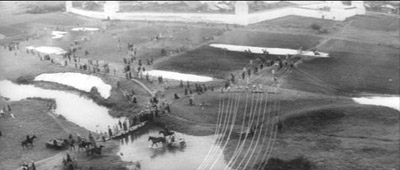
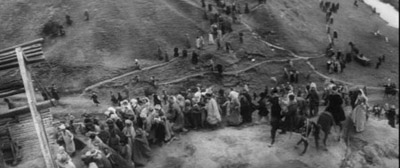
The cinematography in this film is spectacular. Tarkovsky and his D.P. Vadim Yusov have a genius for camera movement, and there are shots in this film that rival Scorcese or Welles at their most elaborate. The best example of this is a shot toward the end, during a sequence in which a cathedral bell is about to be raised from the hole in which it has just been cast. This is one continuous shot, broken down into frames, and worth going over in its entirety.

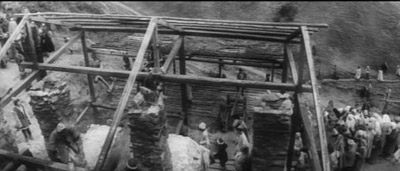
The camera begins rougly above the bell, looking at the line of cables that will be used to pull it from its hole:

The camera follows the cables up, revealing the walls of a city in the distance and putting a procession on horseback crossing a bridge toward the center (this is the prince who has commissioned the bell, leading an Italian ambassador up to hear the bell ring for the first time, but we don't know this yet):

We follow their path across the bridge and up into the middle distance:

The structure of a building appears in the left part of the frame and the camera leaves the procession to track along the roofbeams...:

...Revealing that the building is, in fact, the forge where the metal for the bell was fired (we've seen it in an earlier scene).

Tracking the beams all the way across reveals a group of men gathered around a winch further left:

The camera centers on the winch...

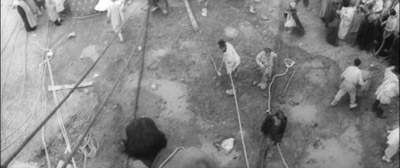
...and then begins a vertical pan along the rope they are pulling, until a man's head appears very near the foreground:

He's standing on a wooden structure directly below the camera; one of its beams cuts straight across the frame as we track back:

Until we are looking down into the pit the frame encloses, and can see the bell far below us, with all the ropes attached.

I love two things about this shot;. First, its scale varies incredibly rapidly. The city walls must be a mile away; the man on the bell structure is a few feet from the lens. You can see kind of the same thing in some of Peter Jackson's best work on Lord of the Rings. The other thing about this sequence is that the camera's movement seems to be motivated more by geometry than by anything human. If you look at the Copacabana shot in Goodfellas, part of what makes it so inviting is the way the camera tails Ray Liotta, like you're someone who also gets to go into the back entrance to the Copa (the same holds for all the shots that ripped it off after then). This is different; the camera seems to pick up a geometric shape in the image (the lines of the cables, or the roofbeams, or the bridge) and tracks it until a more interesting line to follow appears. It's spectacular but not intimate, not human. Tarkovsky's detatchment here reminds me of nothing so much as iconography.

Randoms:

  • The eye-gouging is by no means the hardest thing to watch in this movie. The sack of Vladimir in the second part is nearly impossible to watch. It seems to be based at least in part on Guernica, and has many shots that are truly horrifying (a cow smashing around a stable in terror, its skin on fire; a horse falling down a flight of stairs, struggling to its feet, and collapsing backwards as its broken legs convulse; blood jetting from a young boy's neck). It ends with a villager (a priest?) being tortured to death inside a church. He asks to be allowed to kiss a cross before dying; his tormentors agree, then melt a silver cross down, hold his mouth open, and pour several cups of molten metal down his throat. The gurgling sound he makes has already appeared in one of my nightmares.

  • Vlada Petric quotes Tarkovsky in one of the extra features as saying that what makes a film epic is when each character is his own center of the movie. I think this is a valuable point. When I'm working on an outline for a screenplay, I know I'm on the right track when I can tell the story from the perspective of any of the main characters and get a coherent movie with a beginning, middle, and end. Andrei Rublev takes this to a real extreme; Rublev is arguably not the main character in almost every act of the movie. But from the perspective of any character the film stays with during an act, there's a real story, beginning, middle, and end.

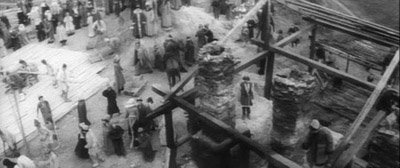
  • I went all the way through that one shot of the bell and I didn't even mention what was, for me, the most beautiful sequence in the movie: Andrei Rublev's vision of the crucifixion. It's pretty traditional, with one exception. It's in Russia in the middle of winter. One still from this hauntingly beautiful scene:

  • The release history of this film is troubled; for some reason, the Soviets didn't want something that could be read as critical of the Soviet experiment on the market. For an example of why they didn't like it, try to read this description of the Pharisees (from the voiceover to the crucifixion scene) and not think of the Russian Revolution:
    The Pharisees were masters of deceit, educated. They had studied to gain power, to take advantage of the people's ignorance. We must remind people more often that they are people. Russians, of the same blood, of the same land.
    As a result of passages like these, the film was shelved upon its completion in 1966 and not publically shown until the 1969 Cannes Film Festival (when it was shown semi-illegally, over protests from the Soviet Embassy). This gap between completion and screening is why the IMDB lists the film as being from 1969, the Criterion Collection from 1966.